
applied · Level 3
AI-assisted vocational lessons and demonstrations
A Mickai / Trust Agent workbook for college tutors designing practical learning with visible evidence and meaningful human control.

Your next step
Start this course online
Register your start, then work through the lessons and exercises at your own pace. You can download the PDF separately. Where a scored exam is available, you will find it after the lessons.
Register or resume your course
Start with the essentials
The short answer
College tutors can use AI to propose lesson resources when the objective, permitted source, review process and evidence of learning are explicit. Check the generated procedure and every example, rehearse the actual demonstration and distinguish supported practice from independent attainment. A knowledge test or attractive worksheet cannot establish practical competence.
What you will learn
- Map a practical learning objective to observable learner actions, conditions and evidence.
- Audit an AI-generated lesson against an approved reference without changing requirements or decision precedence.
- Design and rehearse visible demonstrations with contrasting examples and diagnostic questions.
- Prepare accessible resources and plan guided practice, specific feedback and fresh attempts with recorded assistance.
- Separate product, observation and explanation evidence from knowledge results and formal qualification judgements.
- Assemble and revise a complete teaching pack using rehearsal evidence and an honest workflow comparison.
Who it is for
Adult college, further-education and vocational tutors, training designers and quality leads preparing practical teaching. This course is for educators, not an unsupervised student tutor.
Before you start
- Experience of planning or supporting an adult learning activity. No coding or prior AI tool use is required.
- Use the supplied fictional procedure rather than adapting hazardous work instructions. Real qualification requirements need the relevant authorised review.
Jurisdiction and study scope
These are selected reference pathways. Choose the relevant pathway before applying the exercises. This does not determine applicable law or provide worldwide coverage.
All pathway limits
- England: further education and adult training: Read the DfE guidance in its England scope, then check the actual institution, learner age, qualification and awarding arrangements. JCQ requirements apply where the relevant qualification uses them. HSE work-equipment guidance has a Great Britain context; this paper exercise does not authorise hazardous work.
- European Union: specify the Member State: The Commission educator guidance overview supports responsible teaching discussions. The overview and publication metadata were checked, not a full legal analysis of the 2026 PDF. Identify the Member State, institution, training product, privacy requirements and actual permitted use with the relevant leads.
- Australia: specify state, territory and regulator: ASQA guidance cited here concerns NVR registered training organisations under the 2025 Standards. Confirm your provider and regulator, training product and applicable privacy regime. OAIC guidance is not proof that all institutions have identical obligations.
- Another jurisdiction or cross-border provider: Identify applicable education and qualification rules, accessibility, privacy, source rights, workplace safety and safeguarding requirements with qualified local leads. These selected references are not exhaustive legal coverage.
Run the synthetic exercise
Download the exercise source, tests and instructions (ZIP)
No real records, external service or model is used by this exercise. Read the README before running it.
AI-assisted preparation of this newly commissioned owner course. Merefield, R3, learner cases and timings are original fictional teaching material, not real client results.
Learn in your browser · Chapter 01 of 08
Teach the decision, not just the finished kit
A practical lesson succeeds when learners can perform and explain the intended task. A neat worksheet or correctly packed example may conceal guessing, copying or excessive help. Begin by specifying the performance you want to observe, then decide how AI can assist your preparation.
Merefield Adult Skills Centre is fictional. Its tutors are preparing an introductory workshop using pre-cut rectangular cards, shallow trays, blunt rulers and invented order cards. Learners inspect and pack sample kits. There are no powered tools, electrical connections, blades or real customer records. The setting still needs ordinary local checks for accessible seating, clear walkways and suitable materials. This teaching example does not establish an occupational standard or authorise work with hazardous equipment.
The course-authored procedure is revision R3. Kit A requires two blue cards and one cream card. Kit B requires one blue card and two cream cards. Every card must have a recorded width from 48 through 52 millimetres, including both endpoints. These invented requirements provide a stable reference against which a tutor can check explanations, demonstrations and learner reasoning.
R3 applies HOLD first when the revision is missing or is not R3, the order type is unknown, a card is unreadable or torn, a width is missing or non-numeric, or the quantity cannot be established. Only complete, readable R3 records proceed to the matching checks. Wrong colour quantities or any width outside the inclusive range produce REWORK. Otherwise the result is ACCEPT. A torn card measuring 47 mm therefore produces HOLD, not REWORK: the earlier condition takes precedence.
Design backwards from evidence
A teaching activity is justified by the action it lets the learner demonstrate.
- Practical objective: Name the performance and its conditions.
- Learner action: Identify what must be seen or heard.
- Evidence record: Record the actual action and assistance.
- Teaching activity: Choose demonstration and practice that prepare that action.
- Practical objective to Learner action: Make the objective observable
- Learner action to Evidence record: Specify what supports the judgement
- Evidence record to Teaching activity: Design preparation for the required evidence
Turn that procedure into four observable outcomes. A learner identifies the order type and revision; establishes whether the information and cards are usable; compares the quantities and widths with the appropriate requirements; and explains the resulting disposition. Each outcome needs an action you can see or hear. Replace 'understands quality' with 'identifies the mismatch and points to the relevant R3 rule'.
Specify the conditions of performance as carefully as the outcome. For the first attempt, the learner may use the reference sheet and ask procedural questions. During a later independent check, the tutor presents a different invented order and records any assistance. Independence does not mean forbidding legitimate reference use. It means stating what support is allowed and distinguishing the learner's decision from a decision supplied by someone else.
A finished product cannot reveal every important step. An apparently correct Kit A could have been copied from a neighbour without checking its revision. Conversely, a learner who correctly holds an unreadable order has demonstrated useful judgement even though no kit is completed. Build the observation sheet around decisions, evidence and explanations, rather than rewarding speed or the number of trays marked ACCEPT.
Before introducing AI, write a plain lesson brief: audience, four outcomes, R3 reference, available materials, permitted assistance and expected evidence. An AI tool can suggest alternative wording or practice cases from that brief. It must not quietly change the procedure or manufacture evidence of learner performance. The Department for Education's Generative artificial intelligence (AI) in education guidance, updated 12 August 2025 and applicable to England, retains professional responsibility for the accuracy and appropriateness of generated material.
Try it yourself · Activity 01
30 minBuild an outcome-to-evidence map
Prepare the first page of the Merefield lesson plan before asking an AI tool to draft activities.
- Write four outcomes using observable verbs and the R3 procedure.
- For each outcome, identify an action or explanation that would provide evidence.
- Add one example of apparently successful work that would not supply enough evidence.
- State the references and assistance allowed during guided practice.
- Choose a fresh order for an independent check and explain what the tutor will record.
Which part of your proposed evidence would reveal a learner's reasoning, and which part could still be produced by copying?
Worked answer
A strong map links revision checking to the learner identifying R3 on the actual order; completeness checking to noticing a missing or unusable item; comparison to the learner showing the relevant quantities and widths; and disposition to an explanation grounded in the rule order. A correct finished tray alone does not demonstrate those actions. Guided practice may include tutor prompts, but the record must identify them. The fresh check should change a relevant feature, such as the order type, so copying the previous answer is insufficient.
Try it yourself · Activity 02
15 minChapter 1 review questions
Answer each question before opening the answer guide.
- Why is understand kit quality a weak learning outcome?
- What quantities distinguish Kit A from Kit B?
- Are widths of exactly 48 mm and 52 mm acceptable under R3?
- What is the result when a card is torn and also measures 47 mm?
- Why can a correctly held order demonstrate learning?
- Does passing this course's knowledge exam establish workshop competence?
Rewrite one outcome from a lesson you teach so that another tutor could recognise the intended performance.
Worked answer
1. It does not specify an observable action or the evidence needed to judge learning. 2. Kit A requires two blue and one cream; Kit B requires one blue and two cream. 3. Yes, both endpoints are included, provided all other requirements are satisfied. 4. HOLD, because the torn-card condition takes precedence over the dimensional mismatch. 5. The learner may have correctly recognised that a defensible decision cannot proceed from unusable information. 6. No. The knowledge exam assesses this course's teaching-design knowledge. Occupational competence requires the appropriate practical evidence and authorised assessment process.
Apply what you learned · Practice
Explanation and answer
They applied a stop condition and can explain it. A correct stop can demonstrate reasoning. Completion count alone misses that capability.
Practice only. This does not count towards your exam or certificate.
Learn in your browser · Chapter 02 of 08
Convert the reference procedure into a checkable lesson
A useful teaching explanation makes a procedure easier to understand without changing its meaning. Treat AI-generated text as a proposed adaptation. Check every requirement, decision and example against the reference before it becomes part of a demonstration or learner resource.
Create a compact reference map for R3. One column identifies the requirement, another records its exact teaching meaning, and a third shows where it appears in the lesson. Keep the original course-authored procedure alongside the map. A summary is a derivative teaching aid, not a replacement authority. If the tutor changes a rule deliberately, that requires an explicit new procedure revision and corresponding changes to examples and checks.
Separate three kinds of content. Requirements define what must happen: Kit B needs one blue and two cream cards. Explanations describe why the teaching task uses a rule: checking the order type prevents applying the wrong quantity pattern. Presentation choices describe how to teach it: place a Kit A example beside a Kit B example. AI may propose explanations and presentation choices, but none of them may silently redefine the requirements.
The order of decisions carries meaning. A width of 47 mm normally leads to REWORK after the information checks have passed. If the same record has a missing revision, the result is HOLD. A draft that tells learners to measure first and immediately select REWORK can therefore teach the wrong outcome. Preserve the HOLD-first logic even when rearranging paragraphs to improve readability.
R3 decision precedence
First establish usable current information, then check the known quantities and widths. A mixed fault remains HOLD when a HOLD condition is present.
- Read R3 order: Check revision, type and readable intact cards.
- Information complete?: Missing, unclear or nonnumeric observations require HOLD.
- Counts and widths: For a complete record compare the exact kit and inclusive 48 to 52 mm range.
- ACCEPT: All requirements match.
- HOLD: Resolve the unusable instruction or observation.
- REWORK: Complete known information reveals a mismatch.
- Read R3 order to Information complete?: Current known order first
- Information complete? to Counts and widths: All HOLD checks passed
- Information complete? to HOLD: A HOLD condition exists
- Counts and widths to ACCEPT: All match
- Counts and widths to REWORK: Quantity or width mismatch
Use contrasting records to test the explanation. Record One is a complete R3 Kit A with two blue cards, one cream card and widths of 48, 50 and 52 mm: ACCEPT. Record Two is otherwise identical but has a width of 53 mm: REWORK. Record Three has that same width and an unreadable card: HOLD. These examples distinguish a complete mismatch from information that cannot support the ordinary comparison.
Give an AI assistant a bounded preparation request: Using only the supplied R3 procedure, draft a learner explanation and three practice cases. Preserve the decision order, quantities and inclusive limits. List any uncertainty separately. Return each proposed case with its inputs, result and rule-based explanation. Supplying a source and an output structure makes checking easier; it does not make the output reliable by itself.
Role: resource-drafting assistant for a fictional adult tutor.
Reference: supplied R3 procedure only.
Task: propose an explanation and three contrasting practice cases.
Constraints: preserve counts, inclusive 48..52 and HOLD precedence;
no real learner data, equipment procedures or invented requirements.
Process: map each proposed claim to R3; list unsupported requests.
Verification: tutor independently traces complete and mixed-fault cases.
Output: case inputs | proposed result | supporting rule | uncertainty.
Failure: omit unsupported instructions and ask for a reference decision.
An average request such as make an engaging workshop leaves the task, permitted sources and failure conditions unspecified. The structured request makes the proposal inspectable. It still needs a real review of both the instructions and their examples. Do not treat a model declaring its own answer verified as independent evidence.
Review generated material in two passes. First check meaning: revision, order type, counts, numeric widths, boundary values and precedence. Then check teaching usefulness: language, unnecessary detail, ambiguity and answer leakage. Recalculate every example yourself. Ask a colleague to trace a small set of cases using only the proposed learner sheet. If they need an unwritten assumption, improve the sheet before the lesson.
Keep a correction record that is small enough to use. Record the draft statement, the relevant R3 requirement, the change and the reviewer. For example, replace 'between 48 and 52, excluding the endpoints' with '48 through 52 mm inclusive'. Do not retain real learner submissions merely to demonstrate that a prompt worked. This preparation task needs only invented records and material the centre is permitted to use.
The ASQA Assessment Practice Guide under the 2025 Standards requires relevant NVR registered training organisations to review assessment tools before use and align them with the training product. Its examples warn against generic, uncontextualised tools. That supports checking and contextualising resources; it does not mean this fictional R3 exercise is an accredited training product or that a reviewed prompt satisfies Australian assessment requirements.
Try it yourself · Activity 03
30 minRepair a convincing but incorrect draft
An invented AI draft says: Check widths first. Any result below 48 or above 52 is REWORK. For Kit B, pack two blue and one cream card. If the revision is missing, use the last familiar version.
- Identify each statement that changes R3.
- Explain which incorrect learner decision each change could cause.
- Rewrite the draft without adding a new requirement.
- Test the rewrite with one ACCEPT case, one REWORK case and one HOLD case.
- Add a mixed-fault case that tests precedence.
Which error was easiest to overlook because the wording sounded confident or familiar?
Worked answer
The draft permits dimensional classification before checking HOLD conditions, reverses Kit B quantities and substitutes a remembered revision for a missing one. Correct it by checking all HOLD conditions first, then using one blue and two cream cards for Kit B and applying the inclusive width range. A complete matching R3 record is ACCEPT; a complete record with a 53 mm width is REWORK; a missing revision is HOLD. A torn 53 mm card remains HOLD. The rewrite must expose that precedence rather than relying on the tutor to explain it informally.
Try it yourself · Activity 04
15 minChapter 2 review questions
Use the reference procedure, not memory alone, to answer these questions.
- How does a teaching explanation differ from a procedural requirement?
- Why is decision order part of R3's meaning?
- What happens when quantities are known but incorrect?
- What happens when the quantity cannot be established?
- Why should examples include exact boundary values?
- Does an AI assistant's explanation count as independent verification?
Identify one reference-to-resource comparison that should remain visible in your final lesson pack.
Worked answer
1. An explanation helps understanding; a requirement determines the permitted result or action. 2. HOLD conditions override later mismatch checks, so changing the order can change the result. 3. After all HOLD checks pass, incorrect colour quantities produce REWORK. 4. HOLD, because the required comparison cannot be established. 5. Values of 48 and 52 reveal whether the inclusive limits have been preserved. 6. No. The tutor must independently compare the actual inputs and result with R3; another fluent statement from the same tool does not establish correctness.
Apply what you learned · Practice
Explanation and answer
Replace it with the R3 HOLD rule. Missing revision is a HOLD condition. Fluent wording does not change the reference.
Practice only. This does not count towards your exam or certificate.
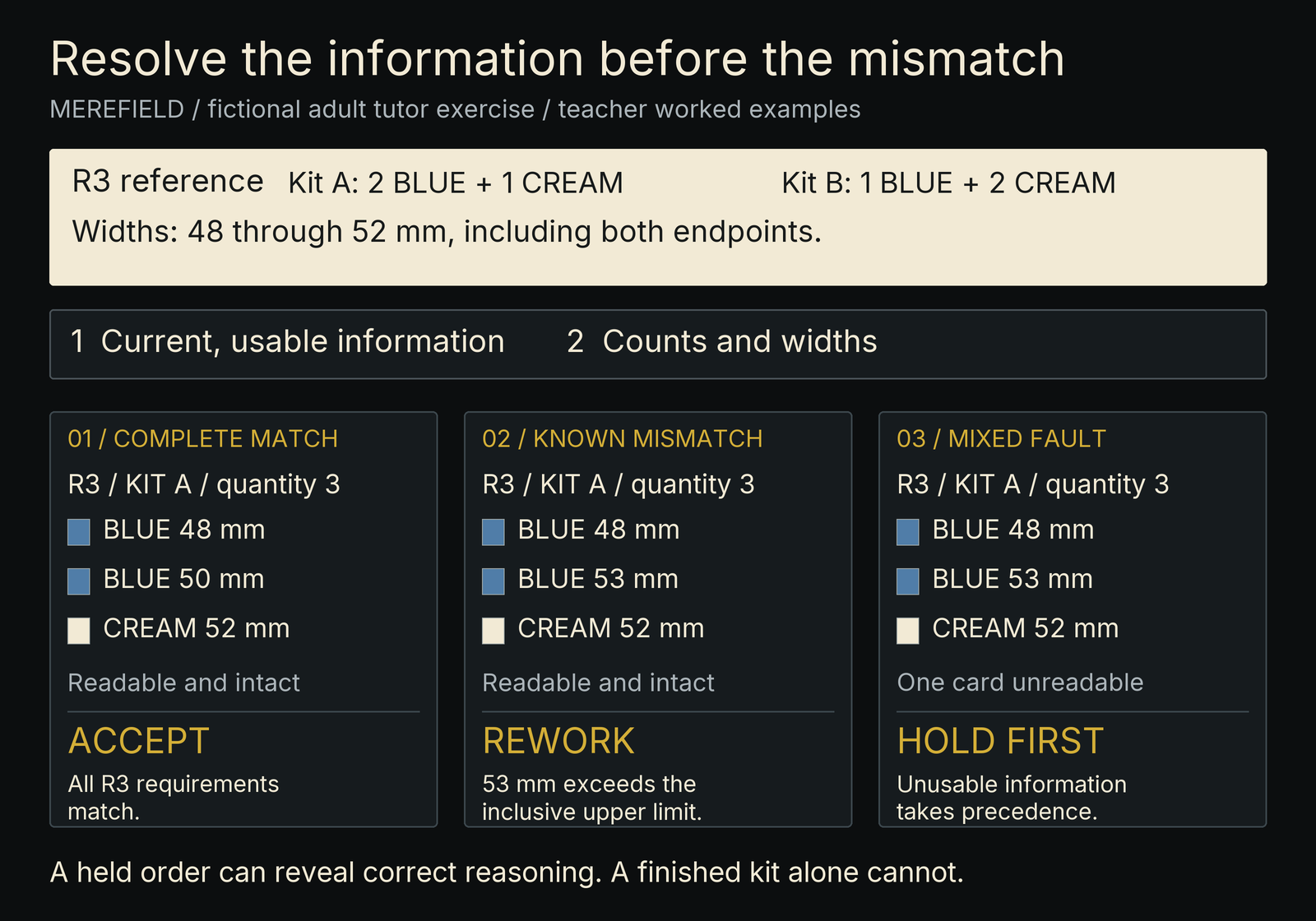
Illustration description: This original illustration is for adult tutor planning, not a photograph or an observed class. The reference states Kit A needs two blue cards and one cream, Kit B one blue and two cream. Every width must be 48 through 52 mm inclusive. Three panels all state R3, Kit A and quantity 3. Panel 1 has blue 48 mm, blue 50 mm and cream 52 mm, all readable and intact: ACCEPT. Panel 2 changes blue 50 to 53 mm while all information remains readable and intact: REWORK. Panel 3 retains those 53 mm inputs but marks one card unreadable: HOLD first. The unavailable information must be resolved before ordinary comparisons. The final line reminds the tutor that a correctly held order may show reasoning, while a finished kit alone does not reveal the learner decision or assistance.
Learn in your browser · Chapter 03 of 08
Stage a demonstration learners can see and explain
A demonstration combines physical actions, spoken explanation and learner attention. Those elements can support one another or compete. Design what learners will watch, what they will hear and when they will respond, then rehearse the sequence from their viewing position.
Begin with the end task in view. Show an invented order card and the sample tray, then explain what the learner will eventually decide. Avoid revealing the result before learners know what evidence matters. For the first demonstration, choose a complete R3 Kit A with matching quantities and widths of 48, 50 and 52 mm. A straightforward case lets the tutor establish the routine before adding exceptions.
Prepare the physical layout deliberately. Keep the reference sheet, order card, unchecked cards and checked cards in distinct positions. Choose a viewing angle from which the relevant markings can be seen. A tutor's hands can hide the feature being discussed, and a projected close-up may reverse or crop useful information. Rehearse the actual view rather than assuming that a description in the lesson plan makes the demonstration visible.
Use a four-column script: show, say, ask and check. Under show, write the action or item that should be visible. Under say, write the short explanation that accompanies it. Under ask, place a question at a point where the learner can reason from available evidence. Under check, specify the response or action that would justify continuing. The columns prevent a polished monologue from becoming the entire lesson.
A demonstration with learner evidence
A script connects a visible action to an explanation, a question and evidence before proceeding.
- Show: Make the card and reference visible.
- Say: Explain the relevant comparison briefly.
- Ask: Request reasoning before revealing the result.
- Check: Hear or see the intended reasoning; adapt if absent.
- Show to Say: Link words to the visible feature
- Say to Ask: Pause for learner reasoning
- Ask to Check: Use the response to decide the next step
Demonstrate the HOLD check before the matching checks. Point to R3, identify the known order type and establish that the cards and measurements are usable. Explain that a known mismatch differs from missing information. Then compare quantities and widths. Pause at 48 mm and ask whether the lower boundary is included. The learner should connect the answer to inclusive, not simply repeat that this tray is expected to pass.
After the straightforward case, change one relevant feature. Keep the order as Kit A but replace a recorded width of 50 mm with 53 mm. Learners should explain REWORK using the changed value. Next present a separate torn-card case and establish HOLD. Do not physically perform a misleading sequence and hope that a verbal warning will undo it. Label deliberately incorrect examples before discussing the error.
Separate watching from recording when both demand the same attention. Give learners a short observation question before a close demonstration, then provide a pause to make notes afterwards. If a learner needs a different view or pace, arrange that without treating the request as evidence of low ability. A printed sequence can support recall, but it should not obscure the particular judgement the learner is being asked to make.
AI can help propose shorter explanations, observation questions or a timing draft. It cannot observe whether the actual room arrangement blocks a learner's view or whether the tutor has demonstrated the wrong card. Record rehearsal findings from direct observation. HSE's Training and competence guidance links appropriate instruction, demonstration and supervision to the actual work context; it does not support treating an AI script as proof that practical instruction is adequate.
Plan a complete lesson rather than filling every minute with presentation. Chapter 8 provides a fifty-minute starting schedule covering orientation, demonstration, supported practice, fresh attempts and feedback. It is a planning example, not a required ratio. Adjust it using the task, access needs and observed progress, while preserving time for learners to practise.
Try it yourself · Activity 05
35 minRehearse a five-minute demonstration
Prepare and rehearse the first Merefield demonstration with a colleague acting as an adult learner. If unavailable, label your activity as a self-walkthrough rather than a peer trial.
- Create a show, say, ask and check script for the matching Kit A case.
- Mark two deliberate pauses, including the inclusive-boundary question.
- Ask your colleague to observe from the intended learner position, or inspect that view yourself and record the limitation.
- Record one point where an action, marking or explanation was unclear.
- Revise the script and repeat the affected section without supplying the answer in advance.
What did observing from the learner's position reveal that reading your script did not?
Worked answer
The script should make the R3 and HOLD checks visible before comparing quantities and widths. It should expose the actual cards or records being discussed, include a pause at the 48 mm boundary and identify what learner explanation is expected. A useful revision responds to an observed difficulty, such as a hand covering the reference or simultaneous note-taking obscuring an action. Rehearsal success means the relevant action and reasoning are clearer; it does not establish that a full learner group has mastered the task.
Try it yourself · Activity 06
15 minChapter 3 review questions
Explain the design choice behind each answer.
- Why start with a straightforward complete record?
- What does the check column add to a demonstration script?
- Why should HOLD checks appear before mismatch checks?
- What is the purpose of changing only one feature in the next example?
- Can a learner's request for a better view be treated as lack of competence?
- What must be checked beyond an AI-generated timing plan?
Which part of your current demonstration most needs a pause, a clearer view or a learner response?
Worked answer
1. It establishes the routine without several competing exceptions. 2. It identifies observable evidence that learners can follow the step, rather than merely hearing it. 3. They preserve the approved precedence and prevent a premature REWORK result. 4. It makes the reason for the changed result easier to identify. 5. No. Access to the demonstration and performance of the task are different issues. 6. The actual room, materials, visibility, access needs, opportunities to practise and observed pace require tutor review and rehearsal.
Apply what you learned · Practice
Explanation and answer
Check Check describes the observable evidence, including what would require further explanation.
Practice only. This does not count towards your exam or certificate.
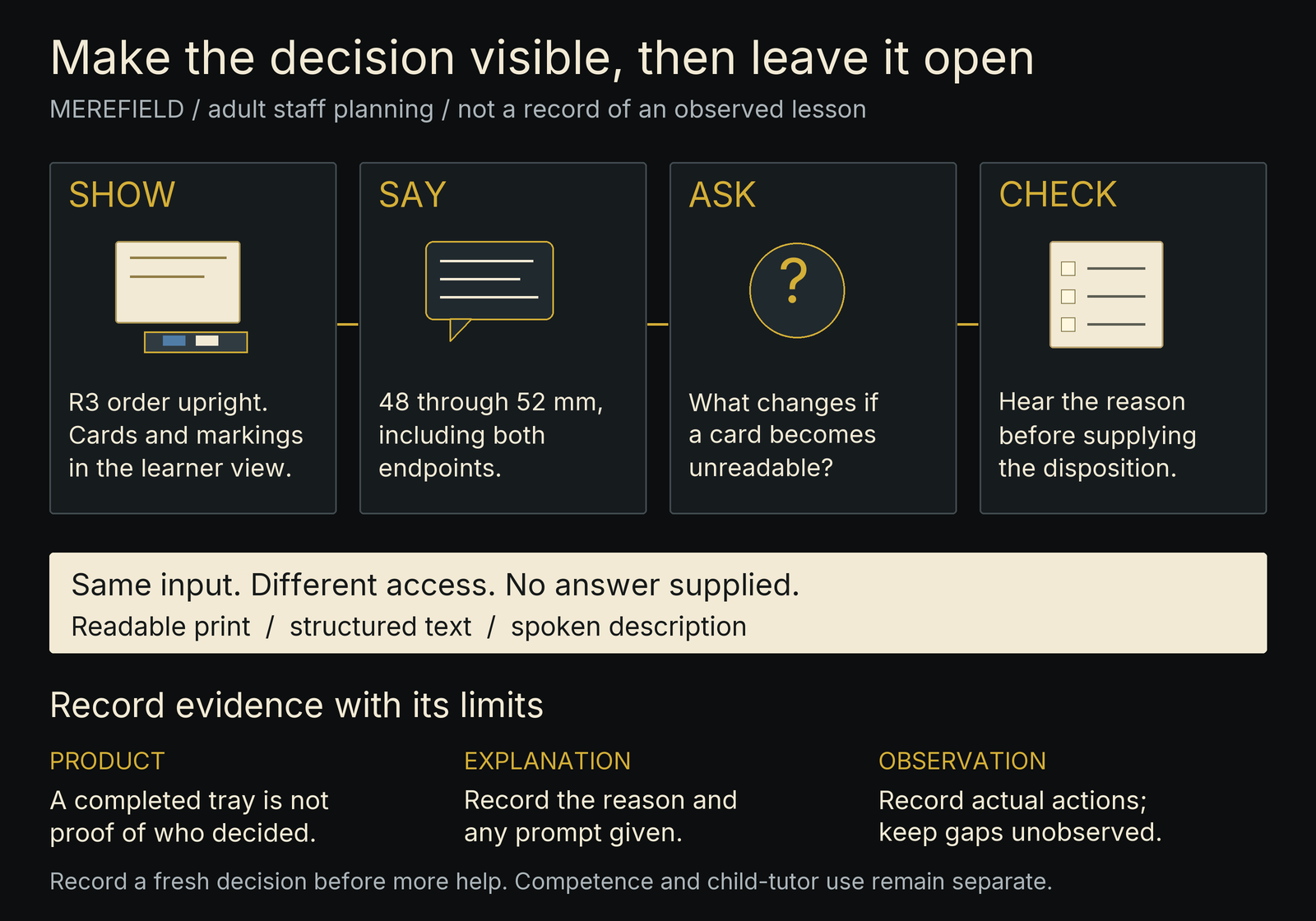
Illustration description: The original teacher-planning illustration has four panels in reading order. SHOW places the R3 order upright with cards and markings visible. SAY uses 48 through 52 millimetres including both endpoints. ASK poses what changes if a card becomes unreadable, without printing its answer in that panel. CHECK requests the reason before the tutor supplies a disposition. A cream band says same input, different access, no answer supplied, with readable print, structured text and spoken description. Three bottom columns distinguish product, explanation and observation: a completed tray does not establish who decided; explanations record reasoning and prompts; observations record actual actions and keep gaps unobserved. On a fresh case, ask for the learner decision before further prompts or feedback. Formal competence decisions and child-facing tutor use remain separate. This is a planning diagram for adults, not evidence that anyone learned, a complete access audit or an approved qualification assessment.
Learn in your browser · Chapter 04 of 08
Use examples and questions to reveal misconceptions
A useful question distinguishes between plausible ways of thinking. It does more than invite the class to agree with the tutor. Design examples that reveal a particular misunderstanding, then decide what you will teach or ask next when that misunderstanding appears.
Start with a misconception map for the sample-kit task. Possible misunderstandings include treating a boundary value as a failure, using the Kit A quantities for every order, assuming any visible defect must mean REWORK, or accepting a familiar-looking order with an old revision. These are hypotheses for teaching design, not diagnoses of real learners. An incorrect answer can also result from an unclear question, inaccessible presentation or an ordinary slip.
Construct a small sequence of examples that changes one concept at a time. Case A is a complete R3 Kit A with two blue cards, one cream card and widths of 48, 50 and 52 mm: ACCEPT. Case B changes only the order type to Kit B: REWORK, because the quantities no longer match. Case C restores Kit A but changes one width to 53 mm: REWORK. Ask learners to identify the changed evidence, not merely name the outcome.
Now introduce precedence. Case D has the same dimensional mismatch as Case C, but also contains a torn card: HOLD. Case E is otherwise matching but uses revision R2: HOLD. These contrasts test whether learners are applying the decision structure or simply counting defects. A learner who says HOLD because it is worse has not yet explained the rule. Ask which condition is present and where it appears in R3.
Respond to the reason for an error
A wrong answer is a starting observation, not a diagnosis of the learner.
- Observed response: Record what the learner actually chose.
- Neutral probe: Ask how they used the reference.
- Specific comparison: Address the boundary, count or precedence issue.
- Fresh example: Check changed reasoning on an unseen case.
- Observed response to Neutral probe: Avoid inferring a personal trait
- Neutral probe to Specific comparison: Use evidence about the reasoning
- Specific comparison to Fresh example: Seek transfer beyond the corrected answer
Use worked examples to expose reasoning without turning every activity into copying. First show one complete explanation. Next give a partially completed explanation with the decisive comparison missing. Finally present a fresh record with no answer scaffold. Keep the permitted reference sheet available where appropriate. Removing all support at once may test memory for wording rather than the ability to use the procedure.
Write questions that require a discriminating response. Does everyone understand provides little evidence. A complete Kit A includes a card exactly 52 mm wide; which R3 phrase determines whether that width is acceptable focuses the response. Follow it with a changed case: what changes if that card is torn? The pair tests the boundary and then precedence without pretending that one correct answer proves complete understanding.
Build plausible distractors from the misconception map. For the torn 53 mm card, REWORK is plausible because the learner may notice the width but miss precedence. ACCEPT is less plausible, unless the question specifically tests ignoring the defect. Avoid making the correct option conspicuously longer, more qualified or more formal than every alternative. Option shuffling cannot remove a wording cue that remains attached to the correct answer.
An AI assistant can propose variants, but test both the facts and the question's educational purpose. Check that every supplied value is complete, only the intended feature changes, the keyed answer follows R3 and the explanation does not introduce a new rule. Reject questions that can be answered from grammatical clues or that require information not supplied. Keep a short note naming the misconception each retained question is intended to probe.
Use responses to choose a teaching action, not to attach a label to the person. If a learner confuses quantities, compare Kit A and Kit B with cards in view. If they miss precedence, trace the two stages using the mixed-fault example. After feedback, use a fresh case to see whether the explanation transfers. For formal qualification assessment, applicable JCQ AI guidance and awarding-body requirements distinguish supported learning from the candidate's own demonstrated attainment.
Try it yourself · Activity 07
30 minBuild a diagnostic example set
Create a short practice sequence that tests boundary values, quantity patterns and HOLD precedence without relying on a memorised answer order.
- Write one complete matching Kit B record and explain why it is ACCEPT.
- Create a quantity-mismatch variant while keeping all information readable and complete.
- Create a mixed-fault variant with a torn card and an out-of-range width.
- Write one question and a plausible wrong answer for each case.
- Specify a feedback action and a fresh follow-up case for the misconception each wrong answer suggests.
Which of your questions could a learner answer correctly without understanding the intended decision?
Worked answer
A matching Kit B uses one blue and two cream cards, R3 and widths within 48 through 52 mm. A complete quantity mismatch produces REWORK. A torn card produces HOLD even when its width also fails. Questions should ask learners to identify the decisive evidence and rule. Feedback should address the relevant comparison or precedence, then test it with changed values or order type. Do not infer a persistent misunderstanding from one response without checking the question, access conditions and learner explanation.
Try it yourself · Activity 08
15 minChapter 4 review questions
Answer from the examples and explain what each question is designed to reveal.
- Why is a misconception map a hypothesis rather than a diagnosis?
- What does changing only the order type reveal?
- Why is REWORK a plausible wrong answer for a torn 53 mm card?
- How does a partially completed worked example differ from revealing the entire answer?
- Why does shuffling options not remove answer-length cues?
- What should happen after corrective feedback?
Choose one question to revise so that the answer provides more useful evidence for your next teaching move.
Worked answer
1. The same response can have several causes, including unclear wording or an ordinary slip. 2. It reveals whether the learner connects quantities to the actual order rather than repeating Kit A's pattern. 3. It follows the width rule while missing the earlier HOLD condition. 4. It leaves a meaningful comparison or explanation for the learner to supply. 5. The conspicuous wording remains with the correct option wherever it appears. 6. Offer an appropriate fresh case and inspect the learner's reasoning; repeating the corrected answer alone does not demonstrate transfer.
Apply what you learned · Practice
Explanation and answer
Ask how they interpreted the inclusive boundary. A neutral probe can distinguish a boundary misconception from a slip or a presentation problem.
Practice only. This does not count towards your exam or certificate.
Learn in your browser · Chapter 05 of 08
Make the practical objective accessible without giving away the answer
Change how learners receive instructions and show their reasoning when appropriate. Preserve the capability being taught and check that an adjustment does not quietly perform the task for them.
Merefield's original kit sheet uses small grey type, colour alone and a photograph of a ruler. Tutor Noor first states the purpose: learners interpret the approved order, check the sample and explain a disposition. The purpose is not to read tiny print or guess what a photograph shows. An accessible version can remove those barriers while retaining the checking decision. This distinction must be reconsidered for each real training product; our fictional paper exercise is not an adjustment policy for a qualification.
Begin with an access conversation through the institution's appropriate process. Ask what would make the material usable, not for a diagnosis to paste into a chatbot. Keep individual support records in their authorised system. For lesson design, an invented requirement such as 'provide a readable text description of the example' is sufficient. Do not ask AI to classify a learner's disability, predict effort or decide entitlement to an adjustment.
Prepare the base reference as structured, selectable text. Use explicit headings and a consistent reading order: revision, order type, required counts, measurements, then decision. State millimetres beside values. Explain that 48 and 52 are included. Put the HOLD conditions before the REWORK checks so a spoken version does not reverse the rule. Keep the same information in the print sheet, digital text and spoken script, with the R3 identifier on each.
Equivalent access, retained objective
Presentation routes provide the same information without supplying the learner decision.
- Common objective: Interpret the order and explain its disposition.
- Readable print: Explicit labels, units and a separate teacher key.
- Structured text: Usable headings, reading order and diagram explanation.
- Spoken description: Preserve every input and the rule order.
- Same reasoning evidence: Learner gives the decision and its basis.
- Common objective to Readable print: Adapt access
- Common objective to Structured text: Adapt access
- Common objective to Spoken description: Adapt access
- Readable print to Same reasoning evidence: Do not embed the answer
- Structured text to Same reasoning evidence: Do not embed the answer
- Spoken description to Same reasoning evidence: Do not embed the answer
Colour is part of this invented kit specification, but colour alone should not carry the teaching instructions. Each physical sample can also carry the readable word blue or cream and a distinct tactile identifier agreed for the exercise. The label describes the sample; it does not say ACCEPT or REWORK. If matching colour unaided were genuinely the assessed occupational skill, changing that requirement would require the relevant assessment decision. Here we are teaching inspection reasoning, not certifying colour discrimination.
A magnified view or a spoken reading of an already recorded width may make a reasoning example accessible. It is not evidence that the learner independently measured the object. Noor therefore splits the record into 'interprets recorded measurements' and 'demonstrates the specified measuring task'. She uses the first in this course's paper simulation and refers any real practical adjustment to the appropriate assessor. This prevents a supportive adaptation from turning into an unsupported claim of practical competence.
For digital resources, W3C WCAG 2.2 supplies useful criteria, including keyboard operation, text alternatives, readable contrast and reflow. Check the actual page at increased text size and with the keyboard. A diagram needs a text explanation of its relationships, not just an image filename. A narrated demonstration needs accurate captions and a usable transcript. These checks do not establish complete WCAG conformance or resolve physical access to a workshop.
Scroll sideways to see every column.
| Barrier in the draft | Proposed change | Evidence still required |
|---|---|---|
| Colour-only instructions | Add colour names and non-answer identifiers | Learner compares the sample attributes with the order. |
| Tiny photo of a width reading | Provide a large view and equivalent text | Learner applies the inclusive boundary; measurement skill is recorded separately. |
| Fast uninterrupted narration | Pause at each decision and provide a transcript | Learner explains why HOLD overrides a visible width defect. |
| AI explanation announces the disposition | Remove the conclusion from the learner version | Learner decides before seeing feedback. |
Worked example: a digital card reads R3, kit A, blue widths 48 and 52, cream width 50, all readable and intact. The accessible learner version states every input in text and asks for a disposition with reasons. ACCEPT remains the correct result. A second version supplies the sentence 'all conditions are met' before the learner responds. That sentence performs a material part of the task and is removed. The tutor keeps a separate answer sheet.
An AI assistant may draft a plain-language version using only that invented card and the R3 rules. The tutor then compares every numeral, condition and decision word with the reference. Readability is not a reason to replace '48 through 52 inclusive' with 'about 50'. Ask a colleague to trace the accessible version without the source beside it and identify anything missing. Record the reviewed version, not a generic promise that AI makes material accessible.
Try it yourself · Activity 09
40 minProduce three equivalent learner versions
Adapt the worked kit A example into a print sheet, structured digital text and a tutor-described version. Keep the answer separate.
- List the capability being practised and the barriers you are removing.
- Preserve every R3 input and the inclusive boundary.
- Add a text equivalent for any diagram. Explain how the learner requests help.
- Compare the three versions field by field and identify which practical capability is not demonstrated by a text response.
Could your helpful explanation accidentally contain the answer?
Worked answer
All versions retain R3, kit A, two blue samples at 48 and 52 mm, one cream at 50 mm, readable and intact status, and a request for a reasoned decision. The teacher key says ACCEPT. The learner versions do not. A text answer can demonstrate interpreting measurements, but not independently using a ruler.
Try it yourself · Activity 10
25 minChapter 5 review
Answer before opening the guide. Explain your decision using the lesson evidence.
- Why is enlarging text different from giving the decision?
- Can the tutor infer a diagnosis from slow responses?
- What information is lost by changing the range to about 50?
- Does a text measurement prove ruler skill?
- What should an accessible diagram include?
- Does passing an automated accessibility scan settle access?
Which answer would change your teaching plan, and what would you do differently?
Worked answer
1. Enlargement changes access; the decision supplies part of the capability being checked. 2. No. Use the appropriate support process and avoid inferred personal classifications. 3. The exact lower and upper limits and their inclusive status. 4. No. Observation of the measuring task would be separate evidence. 5. A meaningful text explanation of the steps and relationships. 6. No. Check actual use, relevant criteria and individual or physical needs.
Apply what you learned · Practice
Explanation and answer
Give all R3 inputs in structured text without a result. Equivalent input access preserves the reasoning. Supplying the result or changing rules does not.
Practice only. This does not count towards your exam or certificate.
Learn in your browser · Chapter 06 of 08
Move from a demonstration to supervised practice and useful feedback
A copied success tells you less than a fresh attempt with an explanation. Plan how support changes over the lesson and how you will respond to different kinds of error.
Noor has shown the R3 checking sequence. Now she must find out whether learners can use it. She distinguishes three phases: a guided attempt where prompts are expected, a supported retry after feedback, and a fresh attempt where the learner makes the decision before receiving help. These are lesson-design choices for this fictional adult workshop, not a universal timetable or a mandated supervision ratio.
Prepare two sets of cases so the independent task is not the tutor's example with a different name. Set one includes a complete kit B with blue 50 and cream 49 and 51: ACCEPT. Set two includes kit A with blue 48 and 52.2 and cream 50: REWORK once the record checks pass. A third case has a torn order card and width 53: HOLD first. Learners must explain the reason for the precedence, not merely memorise three output words.
During the guided attempt, the tutor can ask which reference applies and what must be checked before measuring. Make that assistance visible in the notes. Do not later describe a prompted answer as independent. The physical demonstration should use safe pre-cut cards and a blunt ruler. The optional code uses recorded widths and cannot observe measurement, posture, attention or understanding.
Fade assistance and record it
A prompted success and an independent attempt are different observations.
- Demonstration: Tutor makes the checks visible.
- Guided attempt: Prompts are permitted and recorded.
- Specific feedback: Name the observed issue and a next action.
- Fresh attempt: Seek a new decision before further prompts.
- Demonstration to Guided attempt: Learner tries the sequence
- Guided attempt to Specific feedback: Use the observed response
- Specific feedback to Fresh attempt: Check a new case
Consider three fictional responses. Lee puts a kit A with one blue and two cream samples in ACCEPT: the record is complete but the count comparison is wrong, so it needs REWORK. Amira puts width 48 in REWORK because she thinks the lower boundary is excluded. Tomas sees an unreadable order and asks the tutor for a readable reference before deciding. These require different teaching moves. Lee needs an explicit count-to-order comparison; Amira needs a boundary example; Tomas has used an appropriate stop.
Feedback should identify the observed action, its consequence within the exercise and the next attempt. To Amira: 'You excluded 48. R3 includes both endpoints. Place 47.9, 48 and 48.1 against the rule and explain where the decision changes.' This is more actionable than 'be more accurate'. Then provide a fresh upper-boundary example without the answer. If the learner now applies 52 correctly, record that new evidence and the support that preceded it.
A slip and a misconception can look similar in the finished tray. Ask a neutral question before diagnosing: 'Show how you compared this order with the samples.' A correct explanation followed by a transposed count may need a checking habit; repeated exclusion of both endpoints suggests an issue with the meaning of inclusive. This is a tentative teaching interpretation, not a psychological assessment. Keep the response open to new evidence.
AI can propose feedback wording from wholly invented responses. It should not watch a live learner and automatically declare readiness. A useful constrained request includes the reference, the observed fictional action, the desired next attempt and a ban on invented learner characteristics. The tutor checks that the suggestion neither changes R3 nor humiliates the learner. Feedback must allow a question or disagreement and provide a route back to the actual reference.
Scroll sideways to see every column.
| Observed response | Tutor action | Fresh evidence sought |
|---|---|---|
| 48 mm rejected as too small | Compare 47.9, 48 and 48.1 against the inclusive rule | Learner explains a new 52 mm example. |
| Kit A packed using kit B counts | Put required and observed counts side by side | Learner checks a different complete order. |
| Torn order held despite a visible width defect | Confirm the use of HOLD precedence | Learner explains why a readable current instruction is needed. |
| Correct answer after tutor points at the defect | Record prompted success | Learner handles an unseen case before further prompts. |
The tutor's observation sheet needs space for the case ID, reference revision, actual action, exact prompt if any, learner explanation and next step. Use invented labels in the course workbook. Real learner records belong in the institution's approved system with applicable access and retention controls. A shorthand score without the underlying observation makes later feedback and review harder.
Try it yourself · Activity 11
40 minRehearse feedback that changes the next attempt
Use the three fictional responses from Lee, Amira and Tomas. Prepare a short feedback exchange and a fresh case for each.
- State the observed error or appropriate stop without assigning a personal trait.
- Write one neutral diagnostic question and the relevant R3 comparison.
- Design a new case that checks the same reasoning without repeating the answer.
- Record what was prompted and what the learner later did independently.
Where would you be tempted to rescue the learner so quickly that you lose the opportunity to see their reasoning?
Worked answer
For Amira, ask how she read the lower boundary, show that 48 is included and then ask about a complete kit containing 52. For Lee, compare kit A required counts with observed counts and use a fresh kit B. For Tomas, recognise the HOLD and ask what information would allow checking to resume. None of these exchanges alone establishes occupational competence.
Try it yourself · Activity 12
25 minChapter 6 review
Answer before opening the guide. Explain your decision using the lesson evidence.
- Why use a fresh case after feedback?
- Should prompted success be recorded as independent?
- What is the result for a complete kit A with kit B counts?
- What takes precedence if the order is torn and a width is 53?
- Why ask a neutral question before diagnosing a misconception?
- Can the checker observe practical measuring skill?
Which answer would change your teaching plan, and what would you do differently?
Worked answer
1. To see whether the learner can apply the idea beyond a remembered answer. 2. No. Record the assistance and seek a fresh attempt. 3. REWORK, because the complete record has a quantity mismatch. 4. HOLD, because the instruction cannot first be established. 5. The same product error can arise from different reasoning or a slip. 6. No. It evaluates entered synthetic fields against fixed rules.
Apply what you learned · Practice
Explanation and answer
Prompted success, followed by a fresh case. Record assistance honestly and seek evidence from a new attempt.
Practice only. This does not count towards your exam or certificate.
Learn in your browser · Chapter 07 of 08
Collect evidence without confusing assistance with attainment
Use observations, explanations and products for the capabilities they can actually support. Keep teaching feedback, a knowledge quiz and formal qualification decisions visibly separate.
A tidy finished kit is evidence about that kit. It does not show who chose the samples, whether another learner supplied the answer or whether the learner can explain a HOLD. A polished written reflection is likewise not proof of the practical sequence. The tutor should decide what each capability requires before collecting evidence, then record the conditions and support under which it was produced.
For the fictional workshop, Noor's evidence map has four rows: establish the current instruction; compare quantities and measurements; follow and explain the check sequence; and report a discrepancy without guessing. Each row names an observable action and a question. The record includes 'not yet observed' as a legitimate state. Missing evidence should create a further learning or assessment opportunity, not an invented pass or an automatic failure of the person.
This course is informal adult professional learning about teaching design. A real regulated qualification has its own training product, assessment requirements, permitted assistance, authenticity arrangements, assessor responsibilities and appeal process. Check those with the actual awarding organisation or regulator. ASQA's Assessment Practice Guide is relevant to NVR registered training organisations in its stated Australian scope. Its evidence principles do not convert this course's invented rubric into an approved qualification instrument.
Match evidence to its limits
A product, an explanation and an observation each answer a different question. None automatically establishes all required competence.
- Product: What was produced, with whose assistance?
- Explanation: What reasoning did the learner give?
- Observation: What action was actually seen?
- Scoped human judgement: Compare with the relevant requirements and record gaps.
- Product to Scoped human judgement: Support only justified claims
- Explanation to Scoped human judgement: Record assistance and context
- Observation to Scoped human judgement: Keep unobserved requirements visible
For assessments covered by JCQ arrangements, use the applicable current guidance and qualification instructions. An acknowledgement of AI use does not demonstrate a candidate's own achievement. Where a centre permits AI-assisted marking under JCQ arrangements, the responsible human assessor must examine the complete submission and decide its mark independently of the AI output. Sampling an AI-generated mark or approving it without that review is insufficient. The tutor must distinguish what assistance was allowed in preparation from what the learner needs to demonstrate in the assessment itself. The boundaries cannot be guessed from a generic AI policy.
Scroll sideways to see every column.
| Fictional evidence | What it supports | What remains unknown |
|---|---|---|
| Sam submits an elegant AI-assisted explanation, but accepts a torn order | A written product exists; a particular practical decision was observed | The explanation cannot establish independent use of HOLD precedence. |
| Jo sorts three fresh cases correctly and explains each comparison | Observed decisions and explanations on those cases | Performance across other contexts and any real qualification requirements. |
| A checker reports ACCEPT for typed values | Those inputs meet its encoded synthetic rule | Whether anyone measured accurately or supplied truthful inputs. |
| An exam returns 17 of 20 | A passing result on that knowledge assessment | Microteach quality, practical competence, identity assurance or accreditation. |
Worked judgement: Sam's preparation included permitted AI drafting. In the fresh case, the reference was torn and Sam chose ACCEPT without requesting a readable copy. Noor records the case and action, asks Sam to explain the choice and identifies a gap in applying the stop condition. She does not use the fluent reflection to cancel the observed problem. The next learning step is a guided precedence comparison followed by a fresh independent case. Any formal outcome would require the actual assessment process.
An observation rubric can use explicit descriptors: identifies R3 before checking; compares required with observed counts; explains the inclusive limits; applies HOLD before REWORK; and communicates what must be resolved. Avoid labels such as excellent attitude or seems confident as substitutes for evidence. Where the activity did not reveal a descriptor, record it as unobserved. Preserve the learner's opportunity to explain a disputed record through the institution's proper route.
Do not feed real student submissions, voices, photographs or support records into an unapproved model to save marking time. Data ownership and copyright questions are separate from an individual's willingness to try a tool. Sovereign control involves who can access, retain, reuse or change the system and who retains the decision. Use the institution's authorised processes; the course's synthetic example gives no permission to upload real material.
The Mickai knowledge assessment accompanying this course draws twenty questions from a mapped bank. Strictly above 80 percent is required: sixteen correct is 80 percent and fails; seventeen is 85 percent and passes. Written exercises, the teaching pack and peer microteach are ungraded practice. A named certificate records the course knowledge result and issuance. It does not confer a vocational qualification, professional authorisation, verified identity or proof that an organisation complies with law.
Try it yourself · Activity 13
40 minWrite an evidence-based feedback record
Compare Sam and Jo in the evidence table. Design a record a second tutor could understand without watching the original lesson.
- Map observations to the four workshop capabilities.
- Separate product evidence, explanation, observation and known assistance.
- Identify at least one unobserved capability and a proportionate fresh task.
- Write how a learner can question an inaccurate observation. Keep all names and cases fictional.
Which attractive piece of evidence might cause you to overlook a missing practical observation?
Worked answer
Record the specific case, revision, action, explanation and assistance. Sam needs further evidence of HOLD precedence; Jo has evidence on the three observed cases but no blanket competence claim. The checker and academy exam remain separate. A review route lets the learner clarify the record while the relevant authorised tutor retains the judgement.
Try it yourself · Activity 14
25 minChapter 7 review
Answer before opening the guide. Explain your decision using the lesson evidence.
- What does a tidy kit prove by itself?
- Does citing an AI tool make generated work independent attainment?
- How should an unobserved capability be recorded?
- Who determines the requirements for a regulated qualification?
- Does 16 out of 20 pass this exam?
- What does the Mickai certificate not establish?
Which answer would change your teaching plan, and what would you do differently?
Worked answer
1. Only facts about that product, not who performed or understood the checking. 2. No. Attribution and evidence of the learner's own achievement are different. 3. As not yet observed, with a justified next opportunity to gather evidence. 4. The applicable awarding or regulatory arrangements and authorised institutional process. 5. No. The threshold is strictly above 80 percent; 17 passes. 6. Occupational competence, professional authority, organisational compliance, identity assurance or accreditation.
Apply what you learned · Practice
Explanation and answer
A fail because passing requires strictly above 80 percent. 16/20 is 80 percent.17/20 is 85 percent and passes this knowledge assessment.
Practice only. This does not count towards your exam or certificate.
Learn in your browser · Chapter 08 of 08
Rehearse, revise and deliver a complete lesson pack
A lesson pack is ready for a bounded trial when its instructions, examples, access routes and evidence checks agree. Rehearsal should reveal where the teaching fails, not just confirm that the slides look finished.
Bring the previous chapters together into a fifty-minute adult workshop at fictional Merefield. The output is a teachable pack, not a chatbot transcript. Include the R3 reference, performance objectives, task analysis, demonstration script, learner materials, separate teacher answers, practice cases, observation sheet and a revision log. The time plan is an initial design assumption. Revise it from the rehearsal rather than claiming that every group learns at the same speed.
Scroll sideways to see every column.
| Proposed minutes | Learning activity | Tutor evidence |
|---|---|---|
| 0-5 | Explain the task and probe how learners read an order | Note starting interpretations without turning them into personal labels. |
| 5-12 | Orientating demonstration and slower decision-point explanation | Check sightlines and ask why revision comes first. |
| 12-22 | Guided pair practice using complete cases | Record prompts and examples that cause confusion. |
| 22-32 | Feedback and boundary/precedence comparisons | Look for changed reasoning, not agreement alone. |
| 32-44 | Fresh individual cases and explanation | Observe decisions before supplying help. |
| 44-50 | Teachback, unresolved questions and next steps | Identify missing evidence and invite questions. |
In a peer microteach, one colleague plays the learner and another observes the instruction, not the personality of the tutor. Give the observer three questions: could the learner see the comparison; did each instruction preserve R3; and did the question reveal the intended reasoning? Avoid filming by default. If recording is proposed in a real institution, its permission, access and retention arrangements need separate attention. This fictional course needs no recording or learner upload.
Revise from a rehearsal finding
A versioned change should address observed teaching evidence and be checked again.
- Rehearse: Use a peer, or label a self-walkthrough honestly.
- Identify the barrier: Compare the observed problem with the intended instruction.
- Revise the pack: Update the actual script, resource or layout.
- Recheck: Use a fresh case and record the limitation.
- Rehearse to Identify the barrier: Record what happened
- Identify the barrier to Revise the pack: Choose a specific repair
- Revise the pack to Recheck: Verify the changed part
Worked rehearsal: the observer notes that Noor says 'larger than 48' while the printed sheet says '48 through 52 inclusive'. Two peers then reject the lower-boundary sample. The diagnosis is an inconsistent spoken rule, not poor learner motivation. Noor corrects the script, highlights both endpoints in the teacher notes and rehearses the boundary explanation again. A fresh kit B containing 52 is used to see whether the revised instruction transfers beyond the original example.
A second observation is that the learner cannot see the order while Noor holds a sample over it. Noor places the order upright beside the tray, then pauses before moving the sample. This is a specific design repair tied to an observed barrier. The revision log records version, issue, evidence, change, owner and recheck result. A box saying 'human reviewed' without those details is not equivalent evidence.
Estimate preparation effort honestly. In an invented comparison, a template-only pack takes 35 minutes to adapt, 15 to check and 20 to rehearse: 70 minutes. An AI-assisted draft takes 12 minutes to generate, 28 to correct, 15 to adapt access materials and 20 to rehearse: 75 minutes. The AI route is five minutes longer in this example. It might still offer useful variant ideas, but the timing does not support a speed claim. These numbers are a worked calculation, not a Mickai performance study.
The optional downloadable checker makes one part of the reference testable. Read its README, inspect the supplied synthetic cases and run the standard-library tests in an approved local Python environment. No model or network is needed. The paper table and expected decisions provide the same reasoning exercise without code. Change one field at a time, including 48, 52 and an invalid reference, and explain the result before checking the key. A passing test suite says nothing about an individual learner's practical attainment.
Choose the relevant jurisdiction pathway before adapting the pack for a real course. England's DfE material, the selected European Commission educator guidance and Australia's RTO guidance have different scopes. Identify the actual institution, learner age, qualification, regulator and permitted technology use. Where the reference is only an overview, say so. A general AI-literacy discussion or locally hosted model does not supply legal clearance. Under-18 use and safeguarding remain outside this adult prototype.
Mickai's Trust Agent approach keeps the educator responsible for teaching and the institution responsible for its systems. A useful institutional request might be an approved resource-drafting workflow with bounded sources, controlled access and retained human review. That is a design requirement to validate in the actual organisation, not a claim that this course includes a deployed service or makes all AI safe. Keep confidential source collections and real learner data out of these public exercises.
Try it yourself · Activity 15
90 minCapstone: the complete fifty-minute teaching pack
Deliver a peer-ready pack for the fictional R3 paper-kit workshop. Use only invented cases and safe pre-cut materials.
- Provide four observable objectives and map each to activities and evidence.
- Attach the exact reference, task analysis and show/say/ask/check demonstration script.
- Supply six varied learner cases, a separate teacher key and at least one mixed-fault HOLD case.
- Provide equivalent accessible print, text and spoken versions without embedding the answers.
- Plan guided practice, feedback, fresh attempts and a way to record assistance.
- Attach an observation rubric, jurisdiction note and clearly separated formal-assessment questions for a real institution.
- Rehearse with a colleague or perform a documented self-walkthrough if no colleague is available; label which occurred. Record two issues, revisions and rechecks.
- Trace the paper cases or run the checker, calculate the worked timing comparison and state the limits.
What evidence would make you revise the lesson again rather than expand it?
Worked answer
A complete pack preserves R3 and HOLD precedence, distinguishes quantity and width rework, teaches inclusive boundaries and makes the learner's reasoning visible. It contains no real learner data or unsafe equipment procedure. A self-walkthrough must not be reported as a peer trial. The worked comparison is 70 minutes versus 75, so no time saving is demonstrated. Written practice and this capstone are not graded by the knowledge exam; a real teaching or qualification judgement remains separate.
Try it yourself · Activity 16
25 minChapter 8 review
Answer before opening the guide. Explain your decision using the lesson evidence.
- What should the microteach observer examine?
- What follows from two peers misunderstanding an inconsistent spoken boundary?
- How should a self-walkthrough be described?
- What is the full preparation time difference in the example?
- Does a local model remove source or learner-data obligations?
- What should be checked before adapting this adult pack to a real qualification?
Which answer would change your teaching plan, and what would you do differently?
Worked answer
1. The instruction, visibility, reference fidelity and evidence elicited. 2. Correct and rehearse the instruction, then seek fresh evidence rather than blaming the learners. 3. As a self-walkthrough, not a peer or learner trial. 4. AI-assisted is 75 minutes versus 70, five minutes longer. 5. No. Access, retention, rights, permitted use and decision responsibility still require review. 6. Actual jurisdiction, institution, learner age, training product, assessment requirements, technology policy and appropriate professional review.
Apply what you learned · Practice
Explanation and answer
No time saving was demonstrated in that comparison. Compare the complete workflow. The fictional timing example establishes neither universal performance nor learning impact.
Practice only. This does not count towards your exam or certificate.
Keep learning
The complete workbook
Eight substantial chapters follow fictional Merefield Adult Skills Centre through a safe paper-kit workshop. Build an outcome map, audit a flawed draft, rehearse demonstrations, diagnose misconceptions, adapt access, plan feedback and assemble a complete teaching pack. Each chapter includes an original exercise, six answered review questions, an accessible diagram and an inline check. The offline checker and paper alternative test synthetic R3 decisions only. Scored knowledge assessment is separate from the ungraded capstone. Jurisdiction pathways require a conscious choice and are not worldwide compliance advice.
- 01Teach the decision, not just the finished kitRead here · 2 exercises
A practical lesson succeeds when learners can perform and explain the intended task. A neat worksheet or correctly packed example may conceal guessing, copying or excessive help. Begin by specifying the performance you want to observe, then decide how AI can assist your preparation.
- 02Convert the reference procedure into a checkable lessonRead here · 2 exercises
A useful teaching explanation makes a procedure easier to understand without changing its meaning. Treat AI-generated text as a proposed adaptation. Check every requirement, decision and example against the reference before it becomes part of a demonstration or learner resource.
- 03Stage a demonstration learners can see and explainRead here · 2 exercises
A demonstration combines physical actions, spoken explanation and learner attention. Those elements can support one another or compete. Design what learners will watch, what they will hear and when they will respond, then rehearse the sequence from their viewing position.
- 04Use examples and questions to reveal misconceptionsRead here · 2 exercises
A useful question distinguishes between plausible ways of thinking. It does more than invite the class to agree with the tutor. Design examples that reveal a particular misunderstanding, then decide what you will teach or ask next when that misunderstanding appears.
- 05Make the practical objective accessible without giving away the answerRead here · 2 exercises
Change how learners receive instructions and show their reasoning when appropriate. Preserve the capability being taught and check that an adjustment does not quietly perform the task for them.
- 06Move from a demonstration to supervised practice and useful feedbackRead here · 2 exercises
A copied success tells you less than a fresh attempt with an explanation. Plan how support changes over the lesson and how you will respond to different kinds of error.
- 07Collect evidence without confusing assistance with attainmentRead here · 2 exercises
Use observations, explanations and products for the capabilities they can actually support. Keep teaching feedback, a knowledge quiz and formal qualification decisions visibly separate.
- 08Rehearse, revise and deliver a complete lesson packRead here · 2 exercises
A lesson pack is ready for a bounded trial when its instructions, examples, access routes and evidence checks agree. Rehearsal should reveal where the teaching fails, not just confirm that the slides look finished.
Also inside: a 10-point checklist, a glossary of 12 terms and 12 questions and answers to test yourself. 16 hands-on exercises, each with a worked answer at the back where the workbook gives one.
The PDF is free. We ask for your name and email before downloading. Read the privacy notice at the download form. Free to download and use for personal learning, study groups and inside your own team. Please do not resell the workbooks or republish them as your own. Link people to trust-agent.ai instead.
Get your free PDF workbook
Enter your name and email, then download the complete workbook. This form also works without JavaScript.
Test yourself
Questions and answers
How can college tutors use AI to plan practical lessons?
Give an approved tool a bounded fictional brief and a checked reference. Review every requirement and worked example, rehearse the demonstration and gather evidence of learner reasoning. Keep the educator responsible for the teaching and its materials.
Is this a vocational qualification?
No. This is professional learning about lesson design. Its knowledge exam and named certificate do not establish occupational competence, accreditation or authority to assess a regulated qualification.
Do I need specialist workshop equipment?
No. The fictional exercise uses pre-cut cards, invented order records, trays and a blunt ruler. The paper and code routes use supplied observations. It includes no hazardous equipment procedure.
Can I use the course without an AI subscription or Python?
Yes. Use the supplied flawed draft, paper examples and teacher key. The optional checker uses Python standard-library code with no network or model. An AI tool is optional and subject to institutional approval.
Why is a correct finished product not enough evidence?
The product alone does not show who made the decision, what assistance was given or whether the learner can explain an exception. Map observations and explanations to the intended capability.
Can AI mark student work for me?
Apply the actual assessment and institutional rules. Under the referenced JCQ arrangements, AI cannot be the sole marker and a responsible human must examine the entire submission and determine its mark independently. This course does not authorise uploading real submissions.
How can accessible resources preserve assessment validity?
Identify the capability first, remove irrelevant access barriers and keep the intended reasoning or performance visible. Changes to a real qualification assessment need its authorised process. A text measurement is not proof of ruler skill.
What should a demonstration script contain?
Separate show, say, ask and check. Make the action visible, connect it to a short explanation, pause for learner reasoning and define what evidence would justify moving on.
How should I handle a learner who gives a wrong answer?
Record the action, ask a neutral question and compare with the reference. A wrong answer may reflect a misconception, a slip or inaccessible instructions. Give specific feedback and a fresh attempt.
Can we upload learner support records to personalise a lesson?
This course uses no real learner records. Keep support information in authorised institutional systems. A provider setting or removed name does not by itself establish permission, privacy compliance or source rights.
Does a sovereign or locally hosted model make a lesson safe?
No. Examine data access, retention, source rights, changes and decision control as well as hosting. Verify the actual generated material and retain qualified human responsibility.
What score earns the Mickai knowledge certificate?
Strictly above 80 percent. In 20 questions,16 correct fails and17 passes. Written practice and the capstone are ungraded. Recorded issuance is distinct from verified identity, practical competence and accreditation.
Write as you go
My notes
Use this scratchpad for your own notes, working or answers as you read. Notes are saved in this browser on this device. Downloading makes a local copy; it does not send your notes to Mickai.
Learn → Practise → Demonstrate
Ready to put it into practice?
Take the scored exam when you feel ready. You do not need to download the workbook first. A score strictly above 80% earns a named, dated Mickai certificate with a verification page.
Take the official examYour name and email are collected at exam start. Certificates record an assessment result, not an accredited qualification or verified identity.
Learn the language
Key terms
- Task analysis
- Breaking a practical activity into actions, decision points and evidence needed for teaching.
- Observable outcome
- A statement of what the learner will do, under what conditions and with what evidence.
- Reference fidelity
- Preserving the meaning, conditions and order of an approved reference in derived material.
- HOLD
- In fictional R3, stop the ordinary comparison until unusable or uncertain information is resolved.
- REWORK
- In fictional R3, a complete usable record has a known quantity or width mismatch.
- Inclusive boundary
- A limit whose endpoint is included; R3 allows48 and52 mm.
6 of the workbook's 12 terms. The complete glossary is in the workbook.
Follow the evidence
Sources and checks
Facts last checked: .
These workbooks use AI assistance. See how the workbooks are made.
- Generative artificial intelligence (AI) in educationDepartment for Education
- AI use in assessments: your role in protecting the integrity of qualificationsJoint Council for Qualifications
- Training and competenceHealth and Safety Executive
- Guidelines on the ethical use of artificial intelligence and data in teaching and learning for educatorsEuropean Commission
- Assessment Practice Guide, 2025 StandardsAustralian Skills Quality Authority
- Training Support Practice Guide, 2025 StandardsAustralian Skills Quality Authority
- Guidance on privacy and the use of commercially available AI productsOffice of the Australian Information Commissioner
- Web Content Accessibility Guidelines (WCAG) 2.2World Wide Web Consortium
Created by Mickarle Sean Junior Wagstaff-Irons - Micky Irons with the Mickai team. Published by Mickai LTD. Last updated 1 October 2026.
NextKeep going
Where to go next
Recommended for you
AI literacy for school staff
Choose appropriate school AI tasks, verify resources, protect information and test a synthetic teacher-approval gate with clear safeguarding and local policy boundaries.
Recommended for you
Human-in-the-loop vs human-in-time: oversight before impact
Design AI oversight that acts before impact: distinguish presence from approval, bind decisions to actions, test safe stops and build a proportionate evidence dossier.
Recommended for you
Using AI as an accessibility tool: reading, writing and seeing
AI accessibility features already on your device: screen readers, dictation, live captions and image description. What each does well, and where it goes wrong.