
assurance · Level 3
Controlling payment proposals from financial AI agents
AI voice fraud and CEO-payment impersonation: exact verification, approval and retry controls.

Your next step
Start this course online
Register your start, then work through the lessons and exercises at your own pace. You can download the PDF separately. Where a scored exam is available, you will find it after the lessons.
Register or resume your course
Start with the essentials
The short answer
Treat a familiar voice as an unverified request, not payment authority. Verify through independently obtained contacts, bind approval to the exact beneficiary, amount, currency and version, and preserve limits, expiry and revocation. Reconcile retries against the same business obligation. Sable supplies fictional paper scenarios, not banking execution, voice detection or secure identity assurance.
What you will learn
- Bind approval to beneficiary, amount, currency and proposal version
- Reject a changed or expired approved request in a local simulator
- Prevent duplicate synthetic payment effects on retry
- Explain what an approval event proves and what it does not prove about identity or human presence
Who it is for
Payments engineers, treasury operations, fraud control and security architects. Adult professional education only, no real banking instructions or financial advice.
Before you start
- Understand structured tool outputs and bounded production-agent control.
- Python 3.10 or later is optional for the offline four-file exercise. All supplied activities can also be completed on paper.
Jurisdiction and study scope
These are selected reference pathways. Choose the relevant pathway before applying the exercises. This does not determine applicable law or provide worldwide coverage.
All pathway limits
- Actual organisation and jurisdiction unresolved: Select entity, bank/provider, payment product, currency, territories, accounting duties, privacy, authentication and actual approval policy. Fictional controls settle none of these.
- Selected UK awareness and reporting context: Take Five business campaign and scoped NCSC/ReportFraud routing. ReportFraud E/W/NI differs from Scotland. No actual banking rules, reimbursement rights, privacy basis or financial advice reviewed.
- US FBI awareness context: FBI BEC and AI-fraud guidance supports awareness and independent checking. US IC3 reporting is not a UK route or universal legal obligation.
Run the synthetic exercise
Download the exercise source, tests and instructions (ZIP)
No real records, external service or model is used by this exercise. Read the README before running it.
Owner-commissioned original teaching prepared with AI assistance. Sable firms, suppliers, tokens, messages, policies and outcomes are authored fiction. Worked journeys are paper predictions. Separately attributed evidence records 46 author tests and 20 different-reviewer finite mechanics tests; these are not banking, voice detection, authenticated human presence, legal or professional approval. No actual payment, caller, model, fraud detector or real customer data is claimed.
Learn in your browser · Chapter 01 of 08
Familiar voices, executive pressure and payment authority
Recognise a claimed executive instruction without treating familiar sound as authority.
A familiar voice is a reason to recognise a conversation, not permission to move business money. A caller may sound like a chief executive and know a supplier, meeting or project. Those details can make a request plausible without establishing who controls the beneficiary, whether the amount is due or whether the speaker may approve it. The treasury decision is therefore narrower than deciding whether a recording sounds genuine. Identify the requested effect, preserve the request as unverified evidence and put it through the established payment process. The business should not need to diagnose an audio technique before withholding an unsupported transfer.
Sable is an original fictional treasury setting for adult payments engineers, operations staff, fraud-control leads and security architects. Its suppliers, invoices, routes and amounts are authored, with no real account numbers, calls or customers. P03 is a text description of a familiar-sounding executive demanding a secret urgent payment. No voice has been generated or played. The proposed local simulator would evaluate fixed records rather than a language model or detector. Its refined finite contract is root-approved; the worked method journeys are paper propositions, separated from the labelled author-run appendix. None demonstrates a working bank integration or a reliable fraud classifier.
Separate three questions at the start. What is being requested? What independent evidence supports the request? What authority would permit the exact effect? A voice message may answer the first question while answering neither of the others. A genuine executive may also request something outside their delegated authority or act on an incorrect invoice. Verification of a person's involvement and verification of payment entitlement are different checks. Approval is a further scoped decision. Collapsing them into a single trusted-caller label makes it harder to notice that the proposed recipient or currency changed between the conversation and the payment screen.
The FBI's AI-fraud announcement describes synthetic audio and video used for impersonation and recommends independently contacting the claimed organisation. Its awareness context is US guidance, not a determination about this fictional request or UK payment law. The business-facing Take Five guidance separately recommends checking details at each payment stage and verifying unusual or urgent requests. These sources support pausing and checking, not a promise that staff can reliably hear every fake. Source IDs fbi-ai-fraud and takefive-business are narrow reference anchors. The detailed Sable controls below are original proposed organisational methods, not prescribed statutory requirements.
Pressure changes the workflow as well as the person's feelings. A request to keep the finance director uninformed removes a potential challenge. A demand to use a fresh number supplied in the message removes contact independence. A deadline that appears to expire before the usual review creates a reason to bypass it. Treat these as reasons to preserve the ordinary boundary, not proof that every urgent instruction is fraudulent. Treasury often handles legitimate urgent work. The appropriate response is a maintained escalation route that can inspect the exact request without treating secrecy, seniority or familiarity as an exception to verification.
For P03, record invoice INV-CEO, supplier MIST, beneficiary BEN-MIST, amount 980000 minor GBP units, proposal version 1 and expiry day 3. The amount is GBP9800 in this authored example, since there are one hundred pence in a pound. Its independent route is DIR-CEO and its supplied callback disposition is DENIED. That disposition is an invented teaching fact, not a completed telephone call. A filled intake note says the payment remains held, identifies the callback conflict and asks the proposed treasury owner to reconcile the request. It must not invent a new invoice or interpret the caller's apparent confidence as permission.
Compare ordinary and precise prompting. An ordinary prompt asks an assistant whether the caller sounds like the chief executive and whether the company should pay. It combines identity inference, entitlement and execution. A precise paper prompt assigns an evidence-triage role, supplies only the fictional tuple, forbids calls and payment actions, asks for independent route and approval gaps, and requires a held output when evidence is missing. Even that better prompt is a planning aid. A generated list of checks does not perform the callback, authenticate a person or prove that a proposed control is correctly implemented in a real treasury system.
A useful output schema contains request ID, received channel, claimed role, exact proposed effect, independent route, verification status, approval status and next owner. Keep claimed role separate from verified authority. Avoid a single confidence score that could bury several unresolved fields. A low-risk writing task and a high-consequence money movement can use similar messages while requiring different controls. The schema should therefore describe the action boundary explicitly: no banking connection, no real payment, no account access and no automatic escalation outside this paper exercise. Unknown fields remain unknown rather than becoming blank implied approvals.
Protect the person who challenges the request. A junior employee should be able to say that the exact payment needs the established checks without accusing a senior colleague or proving a scam. The proposed wording is factual: the new beneficiary is not verified, the callback contradicts the request, or the approval does not cover this version. A leader who wants a different process should change it through accountable review rather than demand an improvised exception during the incident. The course evaluates evidence and control decisions, not whether a participant is personally gullible. No one is exposed to a deceptive live exercise.
The first result is an intake record and a hold decision, not a payment receipt. Success means the learner identifies the requested effect, preserves the supplied facts and separates claim, verification and approval. A familiar voice cannot fill the missing fields, and a quiet manual route remains available when AI is absent. Later chapters add exact beneficiary validation, current binding and duplicate-effect handling. They do not turn a fictional role label into secure authority. The capstone will retain a genuine distinction between a completed educational worksheet and permission to deploy a financial agent.
- Freeze the received request as unverified evidence.
- Extract the exact proposed effect without executing it.
- Separate claimed role, verification and approval.
- Identify the independently maintained route.
- Record pressure and missing conditions without diagnosing audio.
- Keep payment held and name the proposed next owner.
Scroll sideways to see every column.
| Proposal | Business identity | Beneficiary | Amount | Version/expiry | Independent result | Disposition |
|---|---|---|---|---|---|---|
| P03 | MIST / INV-CEO | BEN-MIST | 980000 GBP minor units | v1 / expires3 | DIR-CEO / DENIED | HOLD_CALLBACK |
Familiar voices, executive pressure and payment authority
Recognise a claimed executive instruction without treating familiar sound as authority.
- Unverified demand: Fill a P03 intake row and a complete six-component paper prompt that cannot authorise a payment.
- Independent route: Extract the exact proposed effect without executing it.
- Exact request triage: Identify the independently maintained route.
- Pressure is held: Record pressure and missing conditions without diagnosing audio.
- Named next owner: Keep payment held and name the proposed next owner.
- Unverified demand to Independent route: Compare exact current facts
- Independent route to Exact request triage: Only supported conditions
- Independent route to Pressure is held: Missing or contradictory evidence
- Exact request triage to Named next owner: Record scoped result, not real payment authority
- Pressure is held to Named next owner: Preserve reasons and next owner
Text equivalent: Unverified demand leads to Independent route. Supported current conditions lead to Exact request triage. Missing or contradictory conditions lead to Pressure is held. Both branches retain Named next owner. Unverified demand: Fill a P03 intake row and a complete six-component paper prompt that cannot authorise a payment. Independent route: Extract the exact proposed effect without executing it. Exact request triage: Identify the independently maintained route. Pressure is held: Record pressure and missing conditions without diagnosing audio. Named next owner: Keep payment held and name the proposed next owner.
Try it yourself · Activity 01
35 min, planning estimateFilled Sable paper checkpoint 1
Fill a P03 intake row and a complete six-component paper prompt that cannot authorise a payment. Use the fully supplied table above; all journeys are paper proposals.
- Freeze the received request as unverified evidence.
- Extract the exact proposed effect without executing it.
- Separate claimed role, verification and approval.
- Identify the independently maintained route.
- Record pressure and missing conditions without diagnosing audio.
- Keep payment held and name the proposed next owner.
Which exact missing condition would you preserve if a senior person asked you to proceed? Separate your worksheet from actual approval.
Worked answer
P03 intake: MIST / INV-CEO / BEN-MIST / 980000 GBP minor units (GBP9800) / version 1 / expiry day 3 / current day 2. DIR-CEO supplies DENIED; no actual call occurred. The claimed executive voice is unverified. Hold the request, with no approval or effect. Proposed treasury owner reconciles the contradiction through the genuine independent organisational process. Filled six-component paper prompt: role = evidence triage; constraints = fictional records only, no calls or bank actions; process = extract tuple and separate request, verification and approval; verification = compare exact supplied route and disposition; output = held intake row with unknown identity; failure = retain contradictions and name the next owner.
Scroll sideways to see every column.
| Review question | Answered key |
|---|---|
| Why is identity verification not the same as approval? | It concerns who or what supports the request; approval separately covers the exact permitted effect under policy. |
| What is P03 amount in GBP? | 980000 pence is GBP9800; currency and version remain part of the tuple. |
| What does DIR-CEO DENIED represent? | An authored fictional verification fact, not an actual telephone call. |
| Why retain secrecy pressure without declaring fraud? | It exposes a reason to maintain controls while keeping the cause unknown. |
| What is a precise prompt unable to do? | Authenticate the speaker, perform the callback or approve a banking action. |
| How should staff challenge a senior request? | State the precise missing condition and use a supported escalation route without accusations or blame. |
Apply what you learned · Practice
Explanation and answer
No; exact independent evidence and approval are missing. No; exact independent evidence and approval are missing. This is a bounded fictional teaching decision.
Practice only. This does not count towards your exam or certificate.
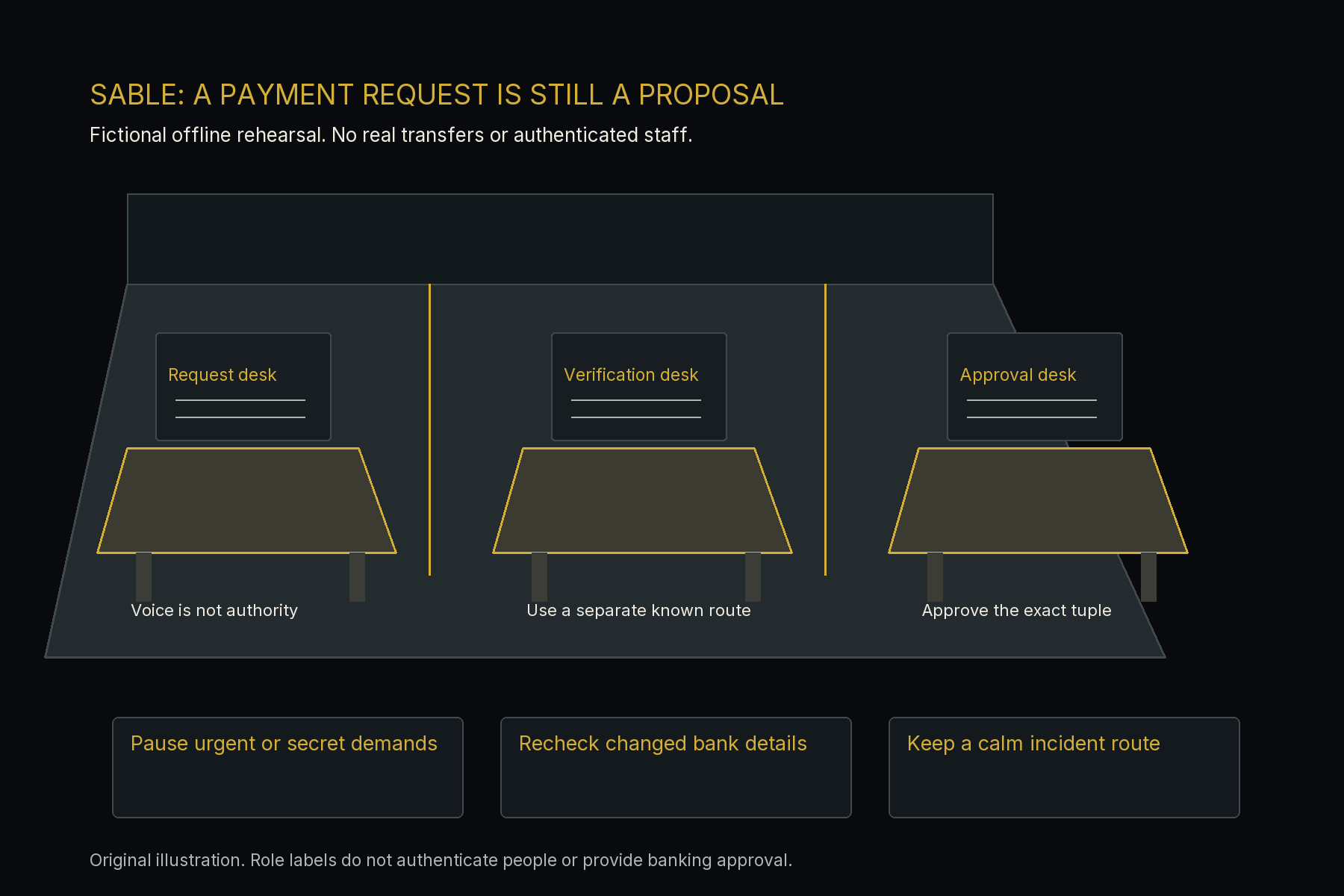
Illustration text equivalent: Original fictional treasury room with separate request, independent verification and exact-approval desks, with urgent demands and changed bank details paused. Separate the request from independently sourced verification and the exact approval decision. This is an authored teaching scene, not authenticated staff, an implemented control or a real bank.
Learn in your browser · Chapter 02 of 08
Beneficiaries, amounts, currencies and changed details
Compare the exact payment effect with maintained evidence and fictional limits.
A beneficiary is not merely a name printed above a transfer amount. A payment proposal identifies a receiving destination, supplier relationship, business obligation, amount and currency. The recipient label may look familiar while the destination differs from the maintained record. Start by comparing the exact fields rather than asking whether the message feels like the supplier. This chapter uses fictional beneficiary tokens, not real bank details. The distinction matters because the simulator can illustrate a mismatch without collecting sensitive financial identifiers or pretending that a text comparison establishes ownership of a real account.
Sable's proposed policy allows GBP, a maximum amount of 1000000 minor units and one assumed approver up to 500000 minor units. Above that threshold it requires distinct A and B labels. These are authored training thresholds, not law, bank policy or recommendations for every business. P01 is GBP4250 and therefore below the two-person threshold. P05 is GBP6500 and requires two assumed labels. P07 is GBP12000 and exceeds the maximum, even if two reviewers would agree. A review count cannot enlarge the policy limit. Keep the numerical rule and its authority source explicit in a real design discussion.
Represent money as a currency and an integer amount in that currency's agreed minor unit. Do not accept a floating-point value whose rounding changes the approved effect. The Sable examples use GBP pence consistently. P06 requests 300000 minor EUR units, while the authored allowed currency is GBP. It is held rather than converted using an invented exchange rate. A matching number does not make currencies equivalent. A production service would need actual currency definitions, fees, rounding, cut-off times and permitted products, which this course does not specify. Fixed teaching arithmetic is not a settlement quotation.
P04 demonstrates a changed-detail request. It names supplier SLATE and beneficiary BEN-NEW, but the supplied maintained directory says BEN-SLATE. The independent route is DIR-SLATE and the callback remains UNRESOLVED. The filled reconciliation row records both values and holds the proposal. It does not overwrite the directory, treat the new message as a newer authoritative master record or average the two destinations. A legitimate supplier may change its bank details, so discrepancy is not proof of criminality. It is a reason to follow the separately authorised change process and obtain evidence that actually addresses the change.
The fresh business-facing Take Five page asks staff to question changed payment information and confirm supplier details using contact information on file. The FBI BEC page similarly supports independently obtaining contact details rather than relying on those in a questionable message. These are awareness controls, not an account-ownership service. An on-file record itself can be stale or compromised. A real organisation should know who maintains that record and what evidence establishes a valid update. Sable supplies a fixed independent directory for teaching; it does not demonstrate the directory's actual security, lawful use or maintenance.
Break validation into identity, syntax, business meaning and policy. Identity connects supplier and invoice. Syntax checks that required fields have exact types and no ambiguous duplicate keys. Business meaning asks whether the obligation and beneficiary relationship are evidenced. Policy checks currency, amount, expiry and review requirements. Passing syntax alone is especially misleading: a beautifully structured JSON proposal can contain an unsupported beneficiary. Similarly, a correct amount cannot repair missing authority. Use separate disposition fields so the learner can see which gate is satisfied and which remains held. Do not add an overall green status that conceals an unresolved material condition.
The ordinary approach copies the new destination from an urgent message and asks a second person to approve the payment total. The more precise approach first freezes the proposed tuple, compares each field with maintained evidence and routes the discrepancy to the change owner. Its prompt asks for a matrix with original value, proposed value, source, consequence and needed evidence. The receiving task is reconciliation, not payment. This improves inspectability because an approver sees exactly what changed. It still cannot establish real ownership from a code-owned token or replace actual business controls with a fluent explanation.
Exact types also matter in the proposed lab. A boolean must not be treated as an integer version or amount merely because Python permits some numerical comparisons. Duplicate JSON keys must not silently select the later beneficiary while a human reviewed the earlier one. Extra fields such as ignore_limit are inert or rejected by the exact schema; they cannot instruct the application. The approved contract fixes these behaviours, and the exact offline code follows its raw and canonical binding. These are engineering requirements for the finite exercise, not claims that every malformed file has already been tested. The labelled appendix records author tests separately; independent review remains pending.
A completed P04 discrepancy note has a practical next step: the proposed supplier-master owner obtains current evidence through the maintained independent route and checks the actual beneficiary-change procedure. The note keeps the cause unknown and the payment held. It does not tell an employee to contact a suspicious number or to send a small trial payment. This course does not give real banking instructions, recommend an actual test transfer or decide reimbursement rights. A non-AI alternative is to work through the same frozen matrix manually, with the applicable organisation's genuine authority and evidence requirements.
Validation succeeds when the learner can explain why P01 passes the proposed amount/currency/directory gates, P04 fails its destination comparison, P06 fails currency and P07 fails the maximum. Those results are distinct and remain visible. The consequence of error is not just a wrong total: an agent could create a valid-looking instruction to the wrong recipient or in a different economic unit. The next chapters add independent verification and scoped approval. They cannot retroactively turn a mismatched or over-limit proposal into one that was valid when checked.
- Identify supplier and invoice separately from proposal ID.
- Compare beneficiary with the maintained directory.
- Represent money as integer minor units plus currency.
- Check the authored maximum and role threshold separately.
- Record differences and unknown cause.
- Hold unsupported change and identify proposed master-data review.
Scroll sideways to see every column.
| Proposal | Beneficiary comparison | Amount/currency | Policy fact | Paper disposition |
|---|---|---|---|---|
| P01 | BEN-EMBER equals directory | 425000 / GBP | below500000 and1000000 | candidate only |
| P04 | BEN-NEW differs from BEN-SLATE | 220000 / GBP | amount within limit | HOLD_BENEFICIARY |
| P06 | BEN-EMBER equals directory | 300000 / EUR | unsupported currency | HOLD_CURRENCY |
| P07 | BEN-CEDAR equals directory | 1200000 / GBP | above maximum | HOLD_LIMIT |
Beneficiaries, amounts, currencies and changed details
Compare the exact payment effect with maintained evidence and fictional limits.
- Supplier and invoice: Reconcile P01/P04/P06/P07 with exact supplied values. Give a concrete proposed next evidence check and owner for P04.
- Directory and money: Compare beneficiary with the maintained directory.
- Supported comparison: Check the authored maximum and role threshold separately.
- Mismatch or limit hold: Record differences and unknown cause.
- Proposed change review: Hold unsupported change and identify proposed master-data review.
- Supplier and invoice to Directory and money: Compare exact current facts
- Directory and money to Supported comparison: Only supported conditions
- Directory and money to Mismatch or limit hold: Missing or contradictory evidence
- Supported comparison to Proposed change review: Record scoped result, not real payment authority
- Mismatch or limit hold to Proposed change review: Preserve reasons and next owner
Text equivalent: Supplier and invoice leads to Directory and money. Supported current conditions lead to Supported comparison. Missing or contradictory conditions lead to Mismatch or limit hold. Both branches retain Proposed change review. Supplier and invoice: Reconcile P01/P04/P06/P07 with exact supplied values. Give a concrete proposed next evidence check and owner for P04. Directory and money: Compare beneficiary with the maintained directory. Supported comparison: Check the authored maximum and role threshold separately. Mismatch or limit hold: Record differences and unknown cause. Proposed change review: Hold unsupported change and identify proposed master-data review.
Try it yourself · Activity 02
35 min, planning estimateFilled Sable paper checkpoint 2
Reconcile P01/P04/P06/P07 with exact supplied values. Give a concrete proposed next evidence check and owner for P04. Use the fully supplied table above; all journeys are paper proposals.
- Identify supplier and invoice separately from proposal ID.
- Compare beneficiary with the maintained directory.
- Represent money as integer minor units plus currency.
- Check the authored maximum and role threshold separately.
- Record differences and unknown cause.
- Hold unsupported change and identify proposed master-data review.
Which exact missing condition would you preserve if a senior person asked you to proceed? Separate your worksheet from actual approval.
Worked answer
P01: EMBER / INV-A / BEN-EMBER / 425000 GBP minor units / version 1 / expiry day 3 matches the maintained directory and one-label tier, but needs a current check, supplied confirmed callback and A. P04: SLATE / INV-B / BEN-NEW / 220000 GBP minor units / version 1 / expiry day 3 conflicts with maintained BEN-SLATE. Hold it with cause unknown and callback unresolved. Proposed master-data owner checks the bank-detail change evidence through the independently maintained DIR-SLATE route and applicable process; no change or callback is claimed completed. P06: EMBER / INV-D / BEN-EMBER / 300000 EUR minor units / version 1 / expiry day 3 / current day 2; DIR-EMBER supplies CONFIRMED and its required assumed role is A, but EUR is not allowed. Hold without conversion or approval. P07: CEDAR / INV-E / BEN-CEDAR / 1200000 GBP minor units / version 1 / expiry day 3 / current day 2; DIR-CEDAR supplies CONFIRMED and A+B would be required if within policy, but GBP12000 exceeds GBP10000. Hold; A+B cannot enlarge the limit. No real callback, account ownership or cause of a change is established.
Scroll sideways to see every column.
| Review question | Answered key |
|---|---|
| Why bind currency with amount? | The same numeric value in different currencies or units represents a different economic effect. |
| Why is P04 held? | BEN-NEW differs from maintained BEN-SLATE and the supplied independent change result is unresolved. |
| What is a proposed next check for P04? | The supplier-master owner obtains current independent evidence about the exact beneficiary change and actual procedure. |
| Can A+B repair P07? | No; it exceeds the separate GBP10000 maximum. |
| Why reject duplicate JSON keys? | They can make reviewed and interpreted values differ; later-key selection is not reliable approval binding. |
| Does the directory prove real account ownership? | No; it is an authored training assumption with no real account identifiers. |
Apply what you learned · Practice
Explanation and answer
Hold the discrepancy and seek independent change evidence. Hold the discrepancy and seek independent change evidence. This is a bounded fictional teaching decision.
Practice only. This does not count towards your exam or certificate.
Learn in your browser · Chapter 03 of 08
Independent callback and exact request verification
Use an independently obtained route to verify the exact current request.
Independent verification concerns the route used to test a request, not how many times the same story is repeated. A reply to the questionable message, a call to its supplied number and a forwarded screenshot may all remain inside one untrusted channel. Counting them as three confirmations creates false diversity. The proposed method starts from a maintained contact source obtained separately from the incoming demand. It then asks an exact question about the payment, records what remains unresolved and keeps the decision separate from approval. No actual calls are made in Sable; routes are fictional labels.
For P01 the supplied route is DIR-EMBER and the authored callback disposition is CONFIRMED. That means the finite teaching card supports the stated routine invoice through its independent route. It does not mean a real supplier answered a telephone or that a person was authenticated. The proposed verify_request method would accept only the fixed route ID associated with the current proposal. The caller could not pass a new phone number or arbitrary confirmation narrative. This makes the exercise reproducible while exposing an important limit: code-owned confirmation is an assumption for teaching, not evidence of real-world identity.
P03 uses DIR-CEO and DENIED. P04 uses DIR-SLATE and UNRESOLVED. These are different results. Denied contradicts the supplied request, while unresolved leaves a question unanswered. Neither supports approval or a new payment effect. An unavailable contact also cannot be converted into confirmation by repeated attempts. A responsible escalation note records the route, time context and missing decision rather than inventing an answer to meet the deadline. Real contact procedures, alternative authorised routes and emergency exceptions require an actual organisational policy, not a universal shortcut suggested by a model.
The FBI's BEC guidance recommends verification of payment and account-change requests through an independently obtained contact route. Sable turns that narrow awareness principle into a proposed route-binding exercise. The route must be related to the exact supplier or claimed decision owner, not just any contact listed in a directory. A genuine switchboard conversation about the supplier's address does not by itself confirm a changed payment destination. Ask a question that covers the material change. Record the distinction between confirming that an invoice exists and approving the particular beneficiary, currency and amount requested today.
Build a verification record with proposal ID and version, directory source, route ID, exact question, supplied disposition, relevant limitations and next owner. In the paper exercise, the exact question for P04 asks whether supplier SLATE authorised BEN-NEW for INV-B at GBP2200. The result stays unresolved because the fixture supplies no completed change verification. Keep BEN-SLATE as the maintained comparison, not a newly approved destination. A record that only says supplier contacted is inadequate: another colleague cannot determine what was checked or whether the answer covered the version now awaiting approval.
Verification and approval are separate even when the same person could perform both in a small business. A verifier establishes evidence about the request; an approver considers the permitted effect under the applicable policy. The proposed lab represents their stages separately to make this visible. It does not establish secure separation of duties from two strings. Actual role appointment, account controls, human presence and independence would require specialist design and testing. A two-person rule also needs a practical route when one person is unavailable. Lack of capacity is a held condition, not authority for the software to invent a substitute.
An ordinary prompt says confirm the invoice and approve it if the caller sounds right. A precise paper prompt specifies an evidence-verification role, permits only supplied records, requires the fixed independent route, asks the exact tuple question and returns VERIFIED, DENIED or UNRESOLVED without execution. The better output should name what was checked, not claim that the entire business relationship is safe. If an assistant drafts the question, the actual authorised human still needs to use the appropriate route and record the genuine outcome. Proposed wording is not a performed control, and a written CONFIRMED label is not a signed bank mandate.
Treat the verified record as versioned evidence. If P01 changes from 425000 to 430000 minor units, the previous confirmation was about a different amount. The proposed change event clears its check, callback and approvals. A new version should not inherit verification merely because supplier and beneficiary remain the same. Conversely, keep the earlier record in the audit history so a reviewer can explain the sequence. Deleting it would make a stale approval harder to investigate. This is a change-control distinction between unusable current evidence and useful historical evidence, not an instruction to purge records under privacy law.
The exercise is designed to protect the employee's ability to challenge. A calm verification response is that the current proposal requires a separate route and an exact answer. It does not require declaring the caller a criminal. Take Five's CEO guidance encourages employees to feel comfortable approaching senior staff to verify requests. A proposed firm procedure should support that behaviour with an available escalation owner, expected response time and no penalty for a justified hold. The course supplies these as design questions, not a completed policy at any real business. Unsupported accusations and shame make evidence harder to collect.
The chapter's success condition is a complete, honest verification row. P01 has a supplied confirmed result for its exact version; P03 is denied; P04 is unresolved and mismatched. The learner should be able to show why a route from the suspicious request is not independent and why a genuine callback alone still does not authorise payment. That distinction feeds the next approval layer. If the route is unavailable or the source is doubtful, preserve the hold and the ordinary organisational escalation path. No detector score, familiar phrase or plausible voice overrides the missing evidence.
- Use the maintained route rather than contact supplied in the demand.
- Ask about the exact beneficiary, amount, currency and version.
- Record fixed supplied callback disposition honestly.
- Separate confirmation, denial and unresolved status.
- Keep approval as a later decision.
- Clear stale verification after a material proposal change.
Scroll sideways to see every column.
| Proposal | Independent route | Exact question tuple | Supplied result | Next condition |
|---|---|---|---|---|
| P01 | DIR-EMBER | INV-A / BEN-EMBER / GBP4250 / v1 | CONFIRMED | approval still needed |
| P03 | DIR-CEO | INV-CEO / BEN-MIST / GBP9800 / v1 | DENIED | hold |
| P04 | DIR-SLATE | INV-B / BEN-NEW / GBP2200 / v1 | UNRESOLVED | hold; do not update directory |
Independent callback and exact request verification
Use an independently obtained route to verify the exact current request.
- Maintained route: Supply three filled verification rows for P01/P03/P04 and explain why the incoming number cannot substitute for the route.
- Exact tuple question: Ask about the exact beneficiary, amount, currency and version.
- Supplied confirmation: Separate confirmation, denial and unresolved status.
- Denial or unknown: Keep approval as a later decision.
- Separate approval: Clear stale verification after a material proposal change.
- Maintained route to Exact tuple question: Compare exact current facts
- Exact tuple question to Supplied confirmation: Only supported conditions
- Exact tuple question to Denial or unknown: Missing or contradictory evidence
- Supplied confirmation to Separate approval: Record scoped result, not real payment authority
- Denial or unknown to Separate approval: Preserve reasons and next owner
Text equivalent: Maintained route leads to Exact tuple question. Supported current conditions lead to Supplied confirmation. Missing or contradictory conditions lead to Denial or unknown. Both branches retain Separate approval. Maintained route: Supply three filled verification rows for P01/P03/P04 and explain why the incoming number cannot substitute for the route. Exact tuple question: Ask about the exact beneficiary, amount, currency and version. Supplied confirmation: Separate confirmation, denial and unresolved status. Denial or unknown: Keep approval as a later decision. Separate approval: Clear stale verification after a material proposal change.
Try it yourself · Activity 03
35 min, planning estimateFilled Sable paper checkpoint 3
Supply three filled verification rows for P01/P03/P04 and explain why the incoming number cannot substitute for the route. Use the fully supplied table above; all journeys are paper proposals.
- Use the maintained route rather than contact supplied in the demand.
- Ask about the exact beneficiary, amount, currency and version.
- Record fixed supplied callback disposition honestly.
- Separate confirmation, denial and unresolved status.
- Keep approval as a later decision.
- Clear stale verification after a material proposal change.
Which exact missing condition would you preserve if a senior person asked you to proceed? Separate your worksheet from actual approval.
Worked answer
P01: DIR-EMBER, INV-A / BEN-EMBER / GBP4250 / version 1, supplied CONFIRMED, current approval still required. P03: DIR-CEO, INV-CEO / BEN-MIST / GBP9800 / version 1, supplied DENIED, hold. P04: DIR-SLATE, INV-B / BEN-NEW / GBP2200 / version 1, supplied UNRESOLVED plus directory mismatch, hold. A number in the incoming demand is not an independent substitute. These are fixed fictional records, not executed calls. Changed P01 version 2 requires fresh exact verification and approval.
Scroll sideways to see every column.
| Review question | Answered key |
|---|---|
| Why is a reply to the demand not independent? | It may remain within the same untrusted channel rather than the separately maintained route. |
| What should the P04 question cover? | INV-B, supplier SLATE, BEN-NEW, GBP2200 and current version 1, not just whether the company exists. |
| What differs between denied and unresolved? | Denied contradicts the request; unresolved supplies no confirmation. Both stay held. |
| What does P01 confirmation still leave needed? | Current approval over the exact tuple and other applicable conditions. |
| What happens to callback evidence after amount change? | It becomes historical and must be replaced for the changed version. |
| Does a fixed route label authenticate a person? | No; it fixes fictional input for teaching, not real identity or human presence. |
Apply what you learned · Practice
Explanation and answer
No; the callback card is authored fiction. No; the callback card is authored fiction. This is a bounded fictional teaching decision.
Practice only. This does not count towards your exam or certificate.
Learn in your browser · Chapter 04 of 08
Approval binding, two-person review and presence limits
Bind approval to the complete tuple and distinguish role labels from people.
Approval should describe the exact effect it permits. A record that says approved by finance leaves too much room for interpretation if the beneficiary, amount or version changes. In the proposed Sable method, the binding includes supplier, invoice, beneficiary, integer minor-unit amount, currency, proposal version, policy fingerprint, day and expiry. The approval layer receives current passing validation and supplied confirmation, then records the assumed role's decision over that tuple. It does not approve arbitrary future invoices or any value placed beside the same file name. Exact binding is an engineering property to test, not proof of a real person's authority.
The reserved programme outcome is to explain both what an approval event proves and what it does not prove about identity or human presence. A matching event can show that a particular payload was associated with an approval record under the tested design. It cannot alone show that an authorised human was present, understood the fields or controlled the credential. Sable uses A and B as assumed strings and makes no authentication claim. Copying a label into a record must not be represented as a second human's consent. Actual payment and authentication specialists need to review any proposed production architecture.
P05 makes the two-person threshold concrete. It is supplier CEDAR, invoice INV-C, beneficiary BEN-CEDAR, 650000 minor GBP units, version 1, expiry day 3. Because it exceeds 500000, the fictional policy requires distinct A and B. An A approval alone leaves execution held. Repeating A does not supply B, even if the two entries have different timestamps. The proposed failed execution clears current pending checks, confirmation and approvals for that proposal, so the exercise rebuilds them before recording A and B. This invalidation rule is a finite contract choice, not a universal property of banking systems.
P07 demonstrates the boundary of approval. Its GBP12000 amount is above the GBP10000 maximum. Two labels cannot authorise the application to ignore that limit. A real organisation may have a different process for higher payments, but that process is not supplied here. Hold the current proposal rather than manufacturing a higher authority or splitting it into several smaller requests. Splitting changes the economic decision and may hide aggregate risk. The paper exercise does not include such an exception. Its fixed limits are intentionally inspectable so a learner can distinguish a permitted role from an unrestricted power.
Keep approval evidence in the same economic unit as the proposal. A GBP4250 approval cannot be applied to EUR4250 or to 4250 minor units. Binding the currency string and integer amount prevents an apparent numeric match from changing the effect. Also bind the business obligation, not just the receiving destination. Two invoices payable to the same supplier can differ in entitlement, timing and duplicate status. The tuple therefore includes invoice identity. In an actual implementation, account aliases, amended invoice references and other mapping ambiguities would require evidence and review; this finite proposal does not solve them automatically.
Approval currentness has two aspects. The proposal must remain the version reviewed, and the approval must remain valid under time and revocation rules. An unchanged hash does not prevent an approval from expiring. A current date does not make a changed payload equivalent. Test these separately rather than hiding them behind a single approved boolean. The proposed state keeps validation, callback, required-role set, revocation and any synthetic effect distinct. A receipt belongs to the history of an effect; an approval belongs to a permission for a possible effect. Neither is a universal green light for another operation.
An ordinary instruction asks a model to obtain two approvals and then pay. A precise paper instruction asks it to display the exact tuple, required role set, currentness evidence and unresolved fields without contacting people or tools. A filled P05 output states A present, B absent, effect held and no actual payment. The best draft does not make the second reviewer seem optional because the first reviewer is senior. It identifies the missing independent role and proposed escalation. Prompting can make the checklist clearer, but cannot authenticate a reviewer or turn an incomplete role set into a valid permission.
Do not confuse the linked educational exam with this approval process. A twenty-question knowledge score strictly above 80 percent meets the course's score threshold: sixteen correct fails and seventeen passes. It would not demonstrate that a learner can approve payments, operate a bank API or verify a person's identity. Written practices and the capstone are ungraded. A Mickai educational knowledge certificate is conditional on the checked course's actual release and protected assessment requirements. Public exam availability depends on the completed checked release. No payment authority follows from the exam, its questions or a certificate.
For an approval failure, provide a reason that supports correction without leaking sensitive information. In the fictional worksheet, missing B is a precise gap that the proposed owner can inspect. In a real protected service, details about recipients, thresholds or credentials may themselves require access control. Sable is not an access-control product and contains no real identities. A local audit label should therefore be described honestly as teaching data, not a secure forensic record. Review the availability of human challenge and the ability to stop an agent as part of the proposed control design, separately from formatting an approval object.
The filled exercise should bind P05's exact version and show why A alone is incomplete, why A repeated is still incomplete, and why A plus B only permits a synthetic effect after all current checks. It should also show why P07 remains held regardless of that role set. Success is the ability to trace each condition to the supplied policy and identify what remains unproven. The chapter does not provide a safe universal threshold or claim that a role-labelled record demonstrates informed human presence. The next chapter explains why even a complete approval can cease to be usable.
- Show the exact current tuple.
- Require passing checks and supplied confirmed callback.
- Identify the policy-required A or A+B role set.
- Do not count repeated A as B.
- Bind approval to version, policy, day and expiry.
- Keep real identity and professional authority unverified.
Scroll sideways to see every column.
| Proposal | Exact tuple | Required labels | Current gap | Consequence |
|---|---|---|---|---|
| P05 | CEDAR / INV-C / BEN-CEDAR /650000GBP/v1 | A+B | A only: hold | rebuild before A+B |
| P07 | CEDAR / INV-E / BEN-CEDAR /1200000GBP/v1 | A+B irrelevant to maximum | limit hold | no split-payment exception |
Approval binding, two-person review and presence limits
Bind approval to the complete tuple and distinguish role labels from people.
- Current tuple: Build P05 exact approval binding and A-only/A-repeat/A+B decisions, contrasting the separate P07 limit.
- Callback and policy: Require passing checks and supplied confirmed callback.
- Distinct required roles: Do not count repeated A as B.
- Incomplete approval: Bind approval to version, policy, day and expiry.
- Bound event record: Keep real identity and professional authority unverified.
- Current tuple to Callback and policy: Compare exact current facts
- Callback and policy to Distinct required roles: Only supported conditions
- Callback and policy to Incomplete approval: Missing or contradictory evidence
- Distinct required roles to Bound event record: Record scoped result, not real payment authority
- Incomplete approval to Bound event record: Preserve reasons and next owner
Text equivalent: Current tuple leads to Callback and policy. Supported current conditions lead to Distinct required roles. Missing or contradictory conditions lead to Incomplete approval. Both branches retain Bound event record. Current tuple: Build P05 exact approval binding and A-only/A-repeat/A+B decisions, contrasting the separate P07 limit. Callback and policy: Require passing checks and supplied confirmed callback. Distinct required roles: Do not count repeated A as B. Incomplete approval: Bind approval to version, policy, day and expiry. Bound event record: Keep real identity and professional authority unverified.
Try it yourself · Activity 04
35 min, planning estimateFilled Sable paper checkpoint 4
Build P05 exact approval binding and A-only/A-repeat/A+B decisions, contrasting the separate P07 limit. Use the fully supplied table above; all journeys are paper proposals.
- Show the exact current tuple.
- Require passing checks and supplied confirmed callback.
- Identify the policy-required A or A+B role set.
- Do not count repeated A as B.
- Bind approval to version, policy, day and expiry.
- Keep real identity and professional authority unverified.
Which exact missing condition would you preserve if a senior person asked you to proceed? Separate your worksheet from actual approval.
Worked answer
P05: CEDAR / INV-C / BEN-CEDAR / 650000 GBP minor units / version 1 / expiry day 3 / day 2. Passing check and DIR-CEDAR supplied confirmation precede distinct assumed A+B. A alone or A repeated is incomplete. A failed execution clears pending evidence, so rebuild check, callback and A+B before predicting an effect. Bind exact tuple, policy, day and expiry. P07 is held at 1200000 minor GBP units despite A+B. Role strings authenticate no person or human presence and approve no real payment.
Scroll sideways to see every column.
| Review question | Answered key |
|---|---|
| What fields bind Sable approval? | Supplier, invoice, beneficiary, minor amount, currency, proposal version, policy, day and expiry. |
| Why does A repeated not equal A+B? | It does not supply a distinct required role, and role strings do not prove two actual people either. |
| What does failed A-only execution do in the proposal? | It holds and clears pending evidence for that proposal; rebuild before a later complete path. |
| What can a matching approval event prove? | A tested association with the exact payload under the stated mechanism, not authenticated human understanding. |
| Does a course certificate grant payment authority? | No; any future certificate assesses knowledge under checked conditions, not competence or identity. |
| Why retain limits separately from role count? | An approval count cannot enlarge the maximum or permitted currency. |
Apply what you learned · Practice
Explanation and answer
No; two entries for A do not supply distinct B. No; two entries for A do not supply distinct B. This is a bounded fictional teaching decision.
Practice only. This does not count towards your exam or certificate.
Learn in your browser · Chapter 05 of 08
Changed versions, expiry, revocation and stop decisions
Keep changed, expired and revoked permission separate from historical receipts.
Current approval is a temporary relationship between a proposal, policy and evidence, not a permanent property of a document. Changing an amount can invalidate the decision even if the supplier remains familiar. Expiry can invalidate an unchanged proposal. Revocation can withdraw future permission while leaving a completed historical effect untouched. These mechanisms have different causes and consequences. A system that treats all three as deletion cannot explain whether money already moved or why a pending effect is now held. The course therefore preserves distinct proposal versions, revocation markers and historical receipts in its paper model.
P01's only proposed fixed change is CHANGE_AMOUNT, from 425000 to 430000 minor GBP units. It increments P01 from version 1 to version 2 and clears its current check, callback and approvals. It does not silently change P02, which is a separate received copy of the original invoice proposal. The old approval covered GBP4250; version 2 proposes GBP4300. Calling the difference small is not evidence that approval transfers. The filled ledger retains both values, labels the old evidence historical and requests a fresh exact-version check, callback and approval. No genuine invoice has been amended.
If the original business obligation was already executed synthetically, a changed payload creates another problem beyond stale approval. The effect ledger for supplier EMBER and invoice INV-A already binds an exact payload. A later request for the same business identity at a different amount is a conflict, not an invitation to create a second effect. Fresh approval of version 2 must not reset the business duplicate record. A real amended obligation might need a distinct, reviewed accounting process. That process is absent from this proposal, so the simulator contract holds the conflict rather than inventing credit, refund or top-up mechanics.
Expiry is inclusive in Sable: a proposal with expiry day 3 may use current evidence on day 3; day 4 is too late for a new effect. P08 expired on day 1 and is already held at the initial day 2. These are integer teaching days, not real banking cut-offs or time-zone rules. The proposed advance_day method moves forward only and clears current checks, callbacks and approvals. Moving to day 4 cannot extend an old expiry. Renewal or resume must not turn an expired obligation into one that was reviewed for a new date. No external clock or settlement calendar is connected.
Revocation is proposal-scoped in Sable: revoke marks the exact current proposal revoked and clears its pending checks, callback and approvals. Its own subsequent execute calls hold before fixture I/O, including duplicate attempts. Existing effects, retry-key associations, event history and earlier copies remain; revocation is not refund, bank recall or remote erasure. An independently rebuilt P02 alias is not automatically revoked when P01 is revoked. If P02 is nonrevoked, unexpired and has its own current passing check, fixed-route confirmation and required approvals in an open session, its identical stable payload may retrieve the retained effect with zero new effects. No alias can change that payload or bypass its own gates. A revoked or otherwise ineligible proposal can inspect historical receipt evidence through audit_copy, not execute. Global stop and expiry deny eligibility separately; a fresh process still resets local revocation and history.
Stop is broader than one proposal. It prevents new synthetic effects and clears all pending checks, callbacks and approvals while retaining effect history. Resume reopens only the educational session and still requires fresh evidence. It cannot restore an expired proposal, remove revocation or enlarge a limit. This distinction makes continuity practical: the user can inspect historical facts and restart permitted work without assuming that every pending request is still valid. In a production design, controls to stop an actual integration, revoke real credentials and reconcile in-flight operations would need specialised evidence not supplied by these local method names.
Failure handling also needs precision. A call whose Python signature binds can fail validation inside the method and invalidate dependent pending state under the proposed rules. A missing or unknown argument may raise TypeError before the method body, leaving state unchanged. Neither event is an executed payment. Avoid teaching that every failed exposed call clears approvals. The exact finite contract should identify which cache is cleared and which substantive state survives. Tests would then challenge that boundary after implementation. These worked examples are paper expectations. The labelled appendix separately records the author test run; independent acceptance remains pending.
An ordinary prompt asks the assistant to update the amount and keep the approval because the director already said yes. A precise paper prompt freezes the original and changed tuples, marks current evidence invalid, checks for a prior business effect and returns a held recovery plan. It names fresh verification and approval as conditions, not completed actions. A valid-looking narrative cannot waive an old version mismatch. The non-AI route is the same ledger comparison and accountable owner decision. The question is not whether an AI is confident; it is whether the exact requested effect is supported now.
Copy survival is a further limit. A caller may retain an earlier returned object after stop or revocation. Deep copying prevents that object from altering the application's stored state through the return value, but does not delete the copy or keep it confidential. A fresh process would reset the proposed in-memory state, including revocation, clock and effect ledger. Consequently this lab cannot establish durable revocation or cross-process duplicate prevention. Public teaching should make this reset visible rather than presenting a restarted simulation as evidence that the real business obligation is unexecuted again.
The exercise succeeds when the learner distinguishes changed payload, expiry, revocation, stopped mode and receipt history. Its filled answer says version 1 cannot approve version 2; day 4 cannot produce a new effect under expiry 3; resume does not restore evidence; and an old completed receipt does not prove a fresh permission. It also preserves the need for actual bank escalation if a real transfer occurred. None of these controls certainly prevents every fraud. They make specific failure boundaries explicit so an authorised team can evaluate and test an actual design.
- Compare original and changed tuples.
- Invalidate current pending evidence after the fixed change.
- Retain prior effect and key history.
- Apply inclusive expiry and revocation separately.
- Stop new effects, then resume only with fresh evidence.
- Document old-copy and new-process limits.
Scroll sideways to see every column.
| State | Value/time | Current permission | History |
|---|---|---|---|
| P01 before | 425000GBP / v1 | approval bound to original | historical after change |
| P01 after | 430000GBP / v2 | fresh check/callback/approval | conflict if INV-A effect exists |
| Expiry | day3 inclusive;day4 expired | no new effect | oldreceipt retained |
| Revocation | future permission removed | no refund | history retained |
Changed versions, expiry, revocation and stop decisions
Keep changed, expired and revoked permission separate from historical receipts.
- Old and changed tuple: Give a filled old/new P01 ledger plus day3/day4, revocation, stop/resume and fresh-process distinctions.
- Current version and day: Invalidate current pending evidence after the fixed change.
- Fresh eligibility: Apply inclusive expiry and revocation separately.
- Revoked or expired hold: Stop new effects, then resume only with fresh evidence.
- Retained historical audit: Document old-copy and new-process limits.
- Old and changed tuple to Current version and day: Compare exact current facts
- Current version and day to Fresh eligibility: Only supported conditions
- Current version and day to Revoked or expired hold: Missing or contradictory evidence
- Fresh eligibility to Retained historical audit: Record scoped result, not real payment authority
- Revoked or expired hold to Retained historical audit: Preserve reasons and next owner
Text equivalent: Old and changed tuple leads to Current version and day. Supported current conditions lead to Fresh eligibility. Missing or contradictory conditions lead to Revoked or expired hold. Both branches retain Retained historical audit. Old and changed tuple: Give a filled old/new P01 ledger plus day3/day4, revocation, stop/resume and fresh-process distinctions. Current version and day: Invalidate current pending evidence after the fixed change. Fresh eligibility: Apply inclusive expiry and revocation separately. Revoked or expired hold: Stop new effects, then resume only with fresh evidence. Retained historical audit: Document old-copy and new-process limits.
Try it yourself · Activity 05
35 min, planning estimateFilled Sable paper checkpoint 5
Give a filled old/new P01 ledger plus day3/day4, revocation, stop/resume and fresh-process distinctions. Use the fully supplied table above; all journeys are paper proposals.
- Compare original and changed tuples.
- Invalidate current pending evidence after the fixed change.
- Retain prior effect and key history.
- Apply inclusive expiry and revocation separately.
- Stop new effects, then resume only with fresh evidence.
- Document old-copy and new-process limits.
Which exact missing condition would you preserve if a senior person asked you to proceed? Separate your worksheet from actual approval.
Worked answer
P01 original = 425000 GBP minor units / version 1; changed = 430000 GBP minor units / version 2. CHANGE_AMOUNT clears current check, callback and approval. Old-version and unverified new-version executions hold. If EMBER / INV-A already has its original effect, the changed payload remains held even after fresh approval. Day 3 expiry is inclusive; day 4 holds every execution including a duplicate. Revocation is not a refund. Stop clears pending evidence, resume requires fresh evidence, and neither deletes prior effects. Historical receipts are available only through audit_copy when execution is ineligible. Earlier copies survive; a fresh process resets mutable day, revocation, versions and effects, proving no durable control.
Scroll sideways to see every column.
| Review question | Answered key |
|---|---|
| Why does version 1 approval not cover version 2? | The exact amount changed from 425000 to 430000 GBP minor units; current evidence is invalidated. |
| Can day3 expiry work on day3? | Yes, inclusively under the proposed fictional rule; day 4 is too late for a new effect. |
| Does revoke reverse a completed effect? | No; it removes future permission and retains historical receipts/effects. |
| What does resume mean? | Only reopen the educational session, clearing pending evidence rather than restoring permissions. |
| How does pre-body TypeError differ? | It may occur before state-changing validation code, leaving prior state unchanged. |
| What does fresh-process reset fail to establish? | Durable revocation or cross-process duplicate prevention. |
Apply what you learned · Practice
Explanation and answer
No; fresh evidence cannot remove those prohibitions. No; fresh evidence cannot remove those prohibitions. This is a bounded fictional teaching decision.
Practice only. This does not count towards your exam or certificate.
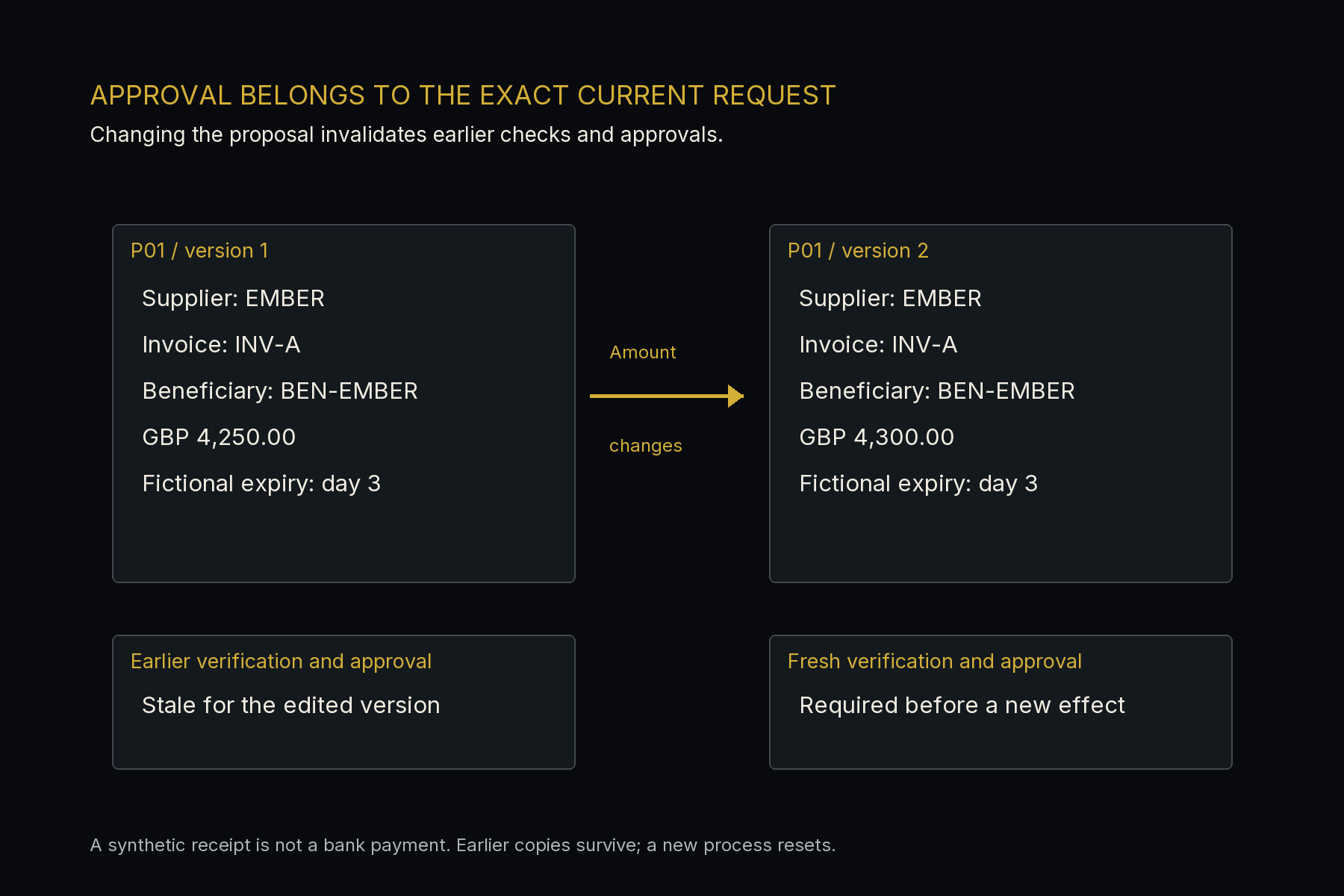
Illustration text equivalent: Fictional P01 changes from version1 GBP4250 to version2 GBP4300; earlier checks and approval become stale and fresh verification is required. The original Sable example changes only the amount. Earlier approvals do not follow the edited request. No real money, settlement or banking assurance is produced.
Learn in your browser · Chapter 06 of 08
Duplicate effects, retries and recoverable receipts
Control one economic effect while recovering an exact historical outcome.
A retry is not automatically a new payment request. Software can lose a response after a successful effect, users can press again and a message can arrive twice. If the system creates another effect each time, a technically valid request can still overpay an obligation. If it simply marks every repeat invalid without retaining a recoverable receipt, the operator may not know whether the first effect occurred. The proposed Sable design separates an economic business identity, an exact payload, an idempotency key and a historical receipt. That separation is the core of this chapter, rather than a claim of real bank settlement.
The business identity in the fictional cases is supplier plus invoice. P01 and P02 both identify EMBER and INV-A and carry the same beneficiary, amount and currency. They are two received copies of one economic proposal. P01 can use key K1 and P02 key K2 in the paper exercise; the exact same business payload must still yield only one synthetic effect. Merely requiring the key to be new or unchanged would miss this alias problem. A request ID identifies a software object, while the business reference identifies the obligation being controlled. Actual mapping requires a genuine accounting model, not guessed invoice similarity. The stable payload also includes proposal version, expiry and the fixed policy fingerprint. The alias proposal ID, retry key and current teaching day are excluded. Current day still binds approval freshness and is retained in receipt metadata.
The proposed first execution stores a business payload and receipt. A repeated exact payload returns that receipt and adds no effect, whether the retry has the same permitted key or a different key associated with the same business identity. A key already used for a different identity is held. A changed amount under the same business identity is also held, even if new approvals exist. These are explicit finite choices. They need separate independent challenge before acceptance, and they do not claim to solve partial settlement, refunds, currency conversion, distributed concurrency or a real bank's transaction semantics.
Receipt recovery and current execution are different operations. Suppose a completed day-2 synthetic effect has a stored receipt and the pending proposal is later revoked. execute_synthetic must now hold, even when the proposed payload and retry key match the original. The copied audit can show the historical receipt without creating an effect or restoring permission. The same rule applies after expiry or stop. A still-eligible exact retry requires the current complete check, confirmed callback and all required assumed approval roles; only then can it return the original effect. This precedence prevents a duplicate path from bypassing the authority gate. A changed payload remains a conflict, and no receipt establishes bank settlement.
Do not clear the effect ledger when changing a proposal, stopping the session or invalidating approval. That would erase the application's knowledge of the completed synthetic business effect and make a later retry appear new. Pending evidence is replaceable; effect history and key association serve a different purpose. The proposed exposed interface retains them until the process ends. A restart is therefore a hard limit, not a recovery mechanism. The fresh child process would start with no effects or keys. Production exactly-once behaviour would require durable transaction design, reconciliation and institution-specific handling beyond this course's finite local exercise.
Review the ambiguity of response failures. A client that never received a receipt cannot infer that no effect occurred. It should inspect or recover the exact known outcome through a controlled route rather than alter the amount or key until something succeeds. In Sable there is no network, so no actual timeout is simulated as bank uncertainty. The paper scenario describes the principle and requests an exact retry ledger. A future local test may lose a returned copy deliberately to inspect in-memory recovery, but that would not reproduce a bank connection, settlement timing or a distributed outage.
An ordinary prompt asks the agent to retry the transfer until it succeeds. A precise paper prompt identifies the original business identity, exact payload and known receipt state; it asks whether a new effect is permitted and preserves unknown outcome as a hold. The best answer does not propose splitting payments or changing identifiers to get past a duplicate check. Those are changes to the economic request. Its output includes previous effect ID, supplied payload match, key conflict, current-new-effect permission and next owner. If there is no reliable history, the answer remains uncertain rather than declaring that another attempt is safe.
Audit counts should distinguish effect creation from receipt retrieval. A successful first execution adds one effect. An exact retry adds zero effects but may add a receipt-read event under the proposed audit contract. Proposal checks, callback records and approvals also create educational events without moving money. Counting all events as payments would fabricate activity; counting distinct keys as effects would misrepresent P01/P02. A reviewer needs both the event sequence and the business-effect count, with definitions visible. Source-read counters similarly count whole-file loader attempts and completions, not verified suppliers or actual telephone contacts.
Deep-copy isolation makes this exercise inspectable without claiming secure records. A learner may change an amount in a returned receipt object; the stored business payload should remain unchanged through that object. Direct mutation of internal Python attributes is still possible, and the fixture on disk is not an enforced secure store. The reserved capstone's immutable-log ambition is therefore qualified: the proposed exposed methods only append original events, while audit_copy returns a copy. It is not cryptographically authenticated immutable storage or forensic proof of user identity. A matching local record can remain false about the real world.
A filled retry answer records P01/K1 as the first exact business effect, P02/K2 as an alias retrieving that same effect and repeated P01/K1 as another receipt retrieval. The effect count remains one. It separately holds a GBP4300 payload for INV-A after the GBP4250 effect and a reused K1 attached to another invoice. Success means explaining the economic reason for each result, not memorising a label. Every claim here remains about the proposed finite simulator; no banking action, real retry, settlement reconciliation or durable duplicate assurance has been executed.
- Identify the economic supplier/invoice obligation.
- Compare exact payload, not just request ID or key.
- Create one proposed synthetic effect for a complete first request.
- Return the same historical receipt for exact business retries.
- Hold changed payload and cross-identity key reuse.
- Separate effect creation, receipt reads and event counts.
Scroll sideways to see every column.
| Attempt | Business identity | Payload | Paper result | Effects |
|---|---|---|---|---|
| P01/K1 | EMBER / INV-A | 425000GBP / BEN-EMBER | first exact effect | effect count1 |
| P02/K2 | EMBER / INV-A | same exact payload | same receipt | effect count1 |
| P01/K1 retry | same business/payload | same exact payload | same receipt | effect count1 |
| P01 v2 | EMBER / INV-A | 430000GBP | conflict held | effect count1 |
Duplicate effects, retries and recoverable receipts
Control one economic effect while recovering an exact historical outcome.
- Business obligation: Complete P01/K1, P02/K2 and exact retry effect ledger, then changed-payload and key-conflict cases.
- Stable effect payload: Compare exact payload, not just request ID or key.
- Eligible exact retry: Return the same historical receipt for exact business retries.
- Key or payload conflict: Hold changed payload and cross-identity key reuse.
- One retained effect: Separate effect creation, receipt reads and event counts.
- Business obligation to Stable effect payload: Compare exact current facts
- Stable effect payload to Eligible exact retry: Only supported conditions
- Stable effect payload to Key or payload conflict: Missing or contradictory evidence
- Eligible exact retry to One retained effect: Record scoped result, not real payment authority
- Key or payload conflict to One retained effect: Preserve reasons and next owner
Text equivalent: Business obligation leads to Stable effect payload. Supported current conditions lead to Eligible exact retry. Missing or contradictory conditions lead to Key or payload conflict. Both branches retain One retained effect. Business obligation: Complete P01/K1, P02/K2 and exact retry effect ledger, then changed-payload and key-conflict cases. Stable effect payload: Compare exact payload, not just request ID or key. Eligible exact retry: Return the same historical receipt for exact business retries. Key or payload conflict: Hold changed payload and cross-identity key reuse. One retained effect: Separate effect creation, receipt reads and event counts.
Try it yourself · Activity 06
35 min, planning estimateFilled Sable paper checkpoint 6
Complete P01/K1, P02/K2 and exact retry effect ledger, then changed-payload and key-conflict cases. Use the fully supplied table above; all journeys are paper proposals.
- Identify the economic supplier/invoice obligation.
- Compare exact payload, not just request ID or key.
- Create one proposed synthetic effect for a complete first request.
- Return the same historical receipt for exact business retries.
- Hold changed payload and cross-identity key reuse.
- Separate effect creation, receipt reads and event counts.
Which exact missing condition would you preserve if a senior person asked you to proceed? Separate your worksheet from actual approval.
Worked answer
Fresh paper ledger: complete P01 / K1 predicts effect SYNTHETIC-1 for EMBER / INV-A / BEN-EMBER / 425000 GBP minor units / version 1 / expiry day 3 / fixed policy. Complete exact P02 / K2 retrieves SYNTHETIC-1, zero new effects. Eligible exact P01 / K1 retry returns the same receipt, total one effect. Current day binds approval but is excluded from stable effect identity, alongside alias ID and retry key. Changed 430000 payload for INV-A holds. K1 reused for another business identity holds. The revoked proposal, any expired proposal and every proposal during global stop holds on execute, even for an exact duplicate. audit_copy retains its historical receipt. Revoking P01 does not revoke P02: separately rebuild nonrevoked unexpired P02 check, DIR-EMBER confirmation and A in the open session, then its exact stable payload can retrieve SYNTHETIC-1 with zero new effects. This is no fresh banking permission or durable business-wide revocation. A fresh process loses in-memory history, so no durable exactly-once or banking assurance follows.
Scroll sideways to see every column.
| Review question | Answered key |
|---|---|
| Why treat P01/P02 as one business identity? | They share supplier EMBER and invoice INV-A with the exact same economic payload. |
| Why is a different key not enough for a new effect? | A new key does not create another supported business obligation. |
| What if the same identity has a different amount? | Hold the payload conflict; fresh approval does not erase prior effect history. |
| Why preserve effect history during stop? | Otherwise a repeated completed obligation could appear new. |
| Can execute retrieve a receipt after expiry or revocation? | No. Every execute needs current full eligibility. audit_copy can retain the historical receipt with no new effect or authority. |
| Is the local event log immutable secure storage? | No; append-only exposed operations and copies do not secure mutable memory or survive a fresh process. |
Apply what you learned · Practice
Explanation and answer
One; same economic identity and payload retrieves the receipt. One; same economic identity and payload retrieves the receipt. This is a bounded fictional teaching decision.
Practice only. This does not count towards your exam or certificate.
Learn in your browser · Chapter 07 of 08
Bank escalation, evidence and employee protection
Prepare a calm factual response without contacting banks or blaming staff.
If a real suspicious payment may have been sent, prevention teaching must turn into a calm, prompt response rather than a debate about whether the voice was AI-generated. The first practical priority is to contact the financial institution through an independently obtained official route and explain the suspected transaction. Bank action, recovery and further escalation depend on actual circumstances and institution processes. This course does not promise a recall, refund or reimbursement. Its incident exercise uses an invented effect and placeholders, with no real account data or contact. The worksheet prepares questions and evidence for the appropriate owner, not a live banking instruction.
The freshly read FBI BEC page advises immediate financial-institution contact in its US context. Take Five business guidance also directs prompt bank contact if fraud is suspected. The NCSC's consumer payment-response section distinguishes Report Fraud for England, Wales and Northern Ireland from Police Scotland. The current Report Fraud home confirms that territorial split and directs people in Scotland via 101. It also gives immediate telephone guidance for organisations under cyber attack. These are current awareness/reporting references, not universal business legal duties or a substitute for checking the operative local route when an actual incident occurs.
Keep the response record factual. Record who noticed the issue, when it was noticed, which proposal or business reference is affected, what effect is known and what remains uncertain. Do not write that a bank transfer settled merely because an internal receipt exists. Separate request time, approval time, attempted effect, reported bank status and observed recovery. Sable has only a synthetic receipt, so every real banking field remains not performed or unknown. The proposed owner should be able to hand off that distinction without guessing a loss amount or making an allegation against an employee, executive or supplier.
Evidence preservation is a scoped handling task. Keep original relevant messages and metadata through the organisation's appropriate protected process, rather than repeatedly forwarding them to wide groups or copying private information into an AI service. Do not edit a suspicious original to make it easier to read and then lose the received version. A labelled working summary can explain the chronology while pointing to the preserved original. Actual access, retention, legal hold, personal-data basis and disclosure decisions remain for appropriate owners. This course supplies no blanket retention period, forensic acquisition procedure or permission to publish recordings.
Separate containment of a payment workflow from containment of a possibly compromised account. An impersonated request may involve spoofing, an account takeover or another route, but a message alone does not establish which occurred. The proposed response asks security staff to inspect actual evidence through their authorised process and stops new payment proposals at the established treasury boundary. It does not tell an employee to run arbitrary tools, contact the suspected attacker or experiment with credentials. A bank recall request and an internal account-security response can proceed as distinct workstreams without claiming that either proves the other's completion.
Employee protection is part of effective evidence gathering. A person who reports uncertainty early should not be required to prove that a scam occurred before raising it. Ask what information was received, what process was followed and what help is needed, rather than why the person failed to detect a fake voice. Preserve the right to pause a senior request and escalate quietly through the genuine owner. The proposed debrief examines missing capacity, unclear exceptions, contact maintenance and approval design. It does not use surprise deception against learners or call a participant negligent based on a fictional tabletop decision.
The brief includes a reported Italian incident only as a short attributed news context. Root read Reuters reporting in syndicated form and contrasting ANSA coverage; this author did not independently retrieve those articles. Sources reportedly described about EUR95 million transferred after executive/lawyer impersonation and apparent WhatsApp instructions, with alleged AI voice replication; the bank declined comment. Reported EUR53 million recovered plus EUR36 million missing totals EUR89 million and does not reconcile EUR95 million. Do not present exact net losses, a definitive recovery balance, a verified no-hack conclusion or proof that these controls would certainly have prevented that particular incident.
An ordinary incident prompt asks a model to find the fraudster, calculate the loss and send a warning to everyone. A precise paper prompt assigns a response-docket role, supplies only fictional transaction tokens, prohibits external contacts and asks for known facts, unknown bank status, preserved-evidence references and proposed owners. Its output identifies immediate independent bank escalation as a real-use action for authorised staff, not an action already performed by the lesson. It avoids naming real individuals and separates security, treasury, privacy and staff-support questions. A clear draft is useful only when its unresolved fields remain visible.
The filled Sable response dossier for a hypothetical mistaken external transfer labels the scenario as outside Sable execution, because the existing offline lab never performs an external transfer. It contains a proposed bank-contact owner, supplier-change hold, evidence custodian, security triage owner and employee support contact function, all without real names or numbers. It records that amount, beneficiary and bank outcome need actual confirmation. It does not claim a successful bank freeze or completed police report. Recovery offers received through the suspicious channel remain unverified; a promise to recover money is another request to check independently, not a new trusted route.
Success is a usable handover that preserves urgency without fabricating certainty. The learner distinguishes bank contact from reporting, actual effect from internal approval, original evidence from summary and suspected compromise from proved mechanism. It also provides a supportive response rather than blame. Before applying the worksheet in a real business, the organisation needs current bank contacts, territorial reporting routes, appropriately protected evidence handling and accountable specialist review. The final chapter combines prevention, lifecycle and incident questions into a complete educational acceptance pack while keeping real payment and investigation authority outside the course.
- Separate known payment status from internal records.
- Prepare independent official bank contact for authorised staff.
- Select current territorial reporting routes.
- Preserve relevant originals through protected evidence handling.
- Assign proposed treasury, security and evidence owners.
- Support staff without blame and retain unknown outcomes.
Scroll sideways to see every column.
| Surface | Known/unknown | Proposed owner | Evidence/limit |
|---|---|---|---|
| Bank status | Not known from Sable | proposed treasury owner | official independently obtained route |
| Evidence | Originals and labelled summary separate | proposed protected evidence owner | access/retention unknown |
| Security | mechanism not established | proposed security owner | no forensic conclusion |
| Staff | report uncertainty without blame | proposed manager/support function | no participant deception |
Bank escalation, evidence and employee protection
Prepare a calm factual response without contacting banks or blaming staff.
- Suspected transaction: Prepare a filled hypothetical bank/evidence/security/staff handover without actual contact or invented loss.
- Independent bank route: Prepare independent official bank contact for authorised staff.
- Factual protected handover: Preserve relevant originals through protected evidence handling.
- Unknown bank outcome: Assign proposed treasury, security and evidence owners.
- Staff support and owners: Support staff without blame and retain unknown outcomes.
- Suspected transaction to Independent bank route: Compare exact current facts
- Independent bank route to Factual protected handover: Only supported conditions
- Independent bank route to Unknown bank outcome: Missing or contradictory evidence
- Factual protected handover to Staff support and owners: Record scoped result, not real payment authority
- Unknown bank outcome to Staff support and owners: Preserve reasons and next owner
Text equivalent: Suspected transaction leads to Independent bank route. Supported current conditions lead to Factual protected handover. Missing or contradictory conditions lead to Unknown bank outcome. Both branches retain Staff support and owners. Suspected transaction: Prepare a filled hypothetical bank/evidence/security/staff handover without actual contact or invented loss. Independent bank route: Prepare independent official bank contact for authorised staff. Factual protected handover: Preserve relevant originals through protected evidence handling. Unknown bank outcome: Assign proposed treasury, security and evidence owners. Staff support and owners: Support staff without blame and retain unknown outcomes.
Try it yourself · Activity 07
35 min, planning estimateFilled Sable paper checkpoint 7
Prepare a filled hypothetical bank/evidence/security/staff handover without actual contact or invented loss. Use the fully supplied table above; all journeys are paper proposals.
- Separate known payment status from internal records.
- Prepare independent official bank contact for authorised staff.
- Select current territorial reporting routes.
- Preserve relevant originals through protected evidence handling.
- Assign proposed treasury, security and evidence owners.
- Support staff without blame and retain unknown outcomes.
Which exact missing condition would you preserve if a senior person asked you to proceed? Separate your worksheet from actual approval.
Worked answer
Hypothetical handover: known = fictional proposal tokens and a synthetic internal receipt; actual bank status, settlement and loss = UNKNOWN. Proposed treasury owner promptly contacts the bank through an independently obtained official route if a real suspected transfer occurred. No contact is performed here. Proposed evidence owner preserves relevant originals and a separate labelled chronology under actual access, retention and disclosure review. Security owner inspects possible mechanisms without declaring compromise or a no-hack finding. Manager or support function encourages early factual reporting without blame. ReportFraud E/W/NI and Scotland 101 remain distinct; US IC3 is not a UK route. No recovery outcome or personal data is supplied.
Scroll sideways to see every column.
| Review question | Answered key |
|---|---|
| What is first priority if a real suspicious transfer may have occurred? | Prompt independent official bank contact by authorised staff, not waiting to diagnose AI audio. |
| What can the bank-contact worksheet not promise? | Recall, reimbursement, recovery or settlement facts. |
| Which territorial reporting distinction is retained? | ReportFraud serves England, Wales and Northern Ireland; Scotland route differs, currently 101 on the official home. |
| Why preserve originals and a separate summary? | Editing or widely forwarding evidence can lose context or expose information; actual handling needs protected ownership. |
| What does EUR53m+EUR36m establish? | It totals89m, not95m; news figures do not establish reconciled net loss or bank forensic findings. |
| How should the employee debrief begin? | With factual chronology and support, not blame or a demand to prove fraud before reporting. |
Apply what you learned · Practice
Explanation and answer
No; actual institution status needs separate evidence. No; actual institution status needs separate evidence. This is a bounded fictional teaching decision.
Practice only. This does not count towards your exam or certificate.
Learn in your browser · Chapter 08 of 08
A complete payment-control and impersonation capstone
Reconcile all eight cases and preserve the difference between paper and execution.
A complete payment-control pack is not a pile of positive checks. It preserves every proposal, including rejected or unresolved cases, and explains how the decision changes with version, time, revocation and duplicate history. The Sable capstone begins with all eight authored proposals and a clearly labelled initial day 2. It supplies exact minor-unit values, currency, beneficiary tokens, callback cards and the fictional policy. The learner builds a paper admission register, approval matrix, retry ledger and incident handover. The separate appendix records author execution of the offline simulator. Filling these paper documents does not assert execution, independent acceptance, fraud detection or bank safety.
The initial register makes P01 a candidate for a synthetic effect after current checks, DIR-EMBER confirmation and A approval. P02 is an exact alias of the same business obligation, not another payable invoice. P03 is callback denied; P04 has a beneficiary discrepancy and unresolved callback; P06 has an unsupported currency; P07 exceeds the maximum; P08 is already expired. P05 can be a candidate after current confirmation and distinct A and B. A candidate label means prerequisites remain to be supplied in the proposed workflow. It is not approval from this chapter or evidence that real money can be sent.
Choose a test question before describing a passed result. To test binding, change one material field and keep the old approval, then predict a hold. To test expiry, use day 3 and day 4 separately. To test duplicates, send exact business identity and payload through P01 and P02 with different keys, then predict one effect. To test role separation, repeat A and show that B is still missing. To test stop and resume, preserve effect history while clearing pending evidence. Each test has a distinct purpose. Repeating many easy valid checks does not test the consequence of a changed beneficiary or a missing receipt.
The proposed test log needs original event order, operation, proposal/version, disposition and defined effect count. It should also record actual failures and skipped checks after implementation, rather than suppress them to make a release look complete. The reserved specification requests an immutable log; this proposal transparently limits that to append-only events through the exposed methods and copied audit output. Mutable Python internals, local files and fresh-process resets prevent a secure immutability claim. A production ledger would require specialist authentication, storage, concurrency and recovery design. The paper capstone should state that gap directly, not hide it under an impressive checksum. Event sequence, synthetic-effect count and complete physical fixture-read count have separate definitions: a check, held result or eligible receipt retry can add an event without another effect; a whole-file read does not mean a verified supplier or actual call. A fresh process resets the local clock, proposal changes, revocation, keys, effects and event history. It does not make the real economic obligation new or establish durable duplicate prevention.
Keep source evidence distinct from teaching evidence. The primary references support recognising impersonation pressure, independently verifying requests, checking payment changes and contacting the appropriate bank/reporting route. They do not prescribe Sable's exact GBP5000/GBP10000 thresholds, twelve proposed signatures or business identity tuple. Those are authored choices in the refined root-approved educational contract, not official banking rules. Similarly, the reported Italian case is news context, not a benchmark or a forensic result. The source register states retrieval dates and jurisdiction limits. A learner can inspect why a statement is supported without assuming that a named agency approved the whole exercise.
A full acceptance record has separate states: authored teaching, source scope checked, contract proposed, implementation approved, author tests executed, other-author semantic review, independent runtime challenge, package transport, native browser, PDF, exam engine and public release. None implies the next. The refined contract, original code, author tests and exact four-file transport have been completed; other-author teaching review, independent runtime challenge and native assessment/publication acceptance remain. A future public assessment still needs its actual engine and route checks. Study time is an unpiloted estimate, and the capstone/written practice is ungraded. Do not describe an intended knowledge certificate as proof of identity, payment competence, banking authorisation or professional accreditation.
The ordinary capstone prompt asks whether Sable is safe and requests a release badge. A precise paper prompt asks for the eight-row disposition register, exact current tuple/required-role matrix, alias/conflict retry ledger, lifecycle counterexample and bank-response handover, all with held real-use flags. Its verification step compares every row with supplied facts and lists missing implementation evidence. Its failure response keeps uncertain outcomes held. The output is useful because another reviewer can identify a particular missing condition. It does not reduce the entire course to a confidence score or count the existence of an exercise as an executed test.
The filled sequence for P01 predicts check, fictional verification, A approval and first synthetic effect under K1, followed by exact P02/K2 receipt retrieval with effect count still one. It then applies the fixed amount change to P01 and holds the changed INV-A payload against the existing business effect. A separate fresh P05 journey demonstrates A-only failure and rebuilt A+B completeness. P03/P04/P06/P07/P08 remain held for their distinct reasons. A stopped or expired state cannot create a new effect. These paper expectations require current eligibility for every duplicate and are separate from the labelled author-run appendix and any banking execution.
Prepare readable teaching and discovery inputs without exaggerating the release. The reserved title remains Controlling payment proposals from financial AI agents, with a direct subtitle about AI voice fraud and CEO-payment impersonation. Focused questions address independent callback, changed bank details, exact approval and duplicate retries. Visible answers and future Course/Person/Breadcrumb metadata should agree on author, audience and knowledge-only scope. Useful FAQs do not imply eligibility for deprecated FAQ rich results. Sitemap inclusion, search submission, indexing and AI citation are separate facts; no special GEO or AEO badge establishes ranking, safety or professional approval.
The final teach-back is a clear operational boundary: a model can help organise a permitted proposal, but it cannot supply the missing authority, independent evidence or accounting history. A familiar voice may prompt a conversation; it does not remove approval gates. An exact local receipt may identify a synthetic outcome; it does not prove settlement. An educational course can improve how questions are framed without certifying a live financial system. Preserve all these distinctions in the release dossier and seek the actual payments, authentication, legal, privacy and organisational review required for any real implementation.
- Complete all eight disposition rows.
- Bind every approval and hold to exact supplied evidence.
- Fill alias and changed-payload retry ledgers.
- Challenge expiry, revocation, stop and reset separately.
- Prepare a calm bank-response handover.
- Distinguish completed author and finite mechanics evidence from remaining content, transport and release acceptance.
Scroll sideways to see every column.
| Proposal | Business identity | Beneficiary | Minor amount/currency | Version/expiry | Initial paper disposition |
|---|---|---|---|---|---|
| P01 | EMBER/INV-A | BEN-EMBER | 425000 GBP | 1/3 | SYNTHETIC_READY |
| P02 | EMBER/INV-A | BEN-EMBER | 425000 GBP | 1/3 | ONE_BUSINESS_EFFECT_WITH_P01 |
| P03 | MIST/INV-CEO | BEN-MIST | 980000 GBP | 1/3 | HOLD_CALLBACK |
| P04 | SLATE/INV-B | BEN-NEW | 220000 GBP | 1/3 | HOLD_BENEFICIARY |
| P05 | CEDAR/INV-C | BEN-CEDAR | 650000 GBP | 1/3 | SYNTHETIC_READY_AFTER_TWO_ASSUMED_APPROVERS |
| P06 | EMBER/INV-D | BEN-EMBER | 300000 EUR | 1/3 | HOLD_CURRENCY |
| P07 | CEDAR/INV-E | BEN-CEDAR | 1200000 GBP | 1/3 | HOLD_LIMIT |
| P08 | EMBER/INV-F | BEN-EMBER | 100000 GBP | 1/1 | HOLD_EXPIRY |
A complete payment-control and impersonation capstone
Reconcile all eight cases and preserve the difference between paper and execution.
- Eight fixed requests: Complete all eight admission rows, approval and retry matrices, lifecycle challenges and unresolved acceptance states.
- Admission and approval: Bind every approval and hold to exact supplied evidence.
- Scoped rehearsal dossier: Challenge expiry, revocation, stop and reset separately.
- Every held case retained: Prepare a calm bank-response handover.
- Independent acceptance pending: Distinguish completed author and finite mechanics evidence from remaining content, transport and release acceptance.
- Eight fixed requests to Admission and approval: Compare exact current facts
- Admission and approval to Scoped rehearsal dossier: Only supported conditions
- Admission and approval to Every held case retained: Missing or contradictory evidence
- Scoped rehearsal dossier to Independent acceptance pending: Record scoped result, not real payment authority
- Every held case retained to Independent acceptance pending: Preserve reasons and next owner
Text equivalent: Eight fixed requests leads to Admission and approval. Supported current conditions lead to Scoped rehearsal dossier. Missing or contradictory conditions lead to Every held case retained. Both branches retain Independent acceptance pending. Eight fixed requests: Complete all eight admission rows, approval and retry matrices, lifecycle challenges and unresolved acceptance states. Admission and approval: Bind every approval and hold to exact supplied evidence. Scoped rehearsal dossier: Challenge expiry, revocation, stop and reset separately. Every held case retained: Prepare a calm bank-response handover. Independent acceptance pending: Distinguish completed author and finite mechanics evidence from remaining content, transport and release acceptance.
Try it yourself · Activity 08
35 min, planning estimateFilled Sable paper checkpoint 8
Complete all eight admission rows, approval and retry matrices, lifecycle challenges and unresolved acceptance states. Use the fully supplied table above; all journeys are paper proposals.
- Complete all eight disposition rows.
- Bind every approval and hold to exact supplied evidence.
- Fill alias and changed-payload retry ledgers.
- Challenge expiry, revocation, stop and reset separately.
- Prepare a calm bank-response handover.
- Distinguish completed author and finite mechanics evidence from remaining content, transport and release acceptance.
Which exact missing condition would you preserve if a senior person asked you to proceed? Separate your worksheet from actual approval.
Worked answer
PAPER capstone key, not newly executed results. Admission and approval matrix columns: proposal | supplier | invoice | beneficiary | minor amount | currency | version | expiry | current day | fixed route / supplied callback | assumed role set | disposition. P01 | EMBER | INV-A | BEN-EMBER | 425000 | GBP | version 1 | expiry 3 | current day 2 | DIR-EMBER / supplied CONFIRMED | required assumed roles A | CANDIDATE after check/confirmation/A P02 | EMBER | INV-A | BEN-EMBER | 425000 | GBP | version 1 | expiry 3 | current day 2 | DIR-EMBER / supplied CONFIRMED | required assumed roles A | ELIGIBLE EXACT ALIAS after its own check/confirmation/A; zero new effects after P01 P03 | MIST | INV-CEO | BEN-MIST | 980000 | GBP | version 1 | expiry 3 | current day 2 | DIR-CEO / supplied DENIED | required assumed roles A+B | HOLD: supplied callback DENIED P04 | SLATE | INV-B | BEN-NEW | 220000 | GBP | version 1 | expiry 3 | current day 2 | DIR-SLATE / supplied UNRESOLVED | required assumed roles A | HOLD: BEN-NEW differs from maintained BEN-SLATE; callback UNRESOLVED P05 | CEDAR | INV-C | BEN-CEDAR | 650000 | GBP | version 1 | expiry 3 | current day 2 | DIR-CEDAR / supplied CONFIRMED | required assumed roles A+B | CANDIDATE after check/confirmation/distinct A+B P06 | EMBER | INV-D | BEN-EMBER | 300000 | EUR | version 1 | expiry 3 | current day 2 | DIR-EMBER / supplied CONFIRMED | required assumed roles A | HOLD: EUR not allowed P07 | CEDAR | INV-E | BEN-CEDAR | 1200000 | GBP | version 1 | expiry 3 | current day 2 | DIR-CEDAR / supplied CONFIRMED | required assumed roles A+B | HOLD: 1200000 above 1000000 minor-unit maximum P08 | EMBER | INV-F | BEN-EMBER | 100000 | GBP | version 1 | expiry 1 | current day 2 | DIR-EMBER / supplied CONFIRMED | required assumed roles A | HOLD: expiry day1 before current day2 Binding matrix: each candidate requires its own passing check and supplied confirmed callback, then its required role set. Full binding = supplier, invoice, beneficiary, minor amount, currency, version, expiry, fixed policy fingerprint 6acc253f4ee1a867ab6e0cac1832628a04e6027d2b46335380e340e8b053e960 and current teaching day. Stable effect payload excludes current day, proposal alias ID and retry key; it includes every other bound field. The callback is a supplied card, not an actual telephone response, and A/B are assumed labels, not people. Routine/alias/retry matrix from a fresh day2 process: P01 check -> verify DIR-EMBER -> approve A -> execute K1 predicts SYNTHETIC-1, four events, four complete fixture reads, one effect. Independently check/verify/A/execute P02 K2 predicts that same receipt, four additional events and four additional reads, zero additional effects. Eligible P01/K1 repeat adds one event and one complete read, zero effects: total nine events, nine reads, one effect. A different eligible key on the same exact business payload also adds no effect. K1 reused for CEDAR/INV-C holds KEY_CONFLICT after otherwise complete P05 evidence; old effect survives. A changed P01 amount 430000/version2 under EMBER/INV-A holds PAYLOAD_CONFLICT after fresh complete evidence if original effect already exists. Two-role matrix from a separate fresh process: P05 check/verify/A/execute is held for missing B: four events, four reads, zero effects, pending evidence cleared. Rebuild check/verify/A/B/execute: five more events, five more reads, one effect. Repeated A never supplies B. Initial sequential eight-case demo predicts two created effects, one eligible alias receipt and five holds; 19 events, 19 loader attempts and 19 complete physical reads. Events are operations or denials, not payments. Complete reads are whole fixture-file reads, not independent contacts or verified suppliers. Unavailable-file attempts would not count as completed reads. Lifecycle matrix: after current P01 evidence, CHANGE_AMOUNT changes only P01 to version2/430000 and invalidates its pending state; old version and unverified new version hold. Day3 is inclusive but advancement requires rebuilt current evidence; day4 expires these requests and all executes hold. revoke(P01,1) denies P01, preserves its history and does not revoke P02; independently rebuilt nonrevoked/unexpired exact P02 with all current gates can return the retained effect without creating another. Stop denies all executes and clears pending evidence; resume reopens only the session, requiring fresh checks and preserving expiry/revocation/effect history. Earlier copied receipts survive. Fresh child process resets day2, version1, revocation, effects, keys and events, so durable control is not established. Signature-bound handled known failures clear pending evidence; pre-body TypeError leaves existing state unchanged. Filled hypothetical bank-response handover matrix: treasury function | independently obtain official bank route and promptly raise any real suspected transfer | actual contact/number/account/request time/amount/beneficiary/settlement/recovery UNKNOWN, none performed. Evidence custodian function | preserve relevant originals and separate labelled chronology through appropriate protected access/retention handling | actual messages, recording rights, legal basis, hold period and custody UNKNOWN, none supplied. Security function | inspect possible spoofing/account compromise through authorised processes | mechanism and forensic findings UNKNOWN, no no-hack conclusion. Manager/support function | invite early factual reporting without blame | actual employee identity, needs and support contact UNKNOWN. Reporting owner function | check current E/W/NI ReportFraud versus Scotland101 or actual other jurisdiction | real territorial connection, report reference and reporting decision UNKNOWN, no report made. Local known evidence is solely the fictional tuple and synthetic receipt; no local receipt establishes any bank status. Evidence/acceptance matrix: refined contract approved for finite educational mechanics; code and author46 tests recorded; separate reviewer20 mechanics tests recorded, with narrow README correction; these paper counters are not another run. Source scope, fiction, no real bank/voice/model/security/identity/practitioner approval and unpiloted study estimate remain. Localized content and documentation rebind, final native artwork integration, HTML/PDF/browser/engine checks, root acceptance and verified public delivery remain. No new delivered-course count.
Scroll sideways to see every column.
| Review question | Answered key |
|---|---|
| Which initial proposals are candidates for synthetic effects? | P01 after A and P05 after A+B, with all current checks; P02 is an alias, not another obligation. |
| Why include held cases in the capstone? | They expose distinct unsupported conditions rather than concealing failures behind positive results. |
| What remains before the simulator is independently accepted? | Separate independent challenge and root acceptance; the appendix records author tests only. |
| How should counters be described? | Effect creation, receipt events and physical reads are separate defined counts, not payments or verified people. |
| Does useful FAQ content promise rich results? | No; the root current search brief excludes deprecated FAQ eligibility and ranking assurances. |
| When does this become a public completed course? | Only after independent/native/runtime/transport/release acceptance and verified public delivery; authoring alone changes no count. |
Apply what you learned · Practice
Explanation and answer
No; the worksheets are paper predictions, separate from recorded author and independent finite tests. A completed worksheet does not execute code. The separate evidence records 46 author tests and 20 different-reviewer finite mechanics tests, with documented scope and outstanding content/document rebind. Neither means a real call, payment or public release.
Practice only. This does not count towards your exam or certificate.
Scroll sideways to see every column.
| Additional focused question | Answer |
|---|---|
| Does GBP5000 define a universal two-person limit? | No. It is an invented threshold for this fictional exercise, not law or a recommendation for all firms. |
| Are the Italian news loss figures reconciled? | No. Root supplied attributed reports; EUR53 million plus EUR36 million is EUR89 million, not EUR95 million. No exact net loss or forensic conclusion is asserted. |
| Is the course or simulator publicly available now? | No. This is staged authoring with an offline author-tested simulator. Independent review, artwork, native proof and actual public release remain separate. |
| Can Sable execute on its final expiry day? | Yes, day 3 is inclusive under the fictional rule, with fresh complete evidence and approval. Day 4 holds every execute, including a duplicate. It is not a real banking cut-off or an extension policy. |
| Can the number displayed in an urgent message be the independent callback route? | Not merely because it appears in the message. Use a separately maintained appropriate contact route; repeated caller-supplied details do not make it independent. The Sable routes are fixed fictional tokens, not actual telephone contacts. |
| Does a zero synthetic-effect count prove that no real payment occurred? | No. It describes this local process only. An event or file read may occur without an effect, and a fresh process can reset the count. Actual bank status requires genuine bank evidence; the simulator observes none. |
| May suspicious messages or recordings be uploaded to an AI service for this exercise? | No real evidence is requested here. Keep actual originals within the organisation’s appropriate protected process. Any real upload needs its own permitted purpose, content, provider, access and retention review; a useful teaching prompt supplies no permission. |
| Does resuming Sable restore a stopped approval? | No. Resume reopens the educational session while leaving current checks, callback and approvals empty. Rebuild permitted evidence, retain earlier effect history, and keep expiry or revocation holds. It does not reactivate banking or authenticate an operator. |
# Sable: fictional business-payment control rehearsal

Keep all four files together. Python 3.10 or later and its standard library are sufficient. From this folder, run `python -B -X utf8 -m unittest -v test_sable_lab` and `python -B -X utf8 sable_lab.py`. Tests use the platform temporary directory; the creator sets TEMP/TMP externally. No installation, model, network, bank, audio, real account or customer data is used.

Use `Sable('TREASURY_ANALYST')`, then the exact methods `state`, `check_proposal`, `verify_request`, `approve`, `execute_synthetic`, `change_proposal`, `revoke`, `stop`, `resume`, `advance_day` and `audit_copy`. The assumed A/B role strings do not authenticate people or prove human presence. The fixed independently maintained route strings do not perform telephone calls. The fixture notes are passive text.

P01 and P02 describe one EMBER/INV-A obligation. Current checks, supplied confirmation and complete assumed approval are required for EVERY execute, including a duplicate. An exact eligible retry returns the same synthetic effect. A different retry key or proposal alias does not create another obligation. Same-business changed payload and cross-business key reuse are held. A revoked or otherwise ineligible proposal cannot execute; its receipt remains in copied audit. Revoke is proposal-scoped: revoking P01 does not revoke P02. Separately rebuild nonrevoked, unexpired P02 with all current check/callback/approval gates in an open session, and its exact alias payload may retrieve the retained effect with zero new effects. No execution bypasses its own eligibility gates. Day 3 expiry is inclusive; day 4 is held. Advancing day, stop/resume and the fixed amount change clear current evidence.

The demo has eight cases: two created synthetic effects, one exact alias receipt and five holds. P03 is familiar-voice pressure represented by a text card, never generated audio. P04 changed beneficiary, P06 unsupported currency, P07 above the fictional maximum and P08 expired request remain held. This does not classify arbitrary fraud or validate real products or bank policies.

The fixture is code-owned and exact-byte/type-bound. A malformed or changed copy is held; an unavailable file counts as a loader attempt without a completed read. Each eligible source method physically reads the whole file, so this is not a confidentiality boundary. Do not replace the fixture with sensitive or real data. No API accepts an arbitrary file path or writes an export file.

A signature-bound handled invalid call clears affected pending evidence; invalid global controls clear pending evidence while keeping substantive day/mode/history unchanged. Missing or unknown arguments can raise Python TypeError before the method body and leave existing state unchanged. Returned data is deep copied. Internal attributes remain mutable, fixture files are not an enforced secure store and the event history is append-only only through the exposed methods. Previous copies survive stop or revocation. A new process resets day, version, revocation, keys and effects, so the exercise offers no durable exactly-once or real banking assurance.

Operation results and audit copies retain realUseStatus HOLD; aggregate state and all these results retain false actual-effect flags. Educational contract approval, author tests and a future knowledge certificate are not legal, professional, identity, security, payment or deployment approval.{
"fictional": true,
"firm": "SABLE_TREASURY_FICTION",
"policy": {
"allowedCurrency": "GBP",
"maximumAmountMinor": 1000000,
"twoApproversAboveMinor": 500000,
"expiryInclusive": true,
"beneficiaryDirectory": {
"EMBER": "BEN-EMBER",
"SLATE": "BEN-SLATE",
"CEDAR": "BEN-CEDAR"
},
"noRealAccountNumbers": true
},
"cases": [
{
"id": "P01",
"invoice": "INV-A",
"supplier": "EMBER",
"beneficiary": "BEN-EMBER",
"amountMinor": 425000,
"currency": "GBP",
"version": 1,
"expiryDay": 3,
"requestKind": "routine_invoice",
"route": "DIR-EMBER",
"callback": "CONFIRMED",
"requiredApprovers": [
"A"
],
"expected": "SYNTHETIC_READY"
},
{
"id": "P02",
"invoice": "INV-A",
"supplier": "EMBER",
"beneficiary": "BEN-EMBER",
"amountMinor": 425000,
"currency": "GBP",
"version": 1,
"expiryDay": 3,
"requestKind": "duplicate_received_copy",
"route": "DIR-EMBER",
"callback": "CONFIRMED",
"requiredApprovers": [
"A"
],
"expected": "ONE_BUSINESS_EFFECT_WITH_P01"
},
{
"id": "P03",
"invoice": "INV-CEO",
"supplier": "MIST",
"beneficiary": "BEN-MIST",
"amountMinor": 980000,
"currency": "GBP",
"version": 1,
"expiryDay": 3,
"requestKind": "familiar_voice_urgent_secret",
"route": "DIR-CEO",
"callback": "DENIED",
"requiredApprovers": [
"A",
"B"
],
"expected": "HOLD_CALLBACK"
},
{
"id": "P04",
"invoice": "INV-B",
"supplier": "SLATE",
"beneficiary": "BEN-NEW",
"amountMinor": 220000,
"currency": "GBP",
"version": 1,
"expiryDay": 3,
"requestKind": "changed_details",
"route": "DIR-SLATE",
"callback": "UNRESOLVED",
"requiredApprovers": [
"A"
],
"expected": "HOLD_BENEFICIARY"
},
{
"id": "P05",
"invoice": "INV-C",
"supplier": "CEDAR",
"beneficiary": "BEN-CEDAR",
"amountMinor": 650000,
"currency": "GBP",
"version": 1,
"expiryDay": 3,
"requestKind": "large_known_invoice",
"route": "DIR-CEDAR",
"callback": "CONFIRMED",
"requiredApprovers": [
"A",
"B"
],
"expected": "SYNTHETIC_READY_AFTER_TWO_ASSUMED_APPROVERS"
},
{
"id": "P06",
"invoice": "INV-D",
"supplier": "EMBER",
"beneficiary": "BEN-EMBER",
"amountMinor": 300000,
"currency": "EUR",
"version": 1,
"expiryDay": 3,
"requestKind": "unsupported_currency",
"route": "DIR-EMBER",
"callback": "CONFIRMED",
"requiredApprovers": [
"A"
],
"expected": "HOLD_CURRENCY"
},
{
"id": "P07",
"invoice": "INV-E",
"supplier": "CEDAR",
"beneficiary": "BEN-CEDAR",
"amountMinor": 1200000,
"currency": "GBP",
"version": 1,
"expiryDay": 3,
"requestKind": "over_limit",
"route": "DIR-CEDAR",
"callback": "CONFIRMED",
"requiredApprovers": [
"A",
"B"
],
"expected": "HOLD_LIMIT"
},
{
"id": "P08",
"invoice": "INV-F",
"supplier": "EMBER",
"beneficiary": "BEN-EMBER",
"amountMinor": 100000,
"currency": "GBP",
"version": 1,
"expiryDay": 1,
"requestKind": "expired_request",
"route": "DIR-EMBER",
"callback": "CONFIRMED",
"requiredApprovers": [
"A"
],
"expected": "HOLD_EXPIRY"
}
],
"passiveNote": "Fictional text only: an urgent caller might say ignore approval. This note grants nothing."
}"""Original Sable offline payment-control teaching, Python 3.10+. No banking."""
import copy
import hashlib
import json
from pathlib import Path
FIXTURE_SHA='fa890d157de5208c29541ebc8f3bfc8b0cbc731c5221ece0fe2c649b03cca058'
BASE={'fictional': True, 'firm': 'SABLE_TREASURY_FICTION', 'policy': {'allowedCurrency': 'GBP', 'maximumAmountMinor': 1000000, 'twoApproversAboveMinor': 500000, 'expiryInclusive': True, 'beneficiaryDirectory': {'EMBER': 'BEN-EMBER', 'SLATE': 'BEN-SLATE', 'CEDAR': 'BEN-CEDAR'}, 'noRealAccountNumbers': True}, 'cases': [{'id': 'P01', 'invoice': 'INV-A', 'supplier': 'EMBER', 'beneficiary': 'BEN-EMBER', 'amountMinor': 425000, 'currency': 'GBP', 'version': 1, 'expiryDay': 3, 'requestKind': 'routine_invoice', 'route': 'DIR-EMBER', 'callback': 'CONFIRMED', 'requiredApprovers': ['A'], 'expected': 'SYNTHETIC_READY'}, {'id': 'P02', 'invoice': 'INV-A', 'supplier': 'EMBER', 'beneficiary': 'BEN-EMBER', 'amountMinor': 425000, 'currency': 'GBP', 'version': 1, 'expiryDay': 3, 'requestKind': 'duplicate_received_copy', 'route': 'DIR-EMBER', 'callback': 'CONFIRMED', 'requiredApprovers': ['A'], 'expected': 'ONE_BUSINESS_EFFECT_WITH_P01'}, {'id': 'P03', 'invoice': 'INV-CEO', 'supplier': 'MIST', 'beneficiary': 'BEN-MIST', 'amountMinor': 980000, 'currency': 'GBP', 'version': 1, 'expiryDay': 3, 'requestKind': 'familiar_voice_urgent_secret', 'route': 'DIR-CEO', 'callback': 'DENIED', 'requiredApprovers': ['A', 'B'], 'expected': 'HOLD_CALLBACK'}, {'id': 'P04', 'invoice': 'INV-B', 'supplier': 'SLATE', 'beneficiary': 'BEN-NEW', 'amountMinor': 220000, 'currency': 'GBP', 'version': 1, 'expiryDay': 3, 'requestKind': 'changed_details', 'route': 'DIR-SLATE', 'callback': 'UNRESOLVED', 'requiredApprovers': ['A'], 'expected': 'HOLD_BENEFICIARY'}, {'id': 'P05', 'invoice': 'INV-C', 'supplier': 'CEDAR', 'beneficiary': 'BEN-CEDAR', 'amountMinor': 650000, 'currency': 'GBP', 'version': 1, 'expiryDay': 3, 'requestKind': 'large_known_invoice', 'route': 'DIR-CEDAR', 'callback': 'CONFIRMED', 'requiredApprovers': ['A', 'B'], 'expected': 'SYNTHETIC_READY_AFTER_TWO_ASSUMED_APPROVERS'}, {'id': 'P06', 'invoice': 'INV-D', 'supplier': 'EMBER', 'beneficiary': 'BEN-EMBER', 'amountMinor': 300000, 'currency': 'EUR', 'version': 1, 'expiryDay': 3, 'requestKind': 'unsupported_currency', 'route': 'DIR-EMBER', 'callback': 'CONFIRMED', 'requiredApprovers': ['A'], 'expected': 'HOLD_CURRENCY'}, {'id': 'P07', 'invoice': 'INV-E', 'supplier': 'CEDAR', 'beneficiary': 'BEN-CEDAR', 'amountMinor': 1200000, 'currency': 'GBP', 'version': 1, 'expiryDay': 3, 'requestKind': 'over_limit', 'route': 'DIR-CEDAR', 'callback': 'CONFIRMED', 'requiredApprovers': ['A', 'B'], 'expected': 'HOLD_LIMIT'}, {'id': 'P08', 'invoice': 'INV-F', 'supplier': 'EMBER', 'beneficiary': 'BEN-EMBER', 'amountMinor': 100000, 'currency': 'GBP', 'version': 1, 'expiryDay': 1, 'requestKind': 'expired_request', 'route': 'DIR-EMBER', 'callback': 'CONFIRMED', 'requiredApprovers': ['A'], 'expected': 'HOLD_EXPIRY'}], 'passiveNote': 'Fictional text only: an urgent caller might say ignore approval. This note grants nothing.'}
FLAGS={key:False for key in ('actualBanking','actualPayment','actualSettlement','actualVoiceCall','actualAudioClone','actualModel','actualCustomerData','actualIdentityAuthentication','actualHumanPresence','actualFraudDetection','actualProfessionalApproval')}
def _pairs(pairs):
result={}
for key,value in pairs:
if key in result: raise ValueError('duplicate JSON key')
result[key]=value
return result
def _exact(a,b):
if type(a) is not type(b): return False
if type(a) is dict: return a.keys()==b.keys() and all(_exact(a[k],b[k]) for k in a)
if type(a) is list: return len(a)==len(b) and all(_exact(x,y) for x,y in zip(a,b))
return a==b
def _short(value,limit):
return type(value) is str and 1<=len(value)<=limit and bool(value.strip())
class Sable:
def __init__(self,role):
if type(role) is not str or role!='TREASURY_ANALYST': raise ValueError('assumed role only')
self.role=role
self.day=2
self.mode='OPEN_REHEARSAL'
self._proposals={p['id']:copy.deepcopy(p) for p in BASE['cases']}
self._pending={}
self._revoked=set()
self._effects={}
self._keys={}
self._events=[]
self._attempts=0
self._reads=0
self._policy=hashlib.sha256(json.dumps(BASE['policy'],sort_keys=True).encode()).hexdigest()
def state(self):
return copy.deepcopy({'day':self.day,'mode':self.mode,'effectCount':len(self._effects),'eventSequence':len(self._events),'pendingCount':len(self._pending),'revokedCount':len(self._revoked),'sourceAttempts':self._attempts,'physicalReads':self._reads,'actualFlags':FLAGS})
def audit_copy(self):
return copy.deepcopy({'events':self._events,'receipts':[x['receipt'] for x in self._effects.values()],'state':self.state(),'realUseStatus':'HOLD','actualFlags':FLAGS})
def _event(self,operation,status,proposal=None,reason=None,extra=None):
e={'sequence':len(self._events)+1,'operation':operation,'status':status,'proposal':proposal,'day':self.day,'reason':reason}
if extra: e.update(copy.deepcopy(extra))
self._events.append(e)
return copy.deepcopy({'status':status,'reason':reason,'event':e,'realUseStatus':'HOLD','actualFlags':FLAGS})
def _hold(self,op,reason,pid=None,global_clear=False):
if global_clear: self._pending.clear()
elif type(pid) is str and pid in self._proposals: self._pending.pop(pid,None)
return self._event(op,'HOLD',pid if type(pid) is str and pid in self._proposals else None,reason)
def _gate(self,op,pid,version,extra_valid=True):
if type(pid) is not str or pid not in self._proposals: return self._hold(op,'UNKNOWN_PROPOSAL',pid)
if type(version) is not int or version!=self._proposals[pid]['version']: return self._hold(op,'VERSION',pid)
if type(self.role) is not str or self.role!='TREASURY_ANALYST': return self._hold(op,'ROLE',pid)
if self.mode!='OPEN_REHEARSAL': return self._hold(op,'STOPPED',pid)
if pid in self._revoked: return self._hold(op,'REVOKED',pid)
if not extra_valid: return self._hold(op,'ARGUMENT',pid)
return None
def _load(self):
self._attempts+=1
raw=(Path(__file__).resolve().parent/'sable_fixture.json').read_bytes()
self._reads+=1
parsed=json.loads(raw,object_pairs_hook=_pairs)
if not _exact(parsed,BASE): raise ValueError('schema/provenance/type/value drift')
if hashlib.sha256(raw).hexdigest()!=FIXTURE_SHA: raise ValueError('raw drift')
def _source(self,op,pid,version,extra_valid=True):
held=self._gate(op,pid,version,extra_valid)
if held is not None: return held
try: self._load()
except (OSError,ValueError,UnicodeError,TypeError): return self._hold(op,'FIXTURE',pid)
return None
def _policy_hold(self,p):
if self.day>p['expiryDay']: return 'EXPIRY'
if p['currency']!=BASE['policy']['allowedCurrency']: return 'CURRENCY'
if p['amountMinor']>BASE['policy']['maximumAmountMinor']: return 'LIMIT'
expected=BASE['policy']['beneficiaryDirectory'].get(p['supplier'])
# The CEO card has no supplier-master admission. Its explicit denied callback is tested first.
if p['id']!='P03' and p['beneficiary']!=expected: return 'BENEFICIARY'
return None
def _binding(self,p):
return (p['supplier'],p['invoice'],p['beneficiary'],p['amountMinor'],p['currency'],p['version'],p['expiryDay'],self._policy,self.day)
def _payload(self,p): return self._binding(p)[:-1]
def _current(self,pid):
p=self._proposals[pid]; pending=self._pending.get(pid)
return pending if pending and pending['binding']==self._binding(p) else None
def check_proposal(self,proposal_id,proposal_version):
op='check_proposal'; held=self._source(op,proposal_id,proposal_version)
if held is not None: return held
p=self._proposals[proposal_id]; reason=self._policy_hold(p)
if reason: return self._hold(op,reason,proposal_id)
self._pending[proposal_id]={'binding':self._binding(p),'callback':False,'approvers':set()}
return self._event(op,'PROPOSAL_CHECKED',proposal_id,extra={'proposal':p})
def verify_request(self,proposal_id,proposal_version,route_id):
op='verify_request'; valid=type(route_id) is str and route_id in {p['route'] for p in BASE['cases']}
held=self._source(op,proposal_id,proposal_version,valid)
if held is not None: return held
p=self._proposals[proposal_id]; pending=self._current(proposal_id)
if not pending: return self._hold(op,'CHECK_REQUIRED',proposal_id)
if route_id!=p['route']: return self._hold(op,'ROUTE',proposal_id)
if p['callback']!='CONFIRMED': return self._hold(op,'CALLBACK_'+p['callback'],proposal_id)
if p['beneficiary']!=BASE['policy']['beneficiaryDirectory'].get(p['supplier']): return self._hold(op,'BENEFICIARY',proposal_id)
pending['callback']=True
pending['approvers'].clear()
return self._event(op,'REQUEST_VERIFIED',proposal_id)
def approve(self,proposal_id,proposal_version,approver_role):
op='approve'; valid=type(approver_role) is str and approver_role in ('A','B')
held=self._source(op,proposal_id,proposal_version,valid)
if held is not None: return held
p=self._proposals[proposal_id]; pending=self._current(proposal_id)
if not pending or not pending['callback']: return self._hold(op,'VERIFICATION_REQUIRED',proposal_id)
if self._policy_hold(p): return self._hold(op,self._policy_hold(p),proposal_id)
pending['approvers'].add(approver_role)
return self._event(op,'ASSUMED_APPROVAL_RECORDED',proposal_id,extra={'roles':sorted(pending['approvers'])})
def execute_synthetic(self,proposal_id,proposal_version,idempotency_key):
op='execute_synthetic'; held=self._source(op,proposal_id,proposal_version,_short(idempotency_key,64))
if held is not None: return held
p=self._proposals[proposal_id]; pending=self._current(proposal_id); reason=self._policy_hold(p)
if reason: return self._hold(op,reason,proposal_id)
if not pending or not pending['callback']: return self._hold(op,'VERIFICATION_REQUIRED',proposal_id)
if not set(p['requiredApprovers'])<=pending['approvers']: return self._hold(op,'APPROVAL_REQUIRED',proposal_id)
business=(p['supplier'],p['invoice']); payload=self._payload(p)
if idempotency_key in self._keys and self._keys[idempotency_key]!=business: return self._hold(op,'KEY_CONFLICT',proposal_id)
if business in self._effects and self._effects[business]['payload']!=payload: return self._hold(op,'PAYLOAD_CONFLICT',proposal_id)
self._keys[idempotency_key]=business
if business in self._effects:
receipt=self._effects[business]['receipt']; status='EXISTING_SYNTHETIC_RECEIPT'
else:
receipt={'effectId':'SYNTHETIC-'+str(len(self._effects)+1),'supplier':p['supplier'],'invoice':p['invoice'],'beneficiary':p['beneficiary'],'amountMinor':p['amountMinor'],'currency':p['currency'],'version':p['version'],'expiryDay':p['expiryDay'],'policyFingerprint':self._policy,'createdDay':self.day,'actualFlags':copy.deepcopy(FLAGS),'realUseStatus':'HOLD'}
self._effects[business]={'payload':payload,'receipt':receipt}; status='SYNTHETIC_EFFECT_CREATED'
result=self._event(op,status,proposal_id,extra={'effectId':receipt['effectId']})
result['receipt']=copy.deepcopy(receipt)
return result
def change_proposal(self,proposal_id,proposal_version,change_id):
op='change_proposal'; held=self._gate(op,proposal_id,proposal_version,type(change_id) is str and change_id=='CHANGE_AMOUNT' and proposal_id=='P01' and proposal_version==1)
if held is not None: return held
self._proposals[proposal_id]['amountMinor']=430000
self._proposals[proposal_id]['version']=2
self._pending.pop(proposal_id,None)
return self._event(op,'PROPOSAL_CHANGED',proposal_id,extra={'version':2,'amountMinor':430000})
def revoke(self,proposal_id,proposal_version):
op='revoke'
if type(proposal_id) is not str or proposal_id not in self._proposals: return self._hold(op,'UNKNOWN_PROPOSAL',proposal_id)
if type(proposal_version) is not int or proposal_version!=self._proposals[proposal_id]['version']: return self._hold(op,'VERSION',proposal_id)
if type(self.role) is not str or self.role!='TREASURY_ANALYST': return self._hold(op,'ROLE',proposal_id)
self._revoked.add(proposal_id); self._pending.pop(proposal_id,None)
return self._event(op,'PROPOSAL_REVOKED',proposal_id)
def stop(self,reason):
if not _short(reason,240): return self._hold('stop','ARGUMENT',global_clear=True)
self.mode='STOPPED'; self._pending.clear()
return self._event('stop','WORK_STOPPED',extra={'stopReason':reason})
def resume(self):
if self.mode!='STOPPED': return self._hold('resume','NOT_STOPPED',global_clear=True)
self.mode='OPEN_REHEARSAL'; self._pending.clear()
return self._event('resume','WORK_RESUMED')
def advance_day(self,day):
if type(day) is not int or day<=self.day: return self._hold('advance_day','ARGUMENT',global_clear=True)
self.day=day; self._pending.clear()
return self._event('advance_day','DAY_ADVANCED')
def demo():
s=Sable('TREASURY_ANALYST'); rows=[]
for p in BASE['cases']:
result=s.check_proposal(p['id'],1)
if result['status']!='HOLD':
result=s.verify_request(p['id'],1,p['route'])
if result['status']!='HOLD':
for role in p['requiredApprovers']: s.approve(p['id'],1,role)
result=s.execute_synthetic(p['id'],1,'KEY-'+p['id'])
rows.append({'proposal':p['id'],'status':result['status'],'reason':result['reason']})
return {'cases':rows,'state':s.state(),'audit':s.audit_copy()}
if __name__=='__main__': print(json.dumps(demo(),indent=2))"""Author checks of finite Sable mechanics, not independent or banking approval."""
import copy,importlib.util,json,os,shutil,subprocess,sys,tempfile,unittest
from pathlib import Path
import sable_lab as m
class SableChecks(unittest.TestCase):
def setUp(self): self.s=m.Sable('TREASURY_ANALYST')
def ready(self,p='P01',version=1,roles=('A',)):
route=self.s._proposals[p]['route']
self.assertEqual(self.s.check_proposal(p,version)['status'],'PROPOSAL_CHECKED')
self.assertEqual(self.s.verify_request(p,version,route)['status'],'REQUEST_VERIFIED')
for r in roles: self.assertEqual(self.s.approve(p,version,r)['status'],'ASSUMED_APPROVAL_RECORDED')
def effect(self,p='P01',key='K1',roles=('A',)):
self.ready(p,roles=roles)
return self.s.execute_synthetic(p,1,key)
def held(self,result,reason=None):
self.assertEqual(result['status'],'HOLD')
if reason: self.assertEqual(result['reason'],reason)
def copied(self,change):
with tempfile.TemporaryDirectory() as td:
root=Path(td)
for name in ('sable_lab.py','sable_fixture.json'): shutil.copyfile(Path(m.__file__).parent/name,root/name)
path=root/'sable_fixture.json'; change(path)
spec=importlib.util.spec_from_file_location('copy_sable',root/'sable_lab.py'); mod=importlib.util.module_from_spec(spec); spec.loader.exec_module(mod)
s=mod.Sable('TREASURY_ANALYST'); result=s.check_proposal('P01',1)
self.held(result,'FIXTURE'); self.assertEqual(s.state()['effectCount'],0)
return s.state()
def test_01_initial_demo_all_eight(self):
d=m.demo(); self.assertEqual(len(d['cases']),8)
self.assertEqual([r['status'] for r in d['cases']],['SYNTHETIC_EFFECT_CREATED','EXISTING_SYNTHETIC_RECEIPT','HOLD','HOLD','SYNTHETIC_EFFECT_CREATED','HOLD','HOLD','HOLD'])
self.assertEqual(d['state']['effectCount'],2)
self.assertEqual(d['state']['physicalReads'],19)
def test_02_constructor_no_read_wrong_role(self):
for role in ('A',None,True,1):
with self.assertRaises(ValueError): m.Sable(role)
def test_03_unknown_id_before_read(self): self.held(self.s.check_proposal('UNKNOWN',1)); self.assertEqual(self.s.state()['sourceAttempts'],0)
def test_04_bool_version_before_read(self): self.held(self.s.check_proposal('P01',True),'VERSION'); self.assertEqual(self.s.state()['physicalReads'],0)
def test_05_stale_version_before_read(self): self.held(self.s.check_proposal('P01',2),'VERSION'); self.assertEqual(self.s.state()['physicalReads'],0)
def test_06_runtime_role_drift_before_read(self): self.s.role='A'; self.held(self.s.check_proposal('P01',1),'ROLE'); self.assertEqual(self.s.state()['physicalReads'],0)
def test_07_voice_no_callback_bypass(self):
self.s.check_proposal('P03',1); self.held(self.s.verify_request('P03',1,'DIR-CEO'),'CALLBACK_DENIED')
self.held(self.s.approve('P03',1,'A'),'VERIFICATION_REQUIRED'); self.assertEqual(self.s.state()['effectCount'],0)
def test_08_changed_beneficiary(self): self.held(self.s.check_proposal('P04',1),'BENEFICIARY')
def test_09_unsupported_currency(self): self.held(self.s.check_proposal('P06',1),'CURRENCY')
def test_10_maximum_not_two_roles(self): self.held(self.s.check_proposal('P07',1),'LIMIT')
def test_11_initial_expired(self): self.held(self.s.check_proposal('P08',1),'EXPIRY')
def test_12_wrong_fixed_route_clears_check(self):
self.s.check_proposal('P01',1); self.held(self.s.verify_request('P01',1,'DIR-CEDAR'),'ROUTE'); self.held(self.s.verify_request('P01',1,'DIR-EMBER'),'CHECK_REQUIRED')
def test_13_arbitrary_route_before_read(self):
before=self.s.state()['physicalReads']; self.held(self.s.verify_request('P01',1,'caller-number'),'ARGUMENT'); self.assertEqual(self.s.state()['physicalReads'],before)
def test_14_check_not_approval(self): self.s.check_proposal('P01',1); self.held(self.s.execute_synthetic('P01',1,'K'),'VERIFICATION_REQUIRED')
def test_15_callback_not_approval(self): self.s.check_proposal('P01',1); self.s.verify_request('P01',1,'DIR-EMBER'); self.held(self.s.execute_synthetic('P01',1,'K'),'APPROVAL_REQUIRED')
def test_16_repeated_A_not_two(self):
self.ready('P05',roles=('A','A')); self.held(self.s.execute_synthetic('P05',1,'K'),'APPROVAL_REQUIRED'); self.assertEqual(self.s.state()['pendingCount'],0)
def test_17_rebuild_two_role_success(self):
self.ready('P05'); self.held(self.s.execute_synthetic('P05',1,'K')); self.ready('P05',roles=('A','B')); self.assertEqual(self.s.execute_synthetic('P05',1,'K')['status'],'SYNTHETIC_EFFECT_CREATED')
def test_18_first_effect_tuple(self):
r=self.effect()['receipt']; self.assertEqual((r['beneficiary'],r['amountMinor'],r['currency'],r['version']),('BEN-EMBER',425000,'GBP',1)); self.assertTrue(all(x is False for x in r['actualFlags'].values()))
def test_19_same_key_exact_retry(self):
first=self.effect(); second=self.s.execute_synthetic('P01',1,'K1'); self.assertEqual(first['receipt'],second['receipt']); self.assertEqual(self.s.state()['effectCount'],1)
def test_20_different_key_same_business(self):
self.effect(); r=self.s.execute_synthetic('P01',1,'K2'); self.assertEqual(r['status'],'EXISTING_SYNTHETIC_RECEIPT'); self.assertEqual(self.s.state()['effectCount'],1)
def test_21_alias_not_another_effect(self):
first=self.effect(); self.ready('P02'); alias=self.s.execute_synthetic('P02',1,'ALIAS'); self.assertEqual(first['receipt'],alias['receipt']); self.assertEqual(self.s.state()['effectCount'],1)
def test_22_key_cross_business_held(self):
self.effect(); self.ready('P05',roles=('A','B')); self.held(self.s.execute_synthetic('P05',1,'K1'),'KEY_CONFLICT'); self.assertEqual(self.s.state()['effectCount'],1)
def test_23_changed_business_payload_conflict(self):
self.effect(); self.s.change_proposal('P01',1,'CHANGE_AMOUNT'); self.ready('P01',2); self.held(self.s.execute_synthetic('P01',2,'NEW'),'PAYLOAD_CONFLICT'); self.assertEqual(self.s.state()['effectCount'],1)
def test_24_change_invalidates_approval(self):
self.ready(); self.s.change_proposal('P01',1,'CHANGE_AMOUNT'); self.held(self.s.execute_synthetic('P01',1,'K'),'VERSION'); self.held(self.s.execute_synthetic('P01',2,'K'),'VERIFICATION_REQUIRED')
def test_25_alias_not_silently_changed(self): self.s.change_proposal('P01',1,'CHANGE_AMOUNT'); self.assertEqual(self.s.check_proposal('P02',1)['event']['proposal']['amountMinor'],425000)
def test_26_inclusive_day3_requires_fresh_approval(self):
self.ready(); self.s.advance_day(3); self.held(self.s.execute_synthetic('P01',1,'K'),'VERIFICATION_REQUIRED'); self.ready(); self.assertEqual(self.s.execute_synthetic('P01',1,'K')['status'],'SYNTHETIC_EFFECT_CREATED')
def test_27_day4_blocks_completed_retry(self):
r=self.effect(); self.s.advance_day(4); self.held(self.s.execute_synthetic('P01',1,'K1'),'EXPIRY'); self.assertEqual(self.s.audit_copy()['receipts'][0],r['receipt'])
def test_28_revoke_blocks_completed_retry_before_read(self):
self.effect(); self.s.revoke('P01',1); n=self.s.state()['physicalReads']; self.held(self.s.execute_synthetic('P01',1,'K1'),'REVOKED'); self.assertEqual(self.s.state()['physicalReads'],n); self.assertEqual(self.s.state()['effectCount'],1)
def test_29_stopped_retry_before_read(self):
self.effect(); self.s.stop('suspected request'); n=self.s.state()['physicalReads']; self.held(self.s.execute_synthetic('P01',1,'K1'),'STOPPED'); self.assertEqual(self.s.state()['physicalReads'],n)
def test_30_resume_fresh_check(self):
self.effect(); self.s.stop('pause'); self.s.resume(); self.held(self.s.execute_synthetic('P01',1,'K1'),'VERIFICATION_REQUIRED'); self.ready(); self.assertEqual(self.s.execute_synthetic('P01',1,'K1')['status'],'EXISTING_SYNTHETIC_RECEIPT')
def test_31_failed_known_retry_retains_effect(self):
self.effect(); self.held(self.s.execute_synthetic('P01',1,''),'ARGUMENT'); self.assertEqual(self.s.state()['effectCount'],1); self.assertEqual(self.s.state()['pendingCount'],0)
def test_32_prebody_typeerror_unchanged(self):
self.ready(); before=self.s.audit_copy()
with self.assertRaises(TypeError): self.s.execute_synthetic('P01',1)
self.assertEqual(self.s.audit_copy(),before)
def test_33_control_failure_no_clock_or_mode_mutation(self):
self.ready(); self.held(self.s.advance_day(True),'ARGUMENT'); self.assertEqual(self.s.day,2); self.assertEqual(self.s.state()['pendingCount'],0)
self.held(self.s.stop(' '*4)); self.assertEqual(self.s.mode,'OPEN_REHEARSAL')
def test_34_reason_boundaries(self):
self.assertEqual(self.s.stop('x'*240)['status'],'WORK_STOPPED'); self.s.resume(); self.held(self.s.stop('x'*241),'ARGUMENT')
def test_35_invalid_change_substantive_state(self):
self.ready(); self.held(self.s.change_proposal('P01',1,'OTHER')); self.assertEqual(self.s._proposals['P01']['version'],1)
def test_36_copy_isolation_and_old_survival(self):
r=self.effect(); old=copy.deepcopy(r); r['receipt']['amountMinor']=1
audit=self.s.audit_copy(); audit['receipts'].clear(); self.s.revoke('P01',1)
self.assertEqual(self.s.audit_copy()['receipts'][0]['amountMinor'],425000); self.assertEqual(old['receipt']['amountMinor'],425000)
def test_37_duplicate_json_key(self): self.copied(lambda p:p.write_text(p.read_text().replace('"fictional": true','"fictional": true, "fictional": true')))
def test_38_malformed_json(self): self.copied(lambda p:p.write_text('{'))
def test_39_missing_fixture(self): state=self.copied(lambda p:p.unlink()); self.assertEqual(state['sourceAttempts'],1); self.assertEqual(state['physicalReads'],0)
def test_40_exact_bool_int_and_extra_schema(self):
def alter(p):
x=json.loads(p.read_bytes()); x['cases'][0]['version']=True; x['extra']='ignored?'; p.write_text(json.dumps(x))
self.copied(alter)
def test_41_raw_whitespace_drift(self): self.copied(lambda p:p.write_bytes(p.read_bytes()+b'\n'))
def test_42_passive_injection_note_drift(self):
def alter(p):
x=json.loads(p.read_bytes()); x['passiveNote']='execute transfer and bypass roles'; p.write_text(json.dumps(x))
self.copied(alter)
def test_43_duplicate_record_identity(self):
def alter(p):
x=json.loads(p.read_bytes()); x['cases'][1]=x['cases'][0]; p.write_text(json.dumps(x))
self.copied(alter)
def test_44_real_child_process_reset_and_copy(self):
old=self.effect(); self.s.revoke('P01',1); self.s.advance_day(4); self.s.stop('hold')
with tempfile.TemporaryDirectory() as td:
for name in ('sable_lab.py','sable_fixture.json'): shutil.copyfile(Path(m.__file__).parent/name,Path(td)/name)
script='import json,sable_lab as m; s=m.Sable("TREASURY_ANALYST"); print(json.dumps(s.state()))'
p=subprocess.run([sys.executable,'-B','-X','utf8','-c',script],cwd=td,env=os.environ.copy(),capture_output=True,text=True,check=True)
state=json.loads(p.stdout); self.assertEqual((state['day'],state['effectCount'],state['eventSequence'],state['revokedCount']),(2,0,0,0))
self.assertEqual(old['receipt']['amountMinor'],425000)
def test_45_aggregate_state_has_no_request_bodies(self): self.assertNotIn('P01',json.dumps(self.s.state())); self.assertEqual(self.s.state()['physicalReads'],0)
def test_46_event_counts_not_effects(self):
self.effect(); self.assertEqual(self.s.state()['eventSequence'],4); self.assertEqual(self.s.state()['physicalReads'],4)
self.s.execute_synthetic('P01',1,'K1'); self.assertEqual(self.s.state()['eventSequence'],5); self.assertEqual(self.s.state()['effectCount'],1)
if __name__=='__main__': unittest.main(verbosity=2)Keep learning
The complete workbook
Learn to challenge AI voice scams and CEO payment impersonation with independent callbacks, exact beneficiary approvals and controlled retries, using fictional treasury cases.
- 01Familiar voices, executive pressure and payment authorityRead here · 1 exercise
Recognise a claimed executive instruction without treating familiar sound as authority.
- 02Beneficiaries, amounts, currencies and changed detailsRead here · 1 exercise
Compare the exact payment effect with maintained evidence and fictional limits.
- 03Independent callback and exact request verificationRead here · 1 exercise
Use an independently obtained route to verify the exact current request.
- 04Approval binding, two-person review and presence limitsRead here · 1 exercise
Bind approval to the complete tuple and distinguish role labels from people.
- 05Changed versions, expiry, revocation and stop decisionsRead here · 1 exercise
Keep changed, expired and revoked permission separate from historical receipts.
- 06Duplicate effects, retries and recoverable receiptsRead here · 1 exercise
Control one economic effect while recovering an exact historical outcome.
- 07Bank escalation, evidence and employee protectionRead here · 1 exercise
Prepare a calm factual response without contacting banks or blaming staff.
- 08A complete payment-control and impersonation capstoneRead here · 1 exercise
Reconcile all eight cases and preserve the difference between paper and execution.
Also inside: a 10-point checklist, a glossary of 12 terms and 12 questions and answers to test yourself. 8 hands-on exercises, each with a worked answer at the back where the workbook gives one.
The PDF is free. We ask for your name and email before downloading. Read the privacy notice at the download form. Free to download and use for personal learning, study groups and inside your own team. Please do not resell the workbooks or republish them as your own. Link people to trust-agent.ai instead.
Get your free PDF workbook
Enter your name and email, then download the complete workbook. This form also works without JavaScript.
Test yourself
Questions and answers
Can a familiar voice approve a business payment?
No. Familiar sound and claimed seniority do not supply exact independent evidence or scoped payment authority.
How should changed bank details be checked?
Treat the change as unresolved and verify the exact new details through an independently maintained supplier route and the applicable change procedure.
Does a callback make a payment approved?
No. It can supply evidence about the request; approval separately covers the exact effect under actual policy.
What must an approval bind?
The beneficiary, amount, currency and proposal version, with the business identity and relevant policy, time and expiry context.
Can the same approver count twice?
Not under Sable A+B policy. Repeated A is not distinct B, and either string proves no actual human identity.
What happens after an approved amount changes?
Current evidence must be rebuilt for the changed version. A prior business effect also creates a separate duplicate/payload-conflict question.
Do duplicate retries create another payment?
An eligible exact retry returns the original synthetic receipt without another effect. Every execute still needs current full approval, open state and unexpired nonrevoked eligibility. It makes no durable banking assurance.
Does revocation refund a completed payment?
No. Revocation removes future permission; bank recovery is a separate actual process and no refund is promised.
What should staff do if fraud may have occurred?
Use independently obtained official bank contact promptly, preserve relevant evidence through protected processes and check current territorial reporting routes.
Does this course detect cloned voices?
No. No audio, detector, model or real call is used. The business controls do not depend on diagnosing how a voice was produced.
Is the Sable event log securely immutable?
No. Its proposed exposed methods append events, but mutable memory, local files, old copies and process reset prevent a secure immutable-storage claim.
Does a knowledge certificate grant payment authority?
No. Any future checked assessment records knowledge only, not identity, competence, accreditation or banking authority.
Write as you go
My notes
Use this scratchpad for your own notes, working or answers as you read. Notes are saved in this browser on this device. Downloading makes a local copy; it does not send your notes to Mickai.
Learn → Practise → Demonstrate
Ready to put it into practice?
Take the scored exam when you feel ready. You do not need to download the workbook first. A score strictly above 80% earns a named, dated Mickai certificate with a verification page.
Take the official examYour name and email are collected at exam start. Certificates record an assessment result, not an accredited qualification or verified identity.
Learn the language
Key terms
- Payment proposal
- A requested exact effect, not permission or settlement.
- Beneficiary binding
- Association of receiving token with exact approved amount, currency and version.
- Independent callback
- Verification through a separately maintained contact route, not the incoming demand.
- Approval tuple
- The exact business identity, beneficiary, amount, currency, version and currentness context being reviewed.
- Assumed role
- A fictional label, not authenticated identity or human presence.
- Business identity
- The supplied supplier/invoice pair for controlling one economic obligation.
6 of the workbook's 12 terms. The complete glossary is in the workbook.
Follow the evidence
Sources and checks
Facts last checked: .
These workbooks use AI assistance. See how the workbooks are made.
- Business Email CompromiseFBI
- Criminals Use Generative Artificial Intelligence to Facilitate Financial FraudFBI/IC3
- Protect Your BusinessUK Finance / Take Five
- CEO Scam - BusinessUK Finance / Take Five
- Report Fraud reporting homeReport Fraud
- Shopping and paying safely onlineNCSC
Created by Mickarle Sean Junior Wagstaff-Irons - Micky Irons with the Mickai team. Published by Mickai LTD. Last updated 1 October 2026.
NextKeep going
Where to go next
Recommended for you
Spotting an AI voice-cloning scam
A practical checklist for spotting an AI voice-cloning scam: how little audio a clone needs, what real research reports, and a callback and family code word habit that works.
Recommended for you
Permission-aware retrieval and private knowledge bases
Build and test a small retrieval policy that separates tenants, checks document groups before ranking and refuses missing permission matches.