
assurance · Level 3
AI outsourcing, resilience and exit planning for financial firms
Test supplier claims, service recovery and usable exit evidence with a fictional claims-support lab

Your next step
Start this course online
Register your start, then work through the lessons and exercises at your own pace. You can download the PDF separately. Where a scored exam is available, you will find it after the lessons.
Register or resume your course
Start with the essentials
The short answer
Keep an AI-supported financial service resilient by defining the customer outcome, testing shared dependencies, checking usable exports and measuring completed work alongside pending queues. This course rehearses those steps with fictional evidence. Technical tests support bounded decisions; accountable people still determine operational readiness, contractual action and data disposition within the applicable rules.
What you will learn
- Map a service to shared and independent dependencies without equating supplier diversity with resilience.
- Separate provider claims, current regulatory references and unresolved evidence requests.
- Reconcile export identities and fields and bind the tested payload.
- Measure completed delays and pending work across recovery scenarios.
- Prepare a human-controlled incident and failback decision record.
- Produce a bounded supplier-exit workpaper with explicit operational, contract and data-disposition gaps.
Who it is for
Vendor-risk, procurement, resilience and technology staff learning to challenge AI supplier arrangements. No specialist claims or legal authority is granted.
Before you start
- Comfort reading a small table and calculating counts and elapsed minutes.
- Optional standard-library Python 3 for the supplied offline checker; every task also has manual inputs and worked answers.
Jurisdiction and study scope
These are selected reference pathways. Choose the relevant pathway before applying the exercises. This does not determine applicable law or provide worldwide coverage.
All pathway limits
- Fictional service rehearsal: All records, capacities, targets, roles and decisions are invented learning inputs. No real claims handling or supplier action.
- Selected UK reference context: FCA and PRA pages checked 12 October 2026. Entity scope and effective dates matter; this is not a legal applicability audit or professional compliance opinion.
- EU scope awareness only: ESMA DORA overview checked 12 October 2026. No detailed DORA compliance assessment; direct EUR-Lex text retrieval was challenged. Other jurisdictions unreviewed.
Run the synthetic exercise
Download the exercise source, tests and instructions (ZIP)
No real records, external service or model is used by this exercise. Extract the ZIP and read README.md. Complete workpaper.md using synthetic inputs; Python is optional. Keep original files and use no real personal data, credentials or external service.
Owner-commissioned course prepared with AI assistance. Alder Claims Support Lab, all suppliers, records, service targets and decisions are original fictional educational inputs. No real institution or professional validation is represented.
Learn in your browser · Chapter 01 of 06
Define the service and expose shared dependencies
An exit plan succeeds only if the institution can continue the intended customer service. A second model or an exported file is useful evidence, but neither is the service itself. Start with the service boundary, the people who remain accountable and the dependencies that can fail together.
Alder Claims Support Lab is an invented financial-services training scenario. The service records and acknowledges a claim notice. It does not decide coverage, investigate a person, settle a claim, provide advice or initiate payment. The assistant may propose summaries and draft acknowledgements for staff checking. A named service owner retains the decision about permitted operation and exceptions. All notices, case records, suppliers, capacities and clocks supplied here are synthetic. There is no real customer information, supplier account, network connector or authority to operate a financial service.
Name the outcome in words a customer could recognise: a notice is recorded once, linked to the institution record and acknowledged through the approved channel. A model response that never reaches the channel has not completed that outcome. A draft produced quickly but checked slowly is still unfinished. Record the start event and completion event before comparing recovery times. In this lab arrival starts the clock and a completed, human-checked acknowledgement ends it. Merely starting a replacement server does not end the clock.
Read dependencies.json as a required-component map. Every listed component is needed for the associated path. Primary and secondary use different model names but share cloud-west, identity-remote, institution-records, trained-staff and outbound-channel. Independent uses a local-access path and offline-checklist instead of the supplier cloud and remote identity. It still needs staff, records and a channel. Independence is therefore a statement about a named failure, not a permanent property of a supplier. If the outbound channel fails, all three paths are unavailable in this map.
Scroll sideways to see every column.
| Path | Distinct components | Shared limits |
|---|---|---|
| Primary | model-a | cloud-west and identity-remote with secondary |
| Secondary | model-b | Same cloud and identity as primary |
| Independent | offline-checklist and local-access | Still relies on institution-records, staff and outbound-channel |
The FCA operational-resilience page says firms within its rules needed to be able to remain within impact tolerances by 31 March 2025. Its outsourcing page describes mapping people, processes, technology, facilities and information, including third parties. These are scoped UK regulatory references, checked on 12 October 2026. They do not classify every AI purchase or set the lab target. Here sixty minutes is an invented acknowledgement target. It must not be presented as an approved regulatory impact tolerance or a universal claims deadline.
A failure case begins with a procurement slide showing two supplier logos. The team assumes redundancy and never maps shared identity or hosting. During a cloud outage it attempts the second model, encounters the same failed dependency and loses thirty minutes. Customers wait while the dashboard reports that a second supplier has been selected. The corrective action is to test a service path against specific component failures before treating that path as a recovery option. Preserve the failed attempt as evidence instead of rewriting the recovery start time.
- State the customer-facing outcome and exclusions.
- Identify the service owner, operational staff and evidence custodian.
- List the components required for each route, including access and communication.
- Challenge at least one shared infrastructure failure and one institution-owned failure.
- Separate graph availability from measured delivery and approved use.
Try it yourself · Activity 01
25 minMap the three service routes
Use dependencies.json to annotate a service dependency map and record availability for cloud-west and outbound-channel failures.
- List each path without dropping a common component.
- For each failure, identify which required component removes each path.
- Name two checks beyond the dependency graph before a route is usable.
Which supplier substitution would leave the underlying failure unchanged?
Worked answer
For cloud-west, primary=false, secondary=false, independent=true. For outbound-channel, all three are false. Different model names do not remove shared hosting. Capacity, access, record quality, staff readiness, channel operation and authorised use still require evidence. Success requires the common dependencies and both failure results, with no claim that graph availability proves recovery.
Try it yourself · Activity 02
20 minWrite the service contract
Complete the service and authority section of workpaper.md using scenario.json.
- Define arrival and completion events.
- Name the permitted AI output and forbidden decisions.
- Label the sixty-minute target as fictional and separate it from legal obligations.
Could someone claim completion by stopping the clock at model recovery?
Worked answer
Arrival is receipt of a synthetic notice; completion is the end of the slot in which a human-checked acknowledgement completes. An AI draft alone is not completion. Staff and the service owner retain control; no coverage, settlement, advice or payment action is authorised. The sixty-minute target is an exercise assumption. Actual service classification and regulatory tolerance require a separate authorised determination. Record this distinction before measuring an outage.
Keep learner notes on the difference between a provider, a component and a customer service. A supplier can support several services, and one service can depend on several suppliers. The unit of the recovery claim should match the outcome measured, so a model uptime figure cannot silently become a service recovery figure.
- Chapter question 1: The replacement model is responding, but no checked acknowledgement has reached the channel. Which recovery statement matches the lab service?
- Chapter question 2: Cloud-west fails. Primary uses model-a and secondary uses model-b, both on cloud-west. What does the dependency map imply?
- Chapter question 3: The independent route survives cloud-west failure. A second inject removes outbound-channel. Which conclusion follows?
- Chapter question 4: A team has shown that a required-component path survives an outage. What additional evidence is needed before treating it as a usable service?
- Chapter question 5: A learner writes that the lab sixty-minute target is the required impact tolerance for every insurer. What is the defensible correction?
- Chapter question 6: Which proposed AI role stays within the Alder service boundary?
- Chapter question 7: An attempted secondary route fails after thirty minutes because it shares the failed cloud. How should the rehearsal record handle the time?
PRIMARY: records + remote identity + cloud-west + model-a + staff + channel
SECONDARY: records + remote identity + cloud-west + model-b + staff + channel
INDEPENDENT: records + local access + offline checklist + staff + channel
cloud-west fails -> primary and secondary unavailable
channel fails -> all three unavailable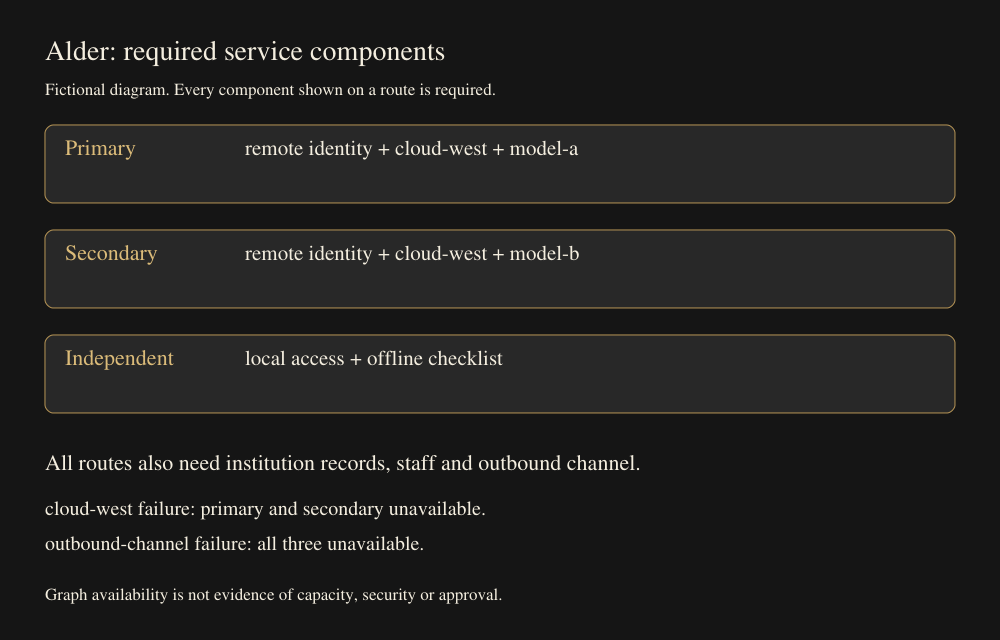
Learn in your browser · Chapter 02 of 06
Test provider claims against evidence and scope
A useful supplier review records what each document proves, what it leaves unresolved and who must resolve the gap. It does not turn confident wording, an unsigned contract or a future rule into present evidence.
The eight claims in provider_evidence.json are deliberately plausible but incomplete. They are not assertions about any real supplier. E01 supplies twelve export rows, E02 offers another model, E03 gives a manual capacity, E04 points to local records, E05 describes a deletion receipt, E06 supplies draft terms, E07 shows a green dashboard and E08 supplies a simulation. Each can contribute to a decision. None answers every question implied by its headline. Keep the supplied fact and the unsupported inference in separate columns.
Use four evidence states: supplied and checked for this claim; supplied but not yet checked; absent; or contradicted by the test. These are classroom labels, not a regulator taxonomy. Attach a locator and an owner to each state. A blanket green rating hides whether the check concerned one sample, one region or a different service. If a supplier changes terms, preserve the old and proposed versions and identify what changed. Do not let an assistant accept the terms or infer that silence is approval. Commercial and legal authority remains with the institution.
Version selection is part of evidence quality. On 12 October 2026 the PRA SS2/21 landing page labels the November 2024 version, effective 31 December 2024, as current. It labels the March 2026 update, effective 18 March 2027, as future. The page states the firm categories to which the statement is relevant. A review should record both version and entity scope. Do not select a document solely because its publication year is newer or assume its scope includes every organisation that uses AI.
The current SS2/21 Chapter 10 discusses business continuity and stressed exit, including viable exit forms and testing. It does not prescribe one universally preferred cloud-resilience arrangement. That supports asking how an institution would continue its service, not requiring every learner to buy a second provider. This course uses an offline route as a synthetic example. Its capacities, task boundaries and evidence checklist are original teaching choices, not a reproduction of the supervisory statement or a compliance attestation.
EU scope is a separate branch. ESMA describes DORA as an EU regulation applying from 17 January 2025 to specified types of financial entities. That reference is enough to reject the shortcut that a UK classroom exercise automatically establishes DORA compliance. It is not a detailed DORA contract, incident-reporting or applicability review. The direct EUR-Lex text was challenged during this authoring check; no unverified article-by-article conclusion is supplied. Where EU obligations matter, identify the entity, arrangement, current text and authorised specialist review before relying on a conclusion.
Scroll sideways to see every column.
| Claim | Useful evidence | Still not established |
|---|---|---|
| E02 backup supplier | Dependency list | Independence from cloud-west |
| E03 fallback ready | Proposed capacity 8 and start 30 | Measured customer outcomes |
| E04 data control | Local institution ledger | Derivative scope and contractual rights |
| E08 test passes | Deterministic result | Live staffing, channel and security readiness |
- Record the precise claim, service and document version.
- Separate observed facts from promises and proposed terms.
- Check scope and effective date for each regulatory reference.
- Assign a named role to each missing or contradictory item.
- Record a bounded decision, conditions and the next evidence request.
Try it yourself · Activity 03
25 minBuild a procurement gap register
Use all eight E01-E08 entries in provider_evidence.json to complete workpaper.md.
- For each claim, state one supplied fact and one unresolved question.
- Assign the role named in the input or justify another accountable role.
- Select which gap prevents an immediate clean exit decision and explain why.
Does your overall rating conceal a missing contract or failed export?
Worked answer
All eight claims remain bounded. E01 needs identity and field reconciliation; E02 shares cloud and identity; E03 needs queue outcomes; E04 lacks access and derivative evidence; E05 excludes backups and other stores; E06 lacks executed transition terms; E07 lacks failback reconciliation; E08 is only a simulation. Multiple gaps prevent a clean exit conclusion. Accept different prioritisation if it addresses customer service, data completeness and authority with named owners rather than inventing an approval.
Try it yourself · Activity 04
20 minResolve a version conflict
A colleague cites the March 2026 SS2/21 update as already effective and calls the lab DORA-compliant. Draft a source correction using the course references.
- Record the as-of date and current/future PRA distinction.
- State that entity scope must be checked.
- Describe exactly what has and has not been reviewed for DORA.
How will you prevent a future document from silently replacing the current rule in a saved memo?
Worked answer
As of 12 October 2026, the PRA page identifies November 2024 as current and March 2026 as future from 18 March 2027. Preserve the source versions and applicability question. ESMA confirms DORA is an EU regime for specified entities; no detailed DORA compliance review or entity conclusion is provided here. The lab proves neither regulatory compliance nor professional competence. A future implementation plan can be recorded separately from the current control assessment.
For reflection, choose a gap that a fluent AI summary might conceal. Write the precise evidence request, recipient role and decision that must remain open until it is answered. Avoid replacing evidence with a promise that the provider is trusted. Trust in this exercise grows from records that another reviewer can inspect and reproduce.
- Chapter question 1: E06 supplies unsigned draft exit terms without agreed transition duration or price. What is the sound review entry?
- Chapter question 2: A memo selects the March 2026 PRA document merely because it is newer. The source index marks it future from March 2027. What should the reviewer do?
- Chapter question 3: A UK classroom exit exercise is described as DORA-compliant because it includes a supplier register. What is the supported response?
- Chapter question 4: A supplier document is available but nobody has checked whether it covers this service. Which evidence state is most accurate?
- Chapter question 5: E04 shows that the institution keeps local records. Which important inference remains unsupported?
- Chapter question 6: A team proposes an offline route instead of a second cloud provider. What does the course support?
- Chapter question 7: E08 contains a passing deterministic simulation. Which procurement conclusion fits that evidence?
Learn in your browser · Chapter 03 of 06
Reconcile exports before relying on portability
A portable export preserves the records and meaning required by the receiving process. A file that downloads successfully or has the expected row count can still be incomplete, duplicated or stale. Reconcile identities and fields before treating export as an exit control.
The institution_ledger.json file is the classroom authority for twelve case records, R001-R012. Each record has a case_id, version, status, retention_tag and document_digest. The digest is generated from a fictional text label; no real document is supplied. These case records are a portability exercise separate from the eighty-eight acknowledgement notices used in the queue simulation. Do not join the two populations by position or treat their different totals as a reconciliation failure. Each has its own stated purpose and input contract.
The faulty supplier export contains twelve rows, just like the ledger. It nevertheless contains only eleven distinct case IDs. R012 is missing and R005 appears twice. R008 has status closed instead of open. R010 has version 2 instead of version 3. A count-only control accepts this file and carries missing or incorrect information into a replacement process. An assistant that silently drops the duplicate may make the output look neater while removing the visible sign of the original fault. Preserve the supplied export before making any repair.
Compare in a deliberate order. Validate identifiers and required fields; compare the expected and actual ID sets; find duplicate IDs; compare non-duplicate records field by field; then record what is correct, wrong and untested. The supplied checker excludes all occurrences of a duplicate ID from its valid_unique list. This prevents an arbitrary first or last occurrence from being treated as the authoritative one. That is a classroom acceptance rule. It does not mean duplicate evidence should be deleted or that every operational system must use the same reconciliation policy.
A canonical payload digest is useful for binding the exact interpretation checked. checker.py sorts records by case_id, sorts object keys, emits compact UTF-8 JSON without a trailing newline and hashes those bytes with SHA-256. This differs from hashing the physical export file. Pretty-printing may change the physical file hash without changing this canonical digest. Changing a version or status changes the payload digest. Neither digest proves that a record is true, complete relative to the real world, properly authorised or safe to retain. State which bytes each hash covers.
Data control includes more than keeping a local copy. A usable exit may require field definitions, version semantics, retrieval references, access permissions, encryption-key arrangements and a process for interpreting unresolved exceptions. An exported vector index is not automatically a replacement for source records. In this lab the institution ledger is explicit, but a real project would need to determine which record is authoritative and how derived stores are rebuilt or handled. A storage-location claim alone does not answer support access, subprocessing or contractual authority questions.
Scroll sideways to see every column.
| Control | Faulty export observation | Decision |
|---|---|---|
| Row count | 12 | Necessary but insufficient |
| Identity set | R012 missing | Hold completeness claim |
| Duplicates | R005 twice | Preserve both; resolve source authority |
| Field match | R008 status;R010 version | Hold fidelity claim |
| Corrected export | All 12 exact | Pass this bounded reconciliation only |
- Preserve supplied files and record the expected population.
- Compare identifiers, duplicate counts and exact fields.
- Keep an exception ledger with IDs and field names.
- Use a separately authorised corrected source, then repeat the comparison.
- Bind the compared payload and retain unresolved operational or rights questions.
Try it yourself · Activity 05
35 minReproduce the export exception ledger
Inspect the three ledger/export JSON files, then run checker.py offline and compare the export results with your manual findings.
- Count rows and distinct IDs independently.
- List the missing, duplicated and mismatched records.
- Explain why the valid_unique list has eight records.
- Record both payload digests from the checker output and name their canonicalisation scope.
Could a file hash alone reveal which case status changed?
Worked answer
Faulty:12 rows, 11 unique, missing R012, duplicate R005, R008 status mismatch and R010 version mismatch; valid unique count 8. Corrected:12 rows, 12 unique, all exact. The checker prints a payload_sha256 for each comparison using sorted compact JSON, not physical file bytes. Record the actual full outputs rather than transcribing a shortened hash. Acceptance is limited to the supplied ledger population and fields; it does not establish ownership, lawful processing or completeness beyond the fixture.
Try it yourself · Activity 06
25 minChallenge a clean-looking export
In a disposable copy, remove one occurrence of R005 from the faulty export. Predict the result before running a comparison. Keep originals untouched.
- State which defect the removal changes.
- State which three record problems remain.
- Explain why dropping the duplicate is not an authorised repair of the source population.
Would reducing the error count justify calling the service ready?
Worked answer
The file becomes 11 rows and 11 unique IDs. R005 is no longer duplicated and can match, so valid_unique rises from 8 to 9. R012 is still missing, R008 still has the wrong status and R010 the wrong version. The comparison must still fail. Deduplication does not create the missing record or authorise changed content. Record the mutation as a test, not as a replacement for the original export.
Leave learner notes distinguishing four claims: the file arrived, its recorded bytes are bound, its supplied records reconcile, and the receiving service can use them under an authorised arrangement. These claims require different evidence. An exit plan should not compress them into one unchecked tick labelled portable.
- Chapter question 1: The faulty export has twelve rows, matching the expected count. Why must completeness still be held?
- Chapter question 2: Which set correctly identifies the faulty export field mismatches?
- Chapter question 3: Why does the checker exclude both R005 occurrences from valid_unique?
- Chapter question 4: After the duplicate, missing ID and two field mismatches are accounted for, how many valid unique records remain in the faulty export?
- Chapter question 5: A file is pretty-printed without changing any record values. Which statement correctly distinguishes the two hashes?
- Chapter question 6: One R005 occurrence is removed from a disposable copy of the faulty export. What remains?
- Chapter question 7: A learner tries to join the twelve case records to the eighty-eight notices by row position. What should the reviewer explain?
Learn in your browser · Chapter 04 of 06
Measure recovery at the end of the service
Measure completed customer outcomes and the work left waiting. A fallback that starts quickly can still be too slow, and an observation window can hide future delays if pending requests are counted as successes.
The queue fixture uses eight fifteen-minute slots from minute 0 through minute 120. Twenty-four initial notices and eight new notices enter at 0, giving 32 notices at the first slot start. Later arrivals are 8 at 15, 12 at 30, 12 at 45, 8 at 60, 8 at 75, 4 at 90 and 4 at 105. Total arrivals are 88. FIFO order is the row order in requests.csv: initial notices precede the new notices arriving at the same instant. Capacity is completed, human-checked acknowledgements per slot. Work completes at the end of the slot, not at its start.
The invented target is completion within 60 minutes of arrival. Exactly 60 is within target; more than 60 is late. At the observation cutoff, a pending notice older than 60 is overdue. A younger pending notice is unresolved, not a completed success. All pending work prevents the checker from reporting within_fixture_target=true. This conservative aggregate test deliberately requires a fully cleared, timely population. It is not a regulatory metric and it does not measure customer harm or whether prioritising particular cases would have been appropriate.
For manual8, work starts at 30 and completes at most 8 notices in each remaining slot. Six working slots yield 48 completed notices. With 88 arrivals, 40 remain at 120. Thirty-two completed notices exceed 60 minutes, and sixteen pending notices already exceed 60 minutes. The maximum completed wait and maximum pending age are each 90. The late-completed and overdue-pending groups are disjoint. Adding them gives 48 known target failures among the 88 arrivals at this cutoff, while 24 other pending notices remain unresolved rather than successful.
The independent16 scenario starts at 30 with 16 completed notices per slot. End-slot backlogs are 32, 40, 36, 32, 24, 16, 4, 0. All 88 complete, none is late and maximum wait is 60. This is a pass for these inputs and assumptions only. It does not show that a real team can sustain the rate or that unmodelled errors, breaks, urgent cases or channel failures are harmless. A capacity statement must identify whether it counts drafts, checked acknowledgements or some other output.
The late16 scenario keeps capacity 16 but starts at 60. Four working slots complete 64 notices;24 remain at 120. All 64 completions are late, yet none of the pending notices is older than 60. A report using only overdue-pending count would look reassuring while ignoring 64 known failures. The maximum completed wait is 90 and maximum pending age 60. This scenario shows why activation delay and throughput require separate measurements. Higher capacity does not retroactively remove waiting that has already occurred.
Scroll sideways to see every column.
| Scenario | Completed/pending | Late completed/overdue pending |
|---|---|---|
| manual8, start 30 | 48/40 | 32/16 |
| independent16, start 30 | 88/0 | 0/0 |
| late16, start 60 | 64/24 | 64/0 |
- Define arrival, completion, time units, queue policy and cutoff.
- Compute arrivals and end-slot backlog before interpreting averages.
- Report completed latency separately from pending age.
- Keep boundary equality and unresolved work explicit.
- Change one assumption at a time and record the decision limits.
Try it yourself · Activity 07
35 minRecompute manual recovery
Use requests.csv and scenario.json to build the manual8 slot ledger before consulting checker.py.
- Calculate the total population and first four slot backlogs.
- Identify the exact 60-minute boundary.
- Report completed, pending, late-completed and overdue-pending counts at 120.
- Explain why 48 known failures is not the complete final failure count.
What would a completed-only percentage leave out?
Worked answer
There are 88 notices. Manual8 backlogs are 32, 40, 44, 48, 48, 48, 44, 40. It completes 48 and leaves 40;32 completed notices are late and 16 pending notices overdue. The other 24 pending notices are unresolved. Exactly 60 minutes is within target. Known failures total 48 at the cutoff, but future outcomes of pending work have not been simulated. Do not divide 32 by 48 and present it as the failure rate for all arrivals.
Try it yourself · Activity 08
25 minCompare capacity with activation delay
Compare independent16 and late16 using the same requests.
- Hold capacity 16 constant and change the start from 30 to 60.
- Record completed/pending counts and both delay measures.
- Write a bounded recommendation that distinguishes test evidence from operational approval.
Would an empty overdue-pending column be enough to claim timely service?
Worked answer
Start 30 completes 88 with 0 pending and 0 late, maximum completed wait 60. Start 60 completes 64 with 24 pending and 64 late, maximum completed wait 90; pending age tops out at 60, so overdue pending is 0. The later start still fails. Prioritise reducing activation delay and testing real checked-output capacity. The deterministic early-start result supports further rehearsal, not permission to operate a service or a universal capacity promise.
For reflection, record which assumptions would fail first in your context. A real service may need priorities, accuracy checks, accessible communication, staff breaks or a different arrival pattern. These are important extensions, but do not alter the supplied model silently and compare the resulting number as though the scenario were unchanged.
- Chapter question 1: What is the total population in the queue fixture?
- Chapter question 2: Manual8 begins at 30. Twelve notices arrive at 30 and the pre-arrival backlog is 40. What is the backlog at 45 after that slot completes?
- Chapter question 3: A notice arrives at 0 and completes at 60. How is it classified under the lab target?
- Chapter question 4: Which statement correctly describes manual8 at the 120-minute cutoff?
- Chapter question 5: Manual8 has 32 late completions and 16 overdue pending notices. What does their sum represent?
- Chapter question 6: Independent16 starts at 30 and has end-slot backlog 0 at 120. Which complete result supports its bounded pass?
- Chapter question 7: Late16 has no overdue pending notices at 120. Why is a recovery pass still incorrect?
At minute 120, all scenarios began with 88 arrivals:
manual8       completed 48 | pending 40 | late completed 32
independent16 completed 88 | pending  0 | late completed  0
late16        completed 64 | pending 24 | late completed 64
Synthetic deterministic comparison; not actual supplier performance.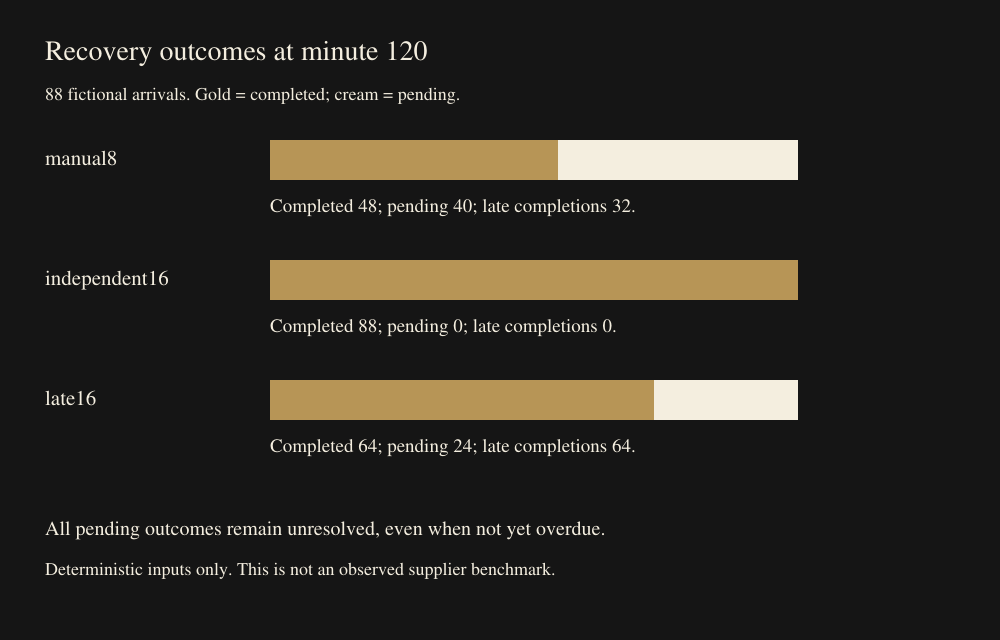
Learn in your browser · Chapter 05 of 06
Coordinate incidents without surrendering authority
An incident record should preserve what was known, when it was known and who made each decision. AI can help organise that evidence, but it must not turn a supplier estimate or a green dashboard into authority to resume the service.
incident_timeline.json supplies six fictional observations and proposed decisions. At 0 cloud-west is unavailable. At 15 the provider gives a recovery estimate without verified restoration. At 30 the manual route is ready in the baseline scenario. At 60 early delay outcomes are available. At 90 a hypothetical dashboard turns green. At 120 the observation window ends. These events do not authorise messages to customers or regulators. They are prompts for practising internal coordination, decision records and evidence requests without contacting any real system or person.
Keep three timestamps when they differ: when the event occurred, when the team observed it and when a decision was made. The fixture supplies a simplified minute value; do not invent additional precise times. Keep the original incident start even when a fallback begins. Record the evidence version and uncertainties behind each decision. A provider estimate may be relevant to planning, but report it as an estimate with a source, not a promised restoration time. If new evidence contradicts it, preserve the old estimate and explain the change.
The incident commander coordinates the response; the service owner decides whether the permitted service can run; the data owner controls record reconciliation; procurement handles supplier commitments; security assesses access and integrity; authorised communications staff determine actual messages. These are exercise roles, not claims about a universal organisation chart. One person may hold more than one role, but that should be explicit. An assistant can draft an evidence summary with record IDs and known gaps. It cannot approve a supplier change, make a claims decision or file a report.
A useful status note has four parts: observed service outcome, remaining work and harm questions, current action and owner, and the next decision or checkpoint. At 120 manual8 has 48 completions, 40 pending, 32 late completed and 16 overdue pending. Report each group. Do not say the service recovered at 30 merely because work began then. Do not say the backlog is harmless because the model endpoint is healthy. The fixture does not quantify real harm, so the note should flag that harm assessment is outside the supplied evidence rather than invent an impact figure.
Failback needs its own control. Compare which notices were completed locally, which were still pending and which the supplier may have processed. Use stable identifiers so a retried action does not create an unnoticed duplicate acknowledgement. Verify the record version, actual channel outcome and unresolved exceptions. In this fixture the checker does not operate either route or perform duplicate suppression in a live system. It demonstrates the need for a reconciliation list; it must not be represented as an implemented transaction control.
The FCA outsourcing page checked on 12 October 2026 notes new operational-incident and third-party reporting requirements coming into force on 18 March 2027. This course does not determine a current or future reporting duty, recipient or deadline for a real firm. Keep any real reporting decision with authorised staff using the applicable current rules. The lab timeline contains no regulatory submission function. A local learning record and a regulator report are different artefacts even if both describe the same hypothetical outage.
- Preserve the original clock and distinguish observations from estimates.
- Record completed outcomes, pending work and known uncertainty.
- Route decisions to the relevant accountable roles.
- Require reconciliation and an explicit decision before failback.
- Capture communications as drafts until the authorised process approves them.
Try it yourself · Activity 09
30 minWrite the 120-minute incident note
Use the manual8 results and incident_timeline.json to write an internal evidence note in workpaper.md.
- Include the four population counts and the cutoff.
- Identify the estimate and dashboard as different evidence from completion records.
- Name the failback decision owner and next evidence needed.
- Leave real harm and reporting obligations explicitly unresolved.
Does your note promise an outcome beyond the data available?
Worked answer
A satisfactory note states 88 arrivals, 48 completed, 40 pending, 32 late-completed and 16 overdue-pending at 120. It preserves start 0 and treats the provider estimate and dashboard as limited observations. The service owner reviews reconciliation with data and operations roles before failback; authorised staff determine any external reporting or communication. No real harm amount, restoration promise or regulator deadline is inferred. An equivalent clear note earns full practice credit without matching the sample wording.
Try it yourself · Activity 10
20 minChallenge the failback decision
At minute 90 the supplier dashboard turns green. List the evidence needed before resuming its path and explain what the fixture cannot verify.
- Identify the stable IDs and version information to compare.
- Explain how already-completed acknowledgements differ from pending notices.
- Record who decides and which operational tests remain absent.
What duplicate or stale-state problem would a blind replay create?
Worked answer
Reconcile completed local notices, supplier outcomes and pending work by stable IDs, verify correct record versions and channel outcomes, and preserve exceptions. Already completed work must not be blindly replayed as if pending. The service owner decides with incident, data and security input. The fixture does not verify live duplicate suppression, access controls, channel delivery or supplier integrity, so a green dashboard is insufficient for a ready decision.
Leave notes on one sentence that communicates uncertainty without becoming vague. For example, "The supplied ledger shows this result; channel delivery has not been tested" is more useful than either "everything is fine" or "nothing can be known". The purpose is to support the next human decision with the evidence actually available.
- Chapter question 1: At 15 the supplier estimates restoration, without verification. What should the incident record say?
- Chapter question 2: Which status note best supports a human decision at 120 in manual8?
- Chapter question 3: The provider dashboard turns green at 90. Which action is a justified next step?
- Chapter question 4: Which proposed automation exceeds the role assigned to the assistant?
- Chapter question 5: A notice completed locally is also present in the provider retry list. What evidence question matters first?
- Chapter question 6: A learner proposes a real regulator deadline using the fictional timeline alone. What is the appropriate correction?
- Chapter question 7: Which uncertainty statement is most useful for deciding the next evidence request?
Learn in your browser · Chapter 06 of 06
Rehearse exit and retain an honest closure record
Close each exit claim against its own evidence. Technical export, continued service, contractual termination and data disposition are separate decisions. A strong rehearsal can reveal that some are ready while others remain open.
Alder plans an exit because proposed terms change and the provider becomes unavailable. The capstone combines the earlier evidence rather than introducing a new hidden dataset. You have dependencies, provider claims, twelve case records and two export versions, eighty-eight acknowledgement notices, three queue scenarios, a simplified incident timeline and deletion receipt D01. Your deliverable is an exit workpaper with a bounded recommendation, not a real procurement approval or a certificate of resilience.
Separate planned transition from stressed recovery. A planned transition may allow agreed handover, rehearsed exports, parallel checks and staged retirement. A stressed exit begins with a supplier or service already disrupted, possibly without useful cooperation. In either case, list the minimum service that can continue, the institution-owned evidence needed and the people who can act. The same recovery option may behave differently when the provider is unavailable, when access fails or when trained staff cannot sustain the assumed output. A rehearsal should expose these differences rather than reward a polished plan.
Receipt D01 reports deletion of a live supplier namespace. It also says backups expire at day 30, derivative stores and subprocessors are not evidenced, and R004 needs a separate authorised retention decision. It is a fictional provider statement, not an independent deletion observation. Record the live-copy statement as supplied with its scope. Keep backup expiry, derivatives, subprocessors and the retention exception open. Neither a successful export nor an empty live namespace establishes complete deletion. Do not invent a legal retention period or assume that deleting everything would be lawful.
Make the decision record reproducible. Include source and result identifiers, the checker output, your manual arithmetic, known assumptions, open gaps, owners and review checkpoints. A hash can bind the version you reviewed, but it does not supply authority. Ask the reviewer to challenge a meaningful failure case, such as a shared outbound-channel outage, a late activation or a missing export record. Record the failure and the limits it reveals. Success in the original scenario does not cancel a different scenario failure.
Use a retention and evidence schedule proportionate to the actual context when working outside the classroom. This course supplies no real personal data, retention law determination or deletion command. The practice file records questions and roles only. A real organisation would separately determine permitted retention, exceptions, access, deletion verification and supplier commitments through its authorised process. The educational point is to avoid converting an uncertain provider statement into an absolute assurance claim.
Scroll sideways to see every column.
| Exit claim | Evidence here | Remaining boundary |
|---|---|---|
| Export reconciles | Corrected 12-record comparison | Only supplied fields and population |
| Service target met | independent16, 88 timely completions | Synthetic capacity and channel assumptions |
| Contract closed | Unsigned draft only | Executed terms and authority missing |
| Data disposed | D01 live-copy statement | Backups, derivatives, subprocessors and R004 open |
| Professional readiness | Learning artefacts | No practitioner validation or accreditation |
- Choose and describe planned and stressed-exit scenarios.
- Bind export reconciliation and end-to-end service outcomes separately.
- Record contract and data-disposition gaps without inventing evidence.
- Assign each open decision to an accountable role and checkpoint.
- Retain the rehearsal record, limitations and changes required before another test.
Try it yourself · Activity 11
60 minProduce the supplier-exit capstone
Complete workpaper.md using every supplied evidence file. Produce a one-page decision summary plus supporting tables and checker output.
- Define the minimum service and map primary, secondary and independent dependencies.
- Reconcile both exports and record exact canonical payload digests.
- Compare all three queue scenarios with completed and pending outcomes.
- Address all E01-E08 claims and D01 limitations.
- State separate technical-test, operational, commercial and data-disposition decisions.
Could another learner reproduce your conclusion without trusting your confidence?
Worked answer
The packet must show both cloud-dependent paths fail together; faulty export fails and corrected 12-record export passes; manual8 and late16 fail while independent16 passes only the supplied target. Include 88 arrivals and each scenario result, with pending work uncounted as success. Contract execution, real staff/channel/access readiness, backup/derivative/subprocessor evidence and R004 retention authority remain open. A defensible recommendation is to retain the independent route for further authorised rehearsal while withholding a clean exit sign-off. Other bounded choices are acceptable if supported by all evidence and explicit residual gaps.
Try it yourself · Activity 12
40 minReview and improve the rehearsal
Act as a second reviewer of your own draft for practice, clearly labelling that this is not independent approval. Then run the supplied unit tests and document one mutation result.
- Check the population and timing equations by hand.
- Select a duplicate, missing-record or dependency mutation in a disposable copy.
- State how the failure changes the decision and which accepted result remains valid.
- Record what a genuinely different reviewer or live rehearsal would still need to examine.
Are you using a passing test suite to claim more than its synthetic scope?
Worked answer
A complete answer records at least one concrete challenge and its expected failure, preserves the original files and distinguishes practice self-review from independent acceptance. Removing one faulty duplicate still leaves missing R012 and mismatches R008/R010; failing outbound-channel removes all paths. The tests check defined arithmetic and comparisons, not people, real service delivery, lawful processing or regulatory compliance. Retain the result and revise the specific affected claim, rather than declaring every prior result invalid or every remaining control proven.
Mickai Training Academy is not an accredited training provider. These materials and any completion certificate are educational only. A scored knowledge assessment does not establish a professional qualification, licence, permission to operate, financial advice or practical competence. The written work and capstone in this packet are ungraded practice unless a separate, honestly described human assessment is arranged. No practitioner validation or regulatory approval is claimed.
The initial study estimate is ten hours and has not been piloted: about 60 minutes reading, 360 minutes for the twelve activities including the capstone, 135 minutes for reflection, chapter questions and review, and 45 minutes for the knowledge assessment. Adapt your pace and record the actual time taken. The estimate is an authoring assumption, not a measured completion promise. This private packet is not a statement that the course or exam is publicly available.
- Chapter question 1: D01 says the live namespace was deleted, backups expire at day 30 and derivative scope is unknown. Which conclusion is supported?
- Chapter question 2: Corrected export and independent16 both pass, but executed transition terms are absent. What is the strongest defensible conclusion?
- Chapter question 3: Which scenario most clearly tests a stressed exit?
- Chapter question 4: A reviewer hashes a workpaper and records the digest. What remains necessary for an authorised exit decision?
- Chapter question 5: A learner successfully runs every supplied test. Which claim should the review reject?
- Chapter question 6: What does a passing automated assessment establish in this course?
- Chapter question 7: A learner finishes faster than the ten-hour estimate. How should the course time be reported?
Keep learning
The complete workbook
A practical Mickai Training Academy course for supplier-risk, procurement, technology and resilience teams. Work through a wholly fictional claims-support outage and exit, with offline data, worked answers and a knowledge-only assessment. Educational only, non-accredited and not financial, legal or compliance advice.
- 01Define the service and expose shared dependenciesRead here · 2 exercises
An exit plan succeeds only if the institution can continue the intended customer service. A second model or an exported file is useful evidence, but neither is the service itself. Start with the service boundary, the people who remain accountable and the dependencies that can fail together.
- 02Test provider claims against evidence and scopeRead here · 2 exercises
A useful supplier review records what each document proves, what it leaves unresolved and who must resolve the gap. It does not turn confident wording, an unsigned contract or a future rule into present evidence.
- 03Reconcile exports before relying on portabilityRead here · 2 exercises
A portable export preserves the records and meaning required by the receiving process. A file that downloads successfully or has the expected row count can still be incomplete, duplicated or stale. Reconcile identities and fields before treating export as an exit control.
- 04Measure recovery at the end of the serviceRead here · 2 exercises
Measure completed customer outcomes and the work left waiting. A fallback that starts quickly can still be too slow, and an observation window can hide future delays if pending requests are counted as successes.
- 05Coordinate incidents without surrendering authorityRead here · 2 exercises
An incident record should preserve what was known, when it was known and who made each decision. AI can help organise that evidence, but it must not turn a supplier estimate or a green dashboard into authority to resume the service.
- 06Rehearse exit and retain an honest closure recordRead here · 2 exercises
Close each exit claim against its own evidence. Technical export, continued service, contractual termination and data disposition are separate decisions. A strong rehearsal can reveal that some are ready while others remain open.
Also inside: a 9-point checklist, a glossary of 10 terms and 10 questions and answers to test yourself. 12 hands-on exercises, each with a worked answer at the back where the workbook gives one.
The PDF is free. We ask for your name and email before downloading. Read the privacy notice at the download form. Free to download and use for personal learning, study groups and inside your own team. Please do not resell the workbooks or republish them as your own. Link people to trust-agent.ai instead.
Get your free PDF workbook
Enter your name and email, then download the complete workbook. This form also works without JavaScript.
Test yourself
Questions and answers
Does a second model remove supplier concentration?
Only if the relevant dependencies differ for the failure being tested. The lab primary and secondary share cloud-west and identity-remote, so a cloud-west outage removes both.
Why does a twelve-row export fail?
The faulty export duplicates R005, omits R012 and changes two fields. Row count alone cannot establish identity coverage or fidelity.
What does the payload hash prove?
It binds the stated canonical representation. It does not prove truth, legal authority, completeness beyond the expected population or practical usability.
Is exactly sixty minutes late?
No. The invented target treats more than sixty minutes as late. Pending work at the cutoff remains unresolved even if not yet overdue.
Which recovery scenario passes?
Independent16 starting at 30 clears 88 notices with no late completions. This result applies only to the supplied deterministic inputs and assumptions.
Can a green dashboard authorise failback?
No. The service owner still needs reconciliation of completed and pending work, record versions, access and channel outcomes.
Does D01 establish complete deletion?
No. It is a fictional live-namespace statement. Backup expiry, derivatives, subprocessors and R004 retention authority remain unresolved.
Which regulatory version is used?
The PRA page checked 12 October 2026 labels November 2024 current and the March 2026 update future from 18 March 2027. Actual firm scope must be checked.
Is this course accredited or professional advice?
No. Mickai Training Academy is not an accredited training provider. Materials and certificates are educational only and grant no qualification, licence, permission or professional approval.
Has the ten-hour estimate been tested with learners?
No. It is an unpiloted estimate covering reading, twelve activities, reflection, chapter questions and the knowledge assessment. Record your actual time.
Write as you go
My notes
Use this scratchpad for your own notes, working or answers as you read. Notes are saved in this browser on this device. Downloading makes a local copy; it does not send your notes to Mickai.
Learn → Practise → Demonstrate
Ready to put it into practice?
Take the scored exam when you feel ready. You do not need to download the workbook first. A score strictly above 80% earns a named, dated Mickai certificate with a verification page.
Take the official examYour name and email are collected at exam start. Certificates record an assessment result, not an accredited qualification or verified identity.
Learn the language
Key terms
- Business service
- A defined outcome delivered to a user or customer, supported by people, processes and technology.
- Dependency
- A required component or resource whose failure can prevent a service path from working.
- Concentration
- Reliance by apparently different arrangements on a common provider or component.
- Impact tolerance
- A scoped regulatory concept about tolerable disruption to an important business service; not the invented sixty-minute lab target.
- FIFO
- First in, first out. The fixture processes notices in arrival order, retaining file order for equal arrival times.
- Pending age
- Elapsed time since arrival for work not completed at the observation cutoff.
6 of the workbook's 10 terms. The complete glossary is in the workbook.
Follow the evidence
Sources and checks
Facts last checked: .
These workbooks use AI assistance. See how the workbooks are made.
- Operational resilience; checked 12 October 2026Financial Conduct Authority
- Outsourcing and operational resilience; checked 12 October 2026Financial Conduct Authority
- SS2/21 current and future version index; checked 12 October 2026Bank of England, Prudential Regulation Authority
- SS2/21 November 2024, Chapter 10; checked 12 October 2026Bank of England, Prudential Regulation Authority
- Digital Operational Resilience Act overview; checked 12 October 2026European Securities and Markets Authority
Created by Mickarle Sean Junior Wagstaff-Irons - Micky Irons with the Mickai team. Published by Mickai LTD. Last updated 12 October 2026.
NextKeep going
Where to go next

Recommended for you
AI governance: risk registers, evidence and human accountability
Govern an AI system without being an engineer: map hazards, score and evidence them, name owners and stop rights, make oversight real, and check the register with tested code.

Recommended for you
Digitising financial records for controlled AI retrieval
Reconcile synthetic financial records, preserve page and revision evidence, enforce account permissions and test withdrawal from an active retrieval index.